



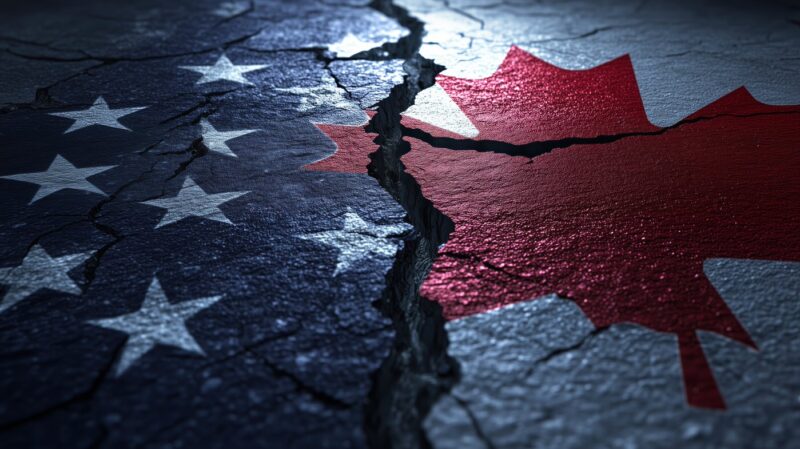

The U.S.-Canada trade conflict has entered a new chapter, and the terms are notably less ambiguous than before. With no last-minute deal reached to avert new Section 338 tariffs, RBC Economics confirms in its August 22, 2026 analysis1 that "new tariffs have now officially taken effect on another subset of U.S. imports from Canada." The measures impose a 50% tariff rate on roughly 5% of Canadian exports to the United States, layering onto existing tariffs already in place on steel, aluminum, lumber, and motor vehicles. Understanding what is known, what remains uncertain, and what it means for portfolios is now essential work for advisors and investors alike.
The Scope Is Targeted, Not Sweeping
The important nuance here is what these tariffs are not. RBC Economics is direct: "The size of the tariffs is likely not large enough to derail Canada's economic growth backdrop." The Canadian value-added content of newly tariffed U.S. imports amounts to approximately 0.4% of Canadian GDP and employment. More than 80% of Canadian exports continue to cross the border duty-free under CUSMA exemptions. In that context, the macro damage is real but concentrated.
The sectors bearing the heaviest load are plastics, electrical machinery, furniture, and wood products. Regionally, the economic pain is highest in Quebec, British Columbia, and Ontario. RBC's observation is pointed: "Because the tariff rate is so high and applies only to Canada, purchases of these products from Canada would be prohibitively expensive." That is not a soft landing for the industries in the crosshairs.
Canada's average effective tariff rate now rises mechanically to around 6% from roughly 3%, which, as RBC notes, means Canada is "no longer the lowest among major U.S. trade partners, but still below the average U.S. tariff rate on imports from all countries (close to 7%)." In practice, the observed tariff rate may rise less than the mechanical figure suggests, precisely because heavily tariffed trade will simply stop.
What Remains Unknown: Four Pivotal Questions
The more important questions at this stage concern what happens next. RBC Economics frames four key uncertainties with disciplined precision.
First, duration. Past tariffs have been modified or withdrawn within weeks of imposition, including the blanket tariffs briefly imposed in March 2025 before CUSMA exemptions restored most trade flows. But this time, "the U.S. and Canadian sides have reportedly cut off negotiations, leaving the path to end the current additional tariffs highly uncertain."
Second, Canada's response. At the time of publication, retaliatory measures had been signaled but not announced. RBC notes a structural asymmetry with genuine strategic optionality: Canada is actually a net importer of the targeted products from the U.S., bringing in approximately $23 billion USD versus $20 billion USD in exports. "On paper," the team writes, "that means that redirecting imports of these specific products to instead purchase from Canadian sellers that otherwise would have been shipping to the United States mechanically could actually fully replace lost U.S. exports." The reality, they acknowledge, is more complex given deeply integrated supply chains. Still, the reorientation potential is meaningful.
Third, business confidence and investment. Tariff unpredictability casts a shadow far beyond directly targeted sectors. RBC is measured here: "businesses have been showing signs of adapting to living under uncertainty after a year and a half of tariff threats with measures of business confidence and investment perking up to-date in 2026." That is not cause for complacency, but it is a counterweight to the more bearish narratives.
Fourth, Bank of Canada policy. RBC's expectation is clear: "We do not expect the broader macroeconomic impact of these new tariffs to be enough to push the Bank of Canada to seriously consider pivoting to interest rate cuts." Fiscal policy is better suited to targeted relief. What the intensification of trade uncertainty does accomplish, alongside moderating underlying inflation trends, is increase "the likelihood that the BoC will not hike interest rates this year."
CUSMA Holds, But Erodes at the Margins
Section 338 further narrows the share of Canadian exports protected by CUSMA, yet the agreement's core architecture remains intact. RBC notes that the broader CUSMA exemption "has held through multiple forms of broader U.S. tariff policies," including the current Section 301 global tariff regime. The deal does not expire for a decade, and the U.S. average tariff rate globally has been drifting lower, with exemptions expanding to cover the bulk of overall imports. "While the future of U.S. trade policy is highly uncertain," RBC concludes, "we continue to argue that trade across the Canada and U.S. border is mutually beneficial, and that argues for the bulk of trade to remain tariff free under CUSMA."
Five Key Takeaways for Advisors and Investors
- The macro damage is real but contained. With only 0.4% of Canadian GDP at risk from newly tariffed exports, broad portfolio de-risking is not warranted. Sector-specific exposure review in plastics, furniture, wood products, and electrical machinery is the more precise response.
- CUSMA remains the structural anchor. Over 80% of Canadian exports continue to flow duty-free. The framework has proven durable across multiple tariff regimes, and RBC sees no credible near-term threat to that core protection.
- Bank of Canada rate cuts are not the base case. RBC's view is that the BoC will neither cut nor hike this year, with the balance of risks tilted slightly toward continued pause. Fixed income positioning should reflect a stable rather than declining rate environment.
- Trade unpredictability is the real portfolio risk. The direct tariff impact is bounded. The more insidious risk is the persistent chill on business investment and capital allocation decisions across all trade-exposed industries, which can weigh on earnings and multiples even without a direct tariff hit.
- Canada's net importer position in targeted goods is a strategic variable. The possibility that Canadian supply chains can partially reorient to replace lost export volumes with domestic sales is non-trivial. Advisors should watch for fiscal support measures that could accelerate that adjustment and partially offset regional employment impacts.
Footnote:
1 RBC Economics. "Next Chapter of U.S.-Canada Trade War: What We Know and Don't About Section 338 Tariffs." RBC Economics, 22 Aug. 2026, https://www.rbc.com/en/economics/canadian-analysis/featured-analysis/insights/next-chapter-of-u-s-canada-trade-war-what-we-know-and-dont-about-section-338-tariffs/.