



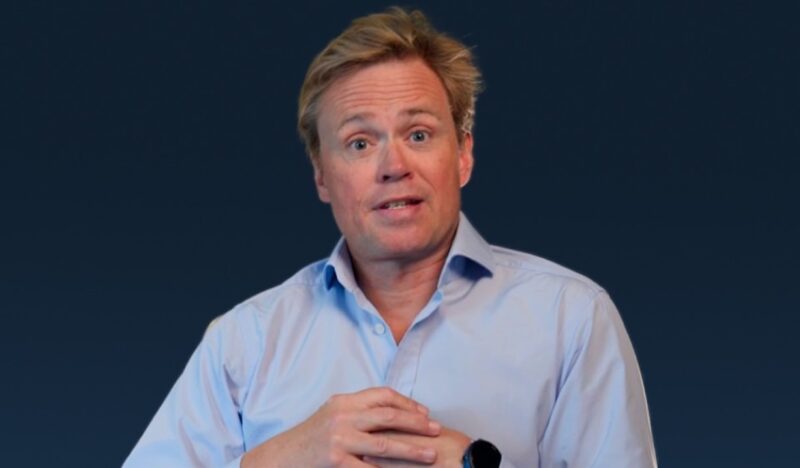

The capital cycle is not a formula. It is, in Django Davidson's words, "a pair of glasses, a way of seeing the world." Davidson, a partner and portfolio manager at Hosking Partners, joined Columbia Business School professors Tano Santos and Michael Mauboussin on Value Investing with Legends1 for what the hosts described as a fitting close to the podcast season: a conversation built around conceptual frameworks that reach well beyond the typical stock pitch.
The result is one of the more substantive investment conversations to emerge this year.
Where the Idea Comes From
The capital cycle is not Davidson's invention. It traces to Jeremy Hosking, who in his early twenties inherited a portfolio of 80 collapsed PC shares from his employer and was forced to diagnose what had gone wrong. The machines were on every desk. Productivity gains were visible. Yet returns to shareholders were abysmal. Hosking's insight was to apply classical economic theory to the industry cycle: too much capital had been raised at valuations that made adequate returns structurally impossible. The stock market had amplified the problem by allowing promoters to raise a dollar of capital and have it valued at five. The cycle worked in reverse, too. When a dollar of capital trades at fifty cents, the rational response is to shrink, return capital, shut down factories. "What the capital cycle framework does," Davidson explains, "is kind of meld two ideas, the industry return framework, but also the role that the stock market and promoters and various actors do in amplifying these cycles on the way up and on the way down."
Weighing, Not Accumulating
If there is a single phrase that organizes Davidson's thinking, it is "weighing information rather than accumulating it." The distinction matters. In any given industry, there are dozens of data points available to an analyst. The capital cycle disciplines that analyst to identify the one or two deep realities that actually determine whether value is created or destroyed, and to resist the noise that clouds them.
The financial crisis gave Davidson an early education in this discipline. He was covering banks at Deutsche Bank when the system came close to collapse, and what he observed was that the deep reality of a financial institution is trust. Once trust evaporated, the standard contrarian framework, being greedy when others are fearful, was suspended. "Until that fundamental trust was reestablished," Davidson says, "I'm not sure that model worked. You know, that's a period in which that model was suspended, albeit briefly." Mauboussin, for his part, notes that the framework still holds in less leveraged industries: "When you move out of financials and out of highly levered banks and look at, I don't know, take the lumber industry, it's much easier to be greedy when others are fearful there because the systemic impact of one lumber company going bust is probably not gonna bring down an economy."
AI and the Capital Cycle Today
The most commercially urgent section of the conversation concerns artificial intelligence. Davidson applies the capital cycle lens directly and finds it flashing a warning. With roughly fifty percent of S&P 500 capital concentrated in technology and semiconductor names, and metals and mining sitting at approximately one and a half percent, the framework is doing exactly what it is designed to do: pointing away from areas of extreme capital formation and toward areas of neglect.
On the AI spending surge specifically, Davidson draws a sharp distinction between demand and supply. "Demand is ultimately storytelling," he says. "How much AI adoption will there be? What will people pay for it? Who will be the ultimate winners? That's a kind of story." Supply, by contrast, is measurable. The capital being committed to data centers runs into the trillions. At a ten percent return requirement, that demands hundreds of billions in annual earnings from businesses that, at present, earn returns in the teens to forties. "Where's this five hundred and fifty billion coming from?" Davidson asks. "Who's losing? Where's that profit?"
Santos adds an important nuance: the returns ultimately depend on whether companies can establish customer captivity sufficient to extract surplus from consumers and redirect it to shareholders. "That is what is not clear at this stage," Santos observes. Davidson largely agrees, while noting that even the customer captivity question comes after a more basic arithmetic problem has been resolved.
The one company Davidson views as structurally advantaged in this landscape is Google, which he describes as "kind of like the sun, and everything else kind of revolves around it." Deploying a line from Peter Thiel, he notes that the thing about a monopoly is they will never tell you they are a monopoly. Google, he suggests, spent years being quietly embarrassed by its AI capabilities. That reserve, by contrast, tells you something about competitive position.
Micron, Saga, and the Practice of the Framework
Two stock cases ground the abstract framework in real outcomes. Micron Technology illustrates the long arc of a supply-side capital cycle thesis. Davidson's team entered the memory semiconductor industry in 2013 on a simple observation: the industry, once home to more than twenty players, had consolidated to roughly eight, and supply discipline was improving structurally. "Micron might earn a hundred bucks a share," Davidson notes, "but it's unlikely to lose twenty bucks a share. Whereas fifteen years ago, there were a number of quarters where Micron would print losses." The AI cycle accelerated an already constructive thesis, but the underlying insight, Davidson is clear, was not about AI. "That was a supply-driven investment case."
Saga, a seventy-five-year-old UK travel and lifestyle company serving the over-sixties demographic, illustrates something different: what happens when a company's deep reality, in this case the trust of older customers, is violated by a private equity owner more interested in leverage and dividend recapitalization than in delivering what the customer expects. The company crashed from a £3 billion valuation in 2004 to a market cap of approximately £150 million at its trough. When the founder's son returned from retirement, injected £250 million of his own capital, and diagnosed the problem as simply as possible, Davidson's team recognized what he calls "a two-foot bar." The investment thesis required no complex analytical architecture. "If you're true to that over seventy-five years," Davidson says of the Saga brand, "that is an amazing brand to have, and it's exactly the sort of business that Buffett would wax lyrical about."
What Worries Davidson
Davidson closes with a concern that sits beyond the market. Supply chain resilience, he argues, has been systematically undervalued in the West, and the costs of that neglect are approaching a reckoning. As a pointed illustration: the United Kingdom is about to close its last salt mine. "Salt is integral to every single pharmaceutical drug," Davidson notes. "It's the fundamental building block of ninety-five percent of our drugs." The deeper problem is cultural: a service-based economy has lost touch with the replacement cost of physical capacity. "We have totally lost touch with the replacement cost and the value of having spare capacity in all of these industries."
His recommended reading on this theme: The Material World by Ed Conway, which explains the physical foundations of the modern economy that financial markets routinely discount. Alongside it, Davidson commends The Bolter, a portrait of extraordinary English wealth in the 1930s, as a reminder of how quickly even apex economies can lose what took generations to build. The message to investors is implicit but pointed: be cautious about the fragility of economic systems you take for granted.
Five Key Takeaways for Advisors and Investors
- The capital cycle is a lens, not a screen. It does not generate buy lists. It disciplines thinking by pointing toward industries where capital is scarce and structures are improving, and away from industries drowning in overcapitalization. The current concentration of S&P capital in technology relative to metals and mining illustrates the contrast in sharp relief.
- Weigh information; don't accumulate it. Every business has a small number of deep realities that determine long-run outcomes. The discipline is to identify those realities early and resist the volume of secondary data that obscures them. In financials, that deep reality is trust. In Saga's case, it was service integrity with a loyal, wealthy, and unforgiving demographic.
- Long-term capital is not a marketing claim; it is a structural requirement. The capital cycle operates on timescales measured in decades. Prosecuting the framework with capital that can be redeemed on short notice is not a minor disadvantage. It is a fundamental incompatibility. Investors should assess their own time horizons honestly before claiming alignment with this approach.
- Supply is measurable; demand is a story. The AI capital cycle debate is most usefully framed not around adoption projections, which are inherently speculative, but around the arithmetic of what the invested capital needs to earn. At current levels of data center commitment, the required returns are historically unprecedented. That observation does not resolve the debate, but it is a more durable anchor than demand forecasts.
- Overconfidence is fatal, especially in cyclical ideas. Davidson is explicit: the capital cycle will highlight underearning areas and better market structures, but it will not tell you when cycles turn. Diversification across multiple cycle positions, and humility about timing, are not optional features of the approach. They are what make the approach survivable over a full investment career.
Footnote:
1 “Value Investing with Legends." 21 Aug. 2026, valueinvestingwithlegends.libsyn.com.