


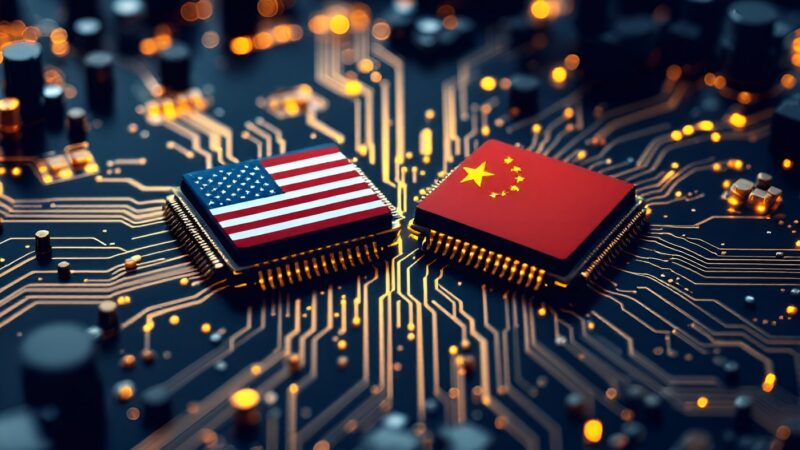

The artificial intelligence investment boom has been the single most powerful engine of US economic growth and financial market returns over the past several years. Now, a new and sobering analysis from Confluence Investment Management argues that the very foundations of that boom may be under threat. In a bi-weekly asset allocation report dated August 17, 20261, Patrick Fearon-Hernandez, CFA, makes the case that Chinese AI firms have closed the technology gap with their American rivals and are now deploying a pricing strategy that could unwind the US AI trade entirely.
The Boom That Built a Sector
The scale of AI-driven capital investment in the US has been extraordinary. Technology firms from Meta to OpenAI have poured billions into large language models, and the infrastructure required to run them has rewritten the construction landscape. Data center buildout has become so dominant that it has, as Fearon-Hernandez observes, offset the pullback in traditional office construction. Analysts, he notes, estimate the AI investment frenzy now accounts for perhaps one-third of current US economic growth. That number alone explains why so much stock market performance is tied to the sector, and why any disruption carries systemic consequences.
Fearon-Hernandez is direct about the prior state of play: "these trends have already made the sector look toppy and risky." The stretched valuations, rising debt levels, and daisy-chain investment structures were already cause for concern before China entered the frame with force.
China Has Caught Up
The technological convergence is no longer a distant risk. At the end of July 2026, DeepSeek released its V4 Flash coding model, which benchmark tests show performs at a level approaching Anthropic's Claude Opus 4.8, widely regarded as one of the most capable AI systems available. That release followed Moonshot AI's Kimi K3 by only days. Fearon-Hernandez reports that Kimi K3 rivals not only Opus 4.8 but also OpenAI's GPT-5.6 Sol. From a total user experience standpoint, he adds, "many firms around the world may even consider the flexible, open-source Chinese models to be superior to US offerings."
The quality argument, which US firms have long relied on to justify premium positioning, is eroding faster than most investors have priced in.
The Pricing Weapon
If technological parity is the structural shift, pricing is the immediate catalyst. DeepSeek priced V4 Flash at approximately $0.28 per million tokens of output. Anthropic's Opus 4.8 costs $25.00 for the same volume. That is a 99% price discount. OpenAI, clearly feeling the pressure, slashed its GPT-5.6 Luna model by 80% in response, bringing it to $1.20 per million tokens. Still more than four times the DeepSeek price.
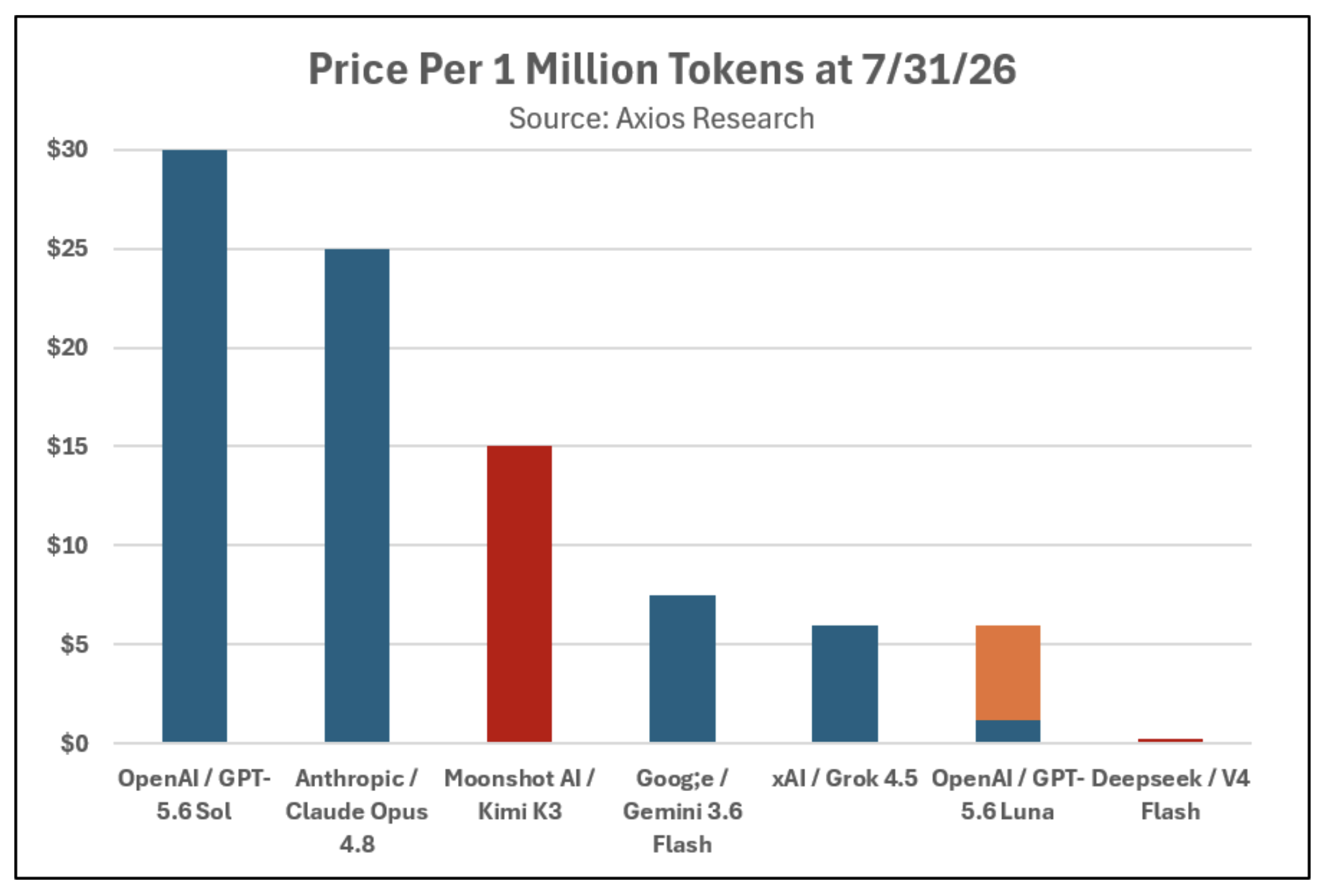
Fearon-Hernandez frames this not as competitive market dynamics but as deliberate industrial strategy: "China has driven scores of foreign industries out of business over the decades." The pattern is established across steel, rare-earth processing, automobiles, and electronics. Beijing subsidizes domestic producers or forces them to accept compressed margins in order to undercut foreign rivals. The conclusion is plainly stated: "Beijing would almost certainly be willing to do the same with a key industry of the future such as AI."
The Premium Defense May Not Hold
Some observers have argued that US firms can cede the commodity end of AI services to China while retaining leadership in higher-value, more sophisticated applications. Anthropic appears to be pursuing exactly this positioning. Fearon-Hernandez acknowledges the logic, but does not accept it as a sufficient defense. "DeepSeek's aggressive new pricing move shows that Anthropic and other US firms are facing such an extreme competitive threat from Chinese AI firms that they may not be able to defend their top-tier pricing." The cost structures diverge too sharply. Chinese firms are building models of comparable quality at a fraction of the investment, while US firms continue to accumulate infrastructure costs at scale. The premium positioning thesis depends on a quality moat that is visibly narrowing.
Five Key Takeaways for Advisors and Investors
1. The AI sector's outsized contribution to US growth, estimated at roughly one-third of current GDP expansion, makes it a systemic risk if sentiment turns. Concentration in AI-exposed equities warrants scrutiny.
2. China's technological convergence with leading US AI labs is not a forecast. It has already occurred. Benchmark parity across multiple model releases in rapid succession signals a structural shift, not a one-time event.
3. The pricing differential, up to 99% below US equivalents, is not sustainable market competition. It reflects state-backed industrial strategy with a long historical precedent across other sectors.
4. The premium-tier defense for US AI firms is weaker than it appears. When cost gaps are this large, even superior quality cannot indefinitely command a multiple of the competitor's price.
5. Valuation risk in AI-linked equities was elevated before China's pricing moves. Those moves add a new demand-side threat to an already extended sector. Advisors should assess client exposure accordingly.
Footnote:
1 Fearon-Hernandez, Patrick. "China's Threat to the AI Investment Boom." Asset Allocation Bi-Weekly, Confluence Investment Management, 17 Aug. 2026, https://www.confluenceinvestment.com/wp-content/uploads/AAW_Aug_17_2026.pdf