




by Christopher Gannatti, CFA, Global Head of Research, WisdomTree
Key Takeaways
- Gold miners’ all-in sustaining costs have risen far more slowly than the gold price over the past decade, pointing to structurally stronger margins than their current equity valuations may reflect.
- We believe the fundamental case for gold producers remains intact in 2026, even as a more range-bound gold price has made the narrative less immediately obvious.
- The WisdomTree Efficient Gold Plus Gold Miners Strategy Fund (GDMN) combines 90 cents of gold miner equity exposure and 90 cents of gold futures exposure per hypothetical dollar, allowing investors to hold both sides of the thesis simultaneously.
It is worth remembering just how extraordinary 2025 was for gold. The metal climbed relentlessly, driven by central bank accumulation, dollar uncertainty and a renewed appetite among investors for assets that sit outside the traditional financial system. Gold miners, with their built-in operating leverage to the gold price, amplified those gains. The trade was not subtle; it was one of the clearest, most rewarding themes of the year.
2026 has been a different story. Gold’s price has been more range-bound, and depending on the time horizon, mildly negative. That has made the narrative less obvious, the enthusiasm somewhat more muted, and the question more complex.
Does the so-called ‘gold thesis’ still hold?
We think the honest answer is yes, but it requires looking more carefully at what is actually happening with gold producers at the business level, not just reacting to where the spot price closed on any given day. Certain fundamentals appear compelling, and there may be something stirring in the recent performance data worth paying attention to.
To frame the opportunity, it helps to think about how investors typically access gold in a portfolio. At the broadest level, three distinct avenues exist:
- Do they take direct exposure to the metal itself, through vehicles like SPDR Gold Shares (GLD),1 and position for stability and monetary debasement hedges?
- Or do they reach for equity-like upside via the shares of gold miners in the VanEck Gold Miners ETF (GDX),2 which historically offer leveraged sensitivity to movements in the gold price, but come with operational risk and higher volatility?
Or, there is a third option, specifically, capital-efficient exposures that combine gold and gold miners into a single vehicle, such as the WisdomTree Efficient Gold Plus Gold Miners Strategy Fund (GDMN).3 The design is intentional: 90 cents of every hypothetical dollar is exposed to gold miners, another 90 cents to gold futures contracts, with 10 cents held in U.S. Treasury collateral. The result is a capital-efficient structure that captures both the monetary hedge characteristics of the metal and the earnings power of the producers, without requiring an investor to choose between them.
With that structure in mind, Figure 1a examines how GDMN has performed relative to a pure gold exposure (GLD) and a pure miner exposure (GDX) across recent periods. After a stretch in which miners lagged and the gold trade felt one-dimensional, something in the most recent month’s data is worth noting. We are not in the business of calling turns with certainty, markets have a way of humbling that kind of confidence, but the pattern is notable enough to warrant a closer look.
Figure 1a: Are We Seeing a Turn?
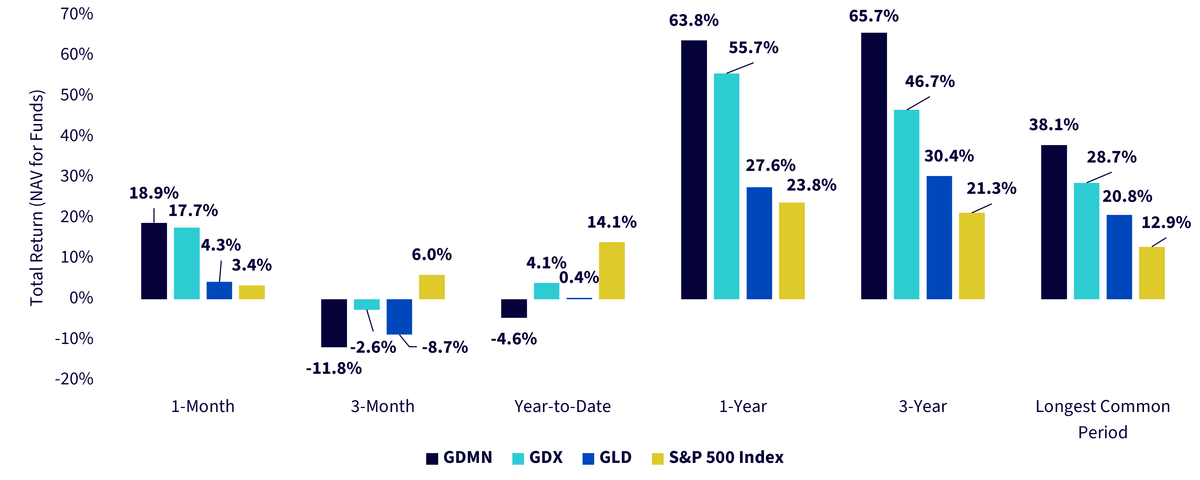
Figure 1b: Standardized Performance
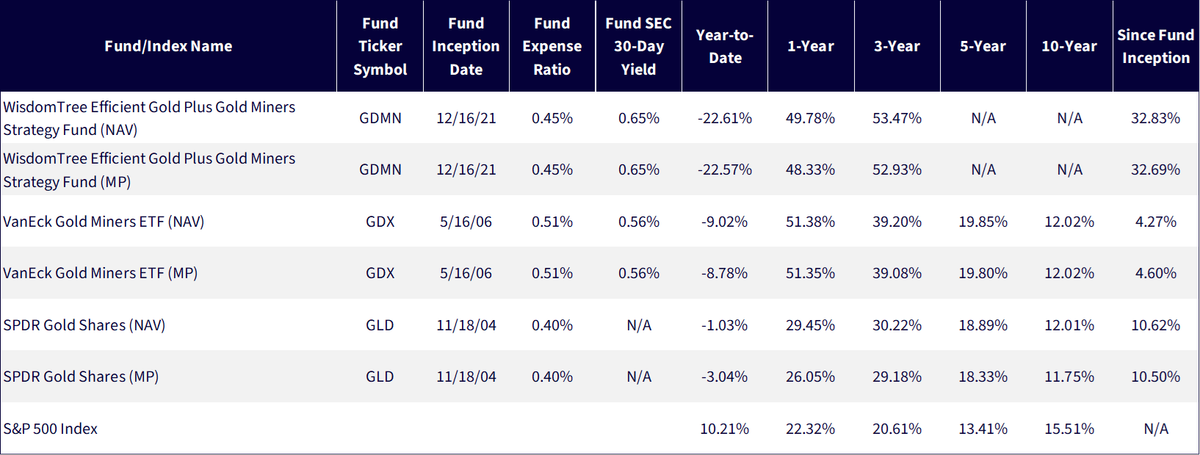
Sources: Morningstar, FactSet and WisdomTree, specifically data is from the PATH Fund Comparison Tool, accessed as of August 10, 2026, but showing returns for the period ended August 7, 2026 for Figure 1a and June 30, 2026 for 1b. NAV denotes total return performance at net asset value. MP denotes market price performance. Past performance is not indicative of future results. Investment return and principal value of an investment will fluctuate so that an investor’s shares, when redeemed, may be worth more or less than their original cost. Current performance may be lower or higher than the performance data quoted. For the most recent month-end and standardized performance, click the relevant ticker: GDMN, GDX, GLD.
To understand why the fundamental picture for miners remains attractive despite the softer gold price environment in 2026 thus far, it helps to focus on a metric that practitioners rely on heavily but that rarely makes headlines: all-in sustaining cost, or AISC. Unlike simple cash cost figures, AISC attempts to capture the full economic cost of maintaining a gold mining operation.
- Production costs
- Sustaining capital expenditures
- Corporate overhead
- The ongoing investment required to keep reserves from depleting
It is, in essence, the break-even threshold below which miners cannot sustain their business long-term.
The spread between the gold price and a miner’s AISC could be the clearest expression of operating profitability in this industry. When gold trades well above AISC, miners could be thought to, in general, generate substantial free cash flow. When the gap narrows, margins, in general, compress and capital allocation decisions become more difficult. We say ‘in general’ because any individual company can have idiosyncratic risk factors that cause a divergence from expected results. Figure 2 shows where major gold producers stand today.
Figure 2: Gold Producers: Strong Margins at Reasonable Valuations
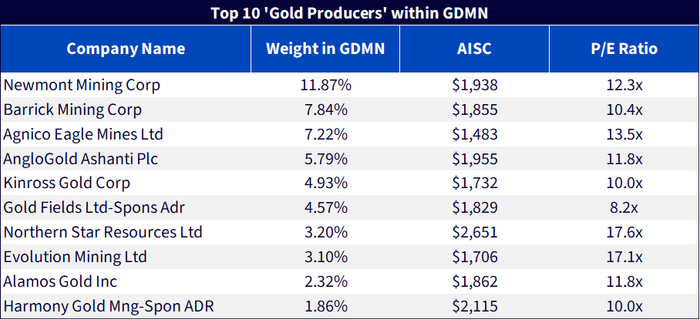
Source: Company filings and earnings reports for all-in sustaining cost (AISC); Stock Analysis for trailing price-to-earnings ratios. Data as of August 2026. AISC represents the latest reported company figure and may differ in reporting period, currency, or methodology across issuers. These companies represent the 10 largest ‘gold producers’ by weight in GDMN as of August 7, 2026. Holdings subject to change.
The snapshot in Figure 2 tells an encouraging story, but the longer arc is even more striking. Over the past decade, gold prices have risen substantially faster than the cost to mine it. This is not a trivial observation. It means the structural profitability of the industry has improved, even accounting for inflationary pressures on labor, energy, and equipment that all producers face. Miners have not simply been riding a rising gold price, they have been doing so while keeping their cost bases relatively contained, which is a meaningful operational achievement.
Figure 3 captures this dynamic across a ten-year window. The widening gap between the gold price line and the AISC line represents overall expanding operating margins, at least in general, margins that may not yet have been fully reflected in how these equities are priced relative to their historical averages. That is where the potential opportunity lies for investors willing to look past the near-term noise in spot prices. Gold’s price can move quickly, as anyone can see, but judging on the basis of history, the costs that gold mining companies face have not tended to move with anywhere near the same degree of rapidity.
Figure 3: Gold Prices Have Risen Much Faster Than Mining Costs
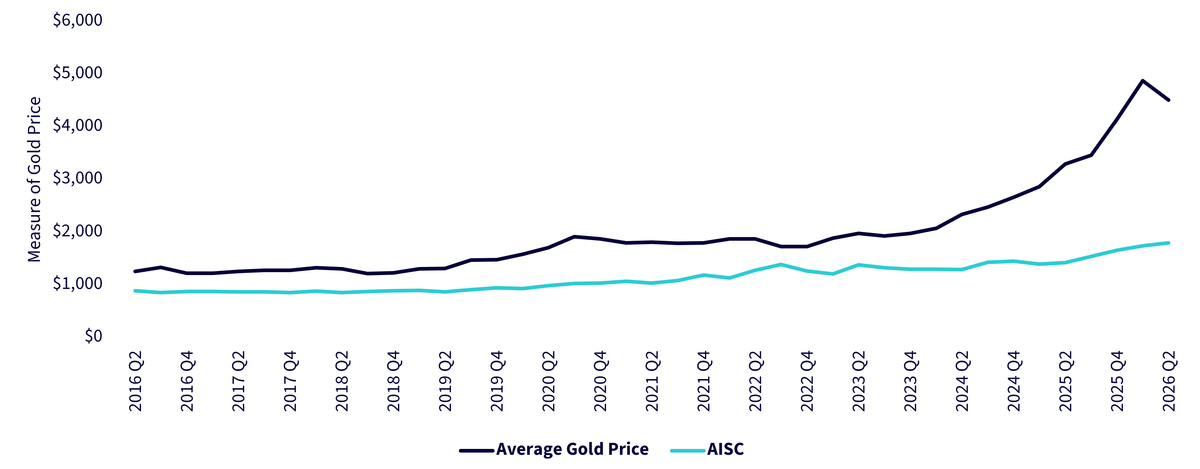
Source: Average gold prices are based on quarterly market data; AISC represents a production-weighted proxy for major gold producers using company-reported results and estimates where necessary. Sources: World Gold Council and company filings. Data through Q2 2026. AISC calculated on a quarterly basis for the universe of gold producing companies within GDMN as of August 7, 2026. Past performance is not indicative of future results.
For investors assessing how to access this thesis, context on the vehicles themselves is useful.
Figure 4: Additional Information
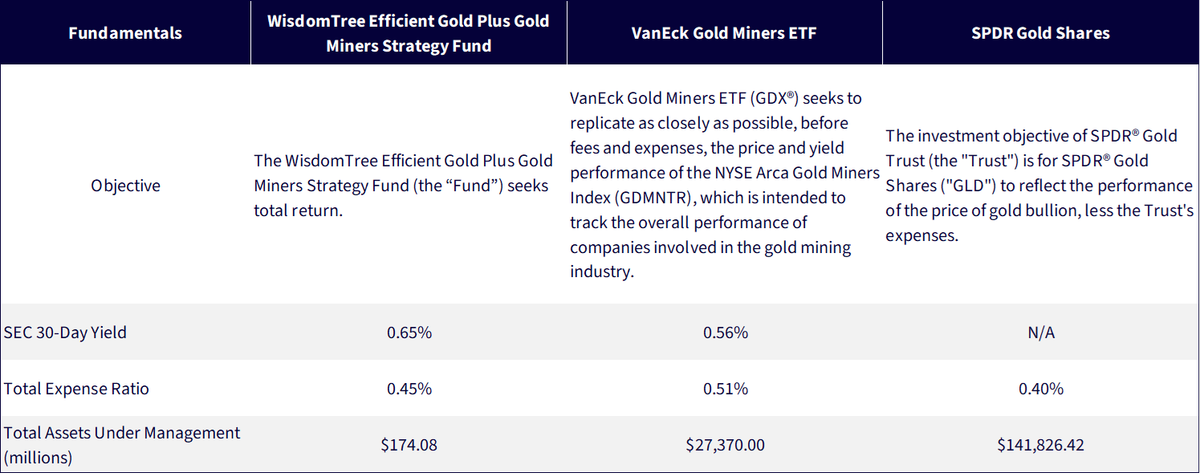
Sources: WisdomTree, VanEck and SPDR. Assets under management as of August 7, 2026.
The beginning of this piece posed what might seem like a binary choice: the stability of gold, or the growth potential of gold miners. 2025 made that question feel almost academic, and we saw that everything worked. 2026 has restored the complexity, and with it, the need to think more carefully.
What the data suggests is that the miner story has not broken down, it has simply become less obvious. Producers are operating with margins that would have looked enviable by almost any historical standard. Their all-in sustaining costs have risen far more slowly than the gold price over the past decade, leaving them structurally better positioned than their equity valuations might imply. And something in the most recent performance data hints that the market may be beginning to recognize this.
GDMN was designed precisely for moments like this, when the case for gold and the case for miners both have merit, and choosing between them feels like leaving return on the table. The capital-efficient structure means investors do not have to make that choice. We cannot know with certainty whether the turn suggested in Figure 1a marks the beginning of a sustained move. But we believe the fundamental groundwork is in place. Sometimes that is the most honest and useful thing we can offer.
1 The investment objective of SPDR® Gold Trust (the "Trust") is for SPDR® Gold Shares ("GLD") to reflect the performance of the price of gold bullion, less the Trust's expenses. It is the largest fund ranked by assets under management that provides exposure to movements in the price of physical gold.
2 VanEck Gold Miners ETF (GDX®) seeks to replicate as closely as possible, before fees and expenses, the price and yield performance of the NYSE Arca Gold Miners Index (GDMNTR), which is intended to track the overall performance of companies involved in the gold mining industry. It is the largest fund ranked by assets under management that provides exposure to movements in the share prices of a group of gold mining companies.
3 The WisdomTree Efficient Gold Plus Gold Miners Strategy Fund seeks total return by investing in gold miners and gold futures contracts. The exposure is designed such that for each $100, $90 is exposed to equities of gold miners, $90 is exposed to gold futures contracts, and $10 is in U.S. treasury collateral.
Copyright © WisdomTree