

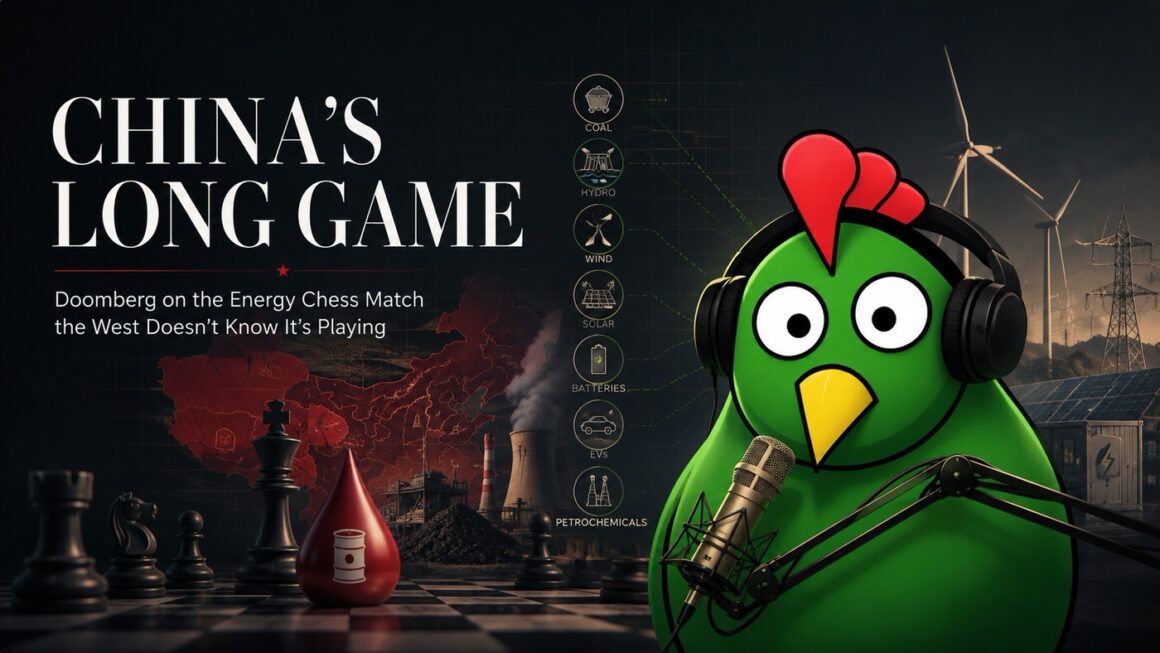

There is an old joke about the person who loses a chess match in twelve moves and spends the next hour explaining to anyone who will listen why their opponent got lucky. Western energy strategists have been that person for about twenty years now. The board is nearly set. The clock is running. And the green cartoon chicken behind Doomberg has been calling the moves in advance.
On a recent episode of Insight Is Capital, we drew out the full architecture of what may be Doomberg's most consequential and least appreciated body of work: a multi-year, multi-article accumulation of evidence that China has been executing a coherent, patient, and almost diabolically clever energy strategy while the West argued about whose fault it was. The anthology of articles that runs alongside that conversation fills in the blueprint square by square.
The picture that emerges is not comfortable. But it is, at minimum, actionable.
The Board: One Weakness, Three Flanks
Start where Doomberg starts: with an honest assessment of China's structural position. The domestic grid runs on coal, hydropower, wind, and solar. None of those fuels arrive by tanker through a chokepoint controlled by a potential adversary. The one genuine vulnerability in the entire architecture is crude oil. China consumes far more than it produces, and the sea lanes it depends on run through waters it does not control.
A lesser strategist would have accepted this as a permanent liability. China treated it as a design problem.
The solution unfolded on three flanks simultaneously, and the elegance of the construction is that each flank reinforced the others. First, China absorbed American natural gas liquids at enormous scale, building the petrochemical facilities and industrial capacity to take US ethane, propane, and butane in quantities that made US shale economics viable. The effect was to turbocharge American crude production, flooding global markets and structurally depressing the oil price China needed to import. As Doomberg put it on the show: "They built the engines, they built the factories, they built the petrochemical facilities to take LPG and ethane on huge scales. Why? It's cheap. And also it enables more crude production." China, the world's largest oil importer, quietly subsidized the technology that lowered the price of oil imports. If that seems like something a chess grandmaster would do, that is because it is.
Second, Beijing positioned itself to dominate every technology required to run an electrified economy: solar panels, batteries, electric vehicles, wind turbines. As Doomberg asks in the podcast, with the kind of rhetorical patience that implies the answer should be obvious: "Suddenly the world is moving towards an electrify-everything movement. Is that a coincidence?" A world running on electricity is a world playing on China's home turf. A world still dependent on crude is a world where its structural weakness is visible every morning.
Third, while progressive environmental organizations in the West were busy congratulating China for its solar installations, Beijing was quietly accumulating roughly 1.5 billion barrels of crude strategic reserve. "Their biggest weakness is oil," Doomberg observes. "So one of the things China did was they convinced the rest of the world that crude oil is bad, while they buy it up hand over fist." Checkmate has a very specific smell, and it smells like subsidized green energy wrapped around a very large oil stockpile.
The Iran Test: When the Insurance Policy Gets Cashed
Theory is pleasing. The Iran conflict was a live fire exam.
Consensus expectation, shared initially even by Doomberg's team, was $150 oil, minimum. The logic was airtight: a hot war in the Middle East, a realistic threat to Strait of Hormuz flows, twelve to fifteen million barrels per day of Gulf crude at risk. Anyone who said otherwise in January/February was either contrarian for sport or had access to information nobody else did.
China had access to infrastructure nobody else had modeled.
When the Strait effectively closed, China absorbed a swing of three to four million barrels per day of crude demand without flinching. Coal to liquids. EV substitution. Petrochemical feedstock switching across ethane and LPG. Doomberg's "Flex Capacitor" piece documents the mechanism in clinical detail: Chinese crude imports dropped from roughly eleven million barrels per day to 7.8 million, the missing three million barrels roughly equal to the combined daily consumption of Italy and France, and yet, as he notes with appropriate incredulity, "tourists are still traveling, factories are still running and store shelves have plenty of toilet paper."
Oil settled into the eighties. The mental model held. The team pivoted: "We too thought oil would go to $150 if you gave us that fact set, but we were quick to pivot when the prices didn't follow through."
The larger takeaway is structural and permanent: "That China has the ability to swing 3 to 4 million barrels per day of crude demand for months at a time without a flinch seems a profoundly important development." If crude oil has shifted from a necessary hydrocarbon to an optional one at the margins, and those margins are as wide as Chinese demand, the implications for energy prices are not subtle. The direction in which the great global hydrocarbon arbitrage closes is lower. Much lower.
The Sanctions Trap: How to Build a Stronger Adversary
The West's response to Chinese strategic progress has followed a consistent pattern: sanction it, restrict it, build moats around it. Doomberg's consistent response to this pattern is consistent too, and he reaches for a medical analogy that is difficult to improve on. Sanctions against strong countries, he argues, operate like a partial cancer treatment. "The cancer that comes back is stronger and angry."
The BYD story is the one he tells with the most relish, because the facts are almost too perfect. He attended a Shanghai auto show years ago and saw the first BYD vehicle: a car that appeared to have been photocopied from a Toyota Corolla by someone with excellent eyesight and no licensing obligations. "Everybody was laughing at it," he recalls. He was not laughing. He knew what the pattern meant. BYD is now larger than Ford.
The semiconductor chapter is following the same script, and Doomberg's "Flipping the Script" and "Treatment Resistant" articles document it with mounting urgency. Huawei, denied access to ASML's EUV lithography machines, is developing a chip-design framework it claims will deliver transistor densities equivalent to 1.4-nanometer-class chips by 2031 without them. DeepSeek V4 arrives at 97 percent lower cost than OpenAI equivalents and is released open source, making frontier AI accessible globally without a subscription to American infrastructure. China's Ministry of Commerce declares US sanctions against its petrochemical refiners null and void, making it illegal for any entity operating in China to comply.
The operating conclusion Doomberg draws across the anthology is consistent: "The thought that there's any moat that a dedicated Chinese attempt to undo can resist is a very, very bad mental model." The EU's LNG sanctions against Russia are the dry-run proof of concept: Western engineering firms pulled out of Russian LNG projects, and Russia built its own compressors. The EU is now importing more Russian LNG than before the sanctions, up nearly eighteen percent year on year, while the Russia that emerges from this affair has minimal external dependencies whatsoever.
For China, a far more capable adversary, the same logic applies with compounding interest.
The Solar Trap: When Intermittency Swamps Dispatchability
There is a subplot to the China energy story that carries its own dark comedy, and it involves the West's habit of praising China's solar installations as evidence of climate leadership while carefully not reading the data behind the press releases.
Doomberg's grid analysis is built on a single, falsifiable heuristic: when intermittency swamps dispatchability, grids begin to break. Dispatchable power, the kind that can be turned up or down on command, comes from natural gas and impoundment hydro. Coal and nuclear are excellent for baseload but behave like ocean liners when you need a speedboat. Wind and solar are neither baseload nor dispatchable. When combined wind and solar generation exceeds combined natural gas and hydro generation, the grid enters a structurally precarious zone.
China crossed that threshold in 2024 for the first time. New solar installations collapsed in 2026, down 79 percent year on year by April. The Energy Institute's summary report, which Doomberg dissects in "Land of the Waning Sun," buries this in statistical jujitsu while celebrating China's renewable leadership on the cover. The actual data confesses that hydrocarbons provided 86.24 percent of all global primary energy in 2025, down from 86.65 percent the year before. As he notes with characteristic dryness: "Won't be long now."
The battery counter-argument, always the raised hand at the back of the room, does not survive the arithmetic. China installs half of all battery energy storage systems deployed globally. Total installed BESS capacity as of the "Awkward Truths" article is sufficient to back up the Chinese grid for approximately thirty seconds. The installed wind and solar capacity could charge those batteries from empty in about eighteen minutes. One is reminded of arriving at a house fire with a very expensive garden hose.
The Escape Route: Coal Gets a Second Act
Doomberg is not a forecaster who forgets to include his own falsification conditions, which is one of the things that separates him from the consensus. He flags a potential escape route for China's grid dilemma, and it is worth watching closely.
A class of emerging technologies, including supercritical carbon dioxide working in closed Brayton cycles, could make coal plants dispatchable: able to ramp up and down quickly enough to balance intermittent renewables. If China cracks this, the intermittency constraint dissolves, coal becomes the ideal partner for wind and solar, and the entire framework requires revision. "We know when it'll be wrong," Doomberg says of the dispatchability model. "And we'll discard it then, which is wonderful." The Chinese are exploring implementation. The capital required would be enormous. The incentive, given the AI power race, is enormous too.
Five Key Takeaways for Advisors
1. The Iran conflict proved China's oil resilience is structural, not improvised. The switching capacity deployed was the deliberate product of two decades of overbuilding. Portfolios modelling Chinese energy vulnerability as a meaningful geopolitical lever need to be retested against what the market actually told us: $80 oil, not $150.
2. The hydrocarbon parity thesis argues for structurally lower energy prices over time. If crude oil has shifted from a necessary to an optional hydrocarbon at the margins of Chinese demand, the direction of the great global arbitrage is lower. Natural gas at current prices is the cheapest energy in human history on a BTU basis. The supercycle narrative requires a China that can no longer switch. That China no longer exists.
3. Sanctions consistently produce stronger adversaries. BYD, Huawei, Russian LNG compressors, DeepSeek: the pattern is the same across every sector where the West has tried to build a moat. Portfolios exposed to companies whose competitive position depends on technology denial face structural risk that compounds over time and does not announce itself with a press release.
4. China's solar enthusiasm was a policy artifact, not a structural trend. The 79 percent year-on-year collapse in Chinese solar installations in early 2026 was exactly what the intermittency-swamps-dispatchability model predicted. The Energy Institute's cheerleading for Beijing's green credentials was, and remains, downstream of the physics. Advisors who used solar installation records as a proxy for Chinese grid health were reading the wrong data.
5. Watch coal dispatchability technology as the model-breaking variable. If supercritical CO2 or equivalent technology makes China's vast coal fleet ramp-able on demand, the intermittency constraint disappears and the energy framework changes materially. This is not the base case. It is the stated falsification condition. Advisors who know in advance what would break the model are positioned to act when the evidence arrives, rather than react after the fact.
Footnote:
1 "Energy, China, AI, and the Calls Nobody Else Made." AdvisorAnalyst, 11 Aug. 2026, advisoranalyst.com/2026/08/11/doomberg-energy-ai-and-the-calls-nobody-else-made.html.
Insight Is Capital is produced by AdvisorAnalyst.com. This editorial was prepared based on a recorded conversation between Pierre Daillie and Doomberg, in conjunction with Doomberg's published Substack anthology. August 2026.