





by Warner Wen, Capital Group
For investors seeking a smoother ride when investing internationally, the answer may lie in a developed international equity fund.
Unlike many broader international equity mandates that combine developed and developing markets into a single fund, developed international equity funds focus on established economies such as Japan, the U.K., Switzerland, France and Germany with limited emerging markets exposure.
"Developed market–focused funds provide access to world-class businesses and established economies while offering less potential volatility than broader international mandates," says product manager Warner Wen.
There’s an additional consideration, though: For investors accessing the asset class through an ETF, these benefits can be further enhanced by the convenience and flexibility of an exchange-traded vehicle.
Expanding the opportunity set
One of the fundamental benefits of developed international equity ETFs is access to a vast investment universe through a single, cost-effective vehicle.
The U.S. represented 1,559 constituents in the FTSE Global All Cap Index as of May 31, 2026. But outside the U.S. there were 10,137 constituents, highlighting the breadth of opportunity available beyond a single market.
Put simply, diversification across geographies is not just about owning more stocks; it’s about owning different drivers of return. And because global markets move in different cycles, this broader exposure can improve risk-adjusted outcomes over time.
Importantly, developed international markets also provide exposure to different sector leadership. While the U.S. market is heavily concentrated in technology, developed international markets tend to have greater representation in sectors such as financials, industrials, consumer staples and healthcare.
Different weights, different outcomes
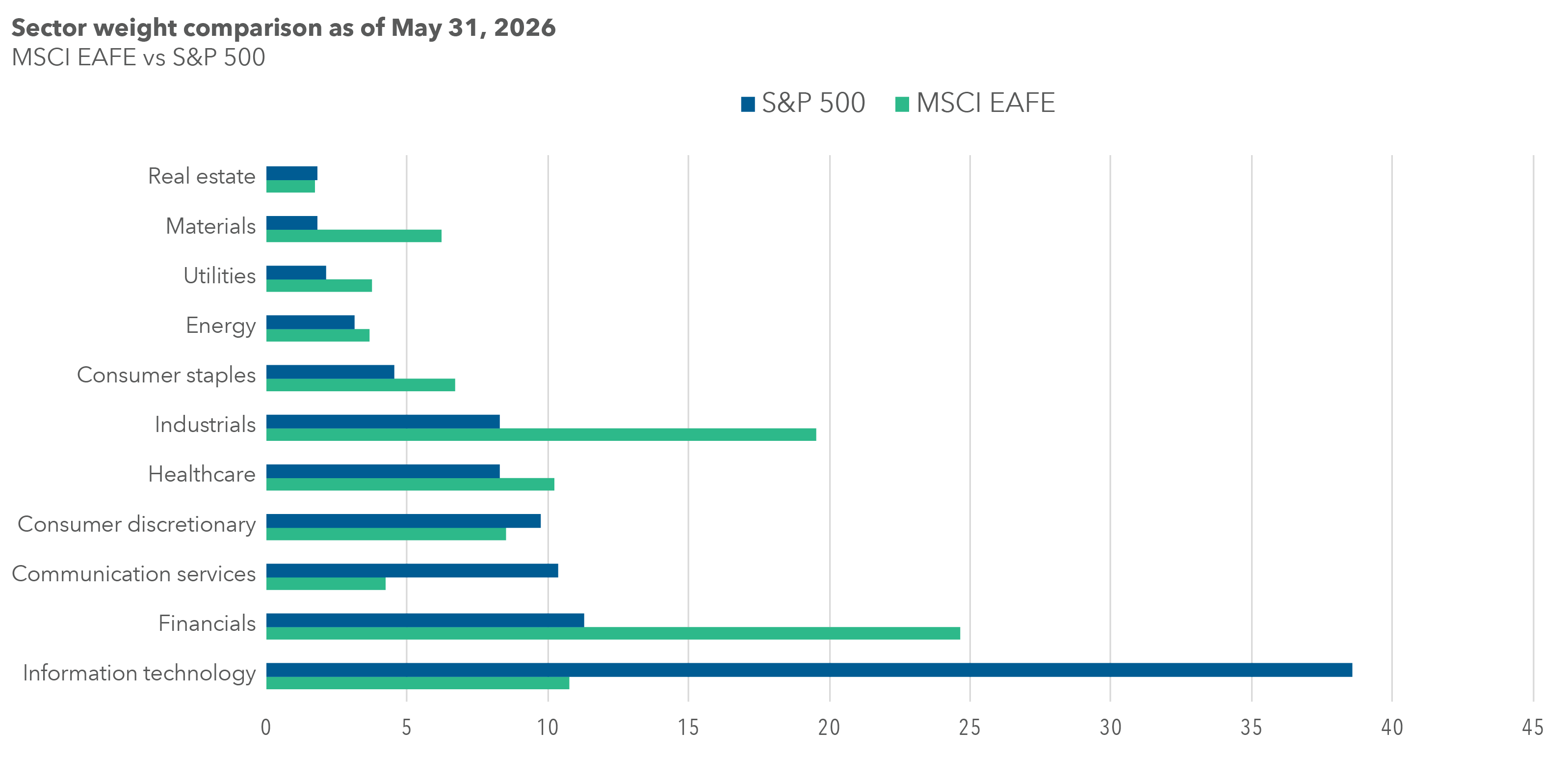
Sources: MSCI and S&P Dow Jones Indices LLC.
Relative attractiveness: Income and valuation support
Beyond diversification, international developed equities currently offer a compelling valuation and income advantage. After years of U.S. outperformance, the valuation gap between U.S. and international markets remains meaningful, with non-U.S. equities trading at a discount across many sectors. Historically, such discounts have often preceded periods of relative outperformance for international equities.
Sectors are historically discounted outside the U.S.
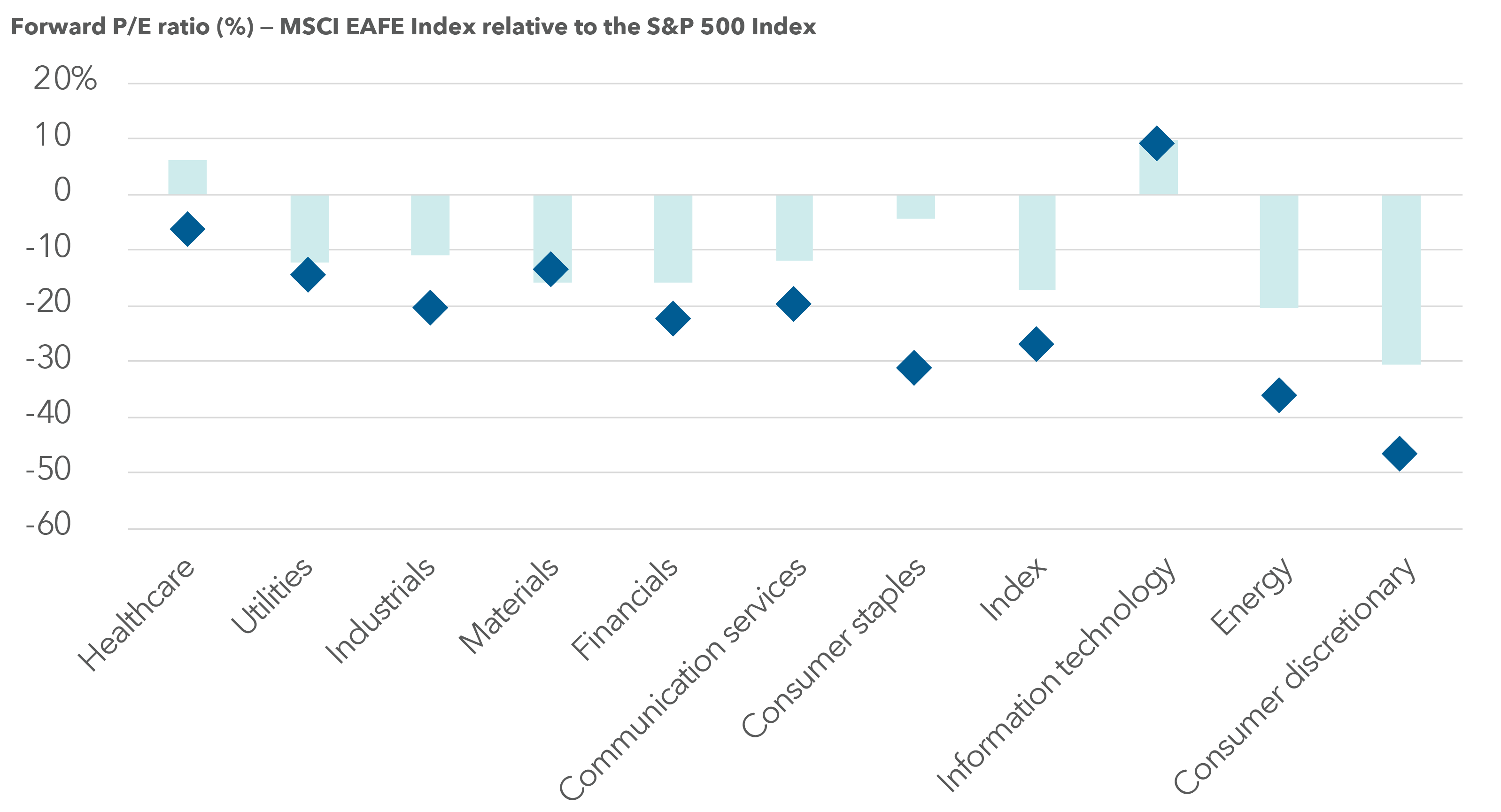
Sources: Capital Group, FactSet. As of March 31, 2026 . Relative forward P/E (price-to-earnings ratio) is calculated by dividing the forward P/E ratio for the MSCI EAFE Index by the forward P/E ratio for the S&P 500 Index. Valuation: An estimate of a company's worth based on metrics including earnings, revenue or assets.
In addition, developed international markets tend to exhibit higher dividend yields than the U.S., supported by a stronger shareholder payout culture and sector composition. This combination of higher income and lower starting valuations provides investors with a built-in margin of safety that can cushion against potential downside risk and serve as a foundation for long-term return generation.
Developed international dividend yields sit near 20-year relative highs
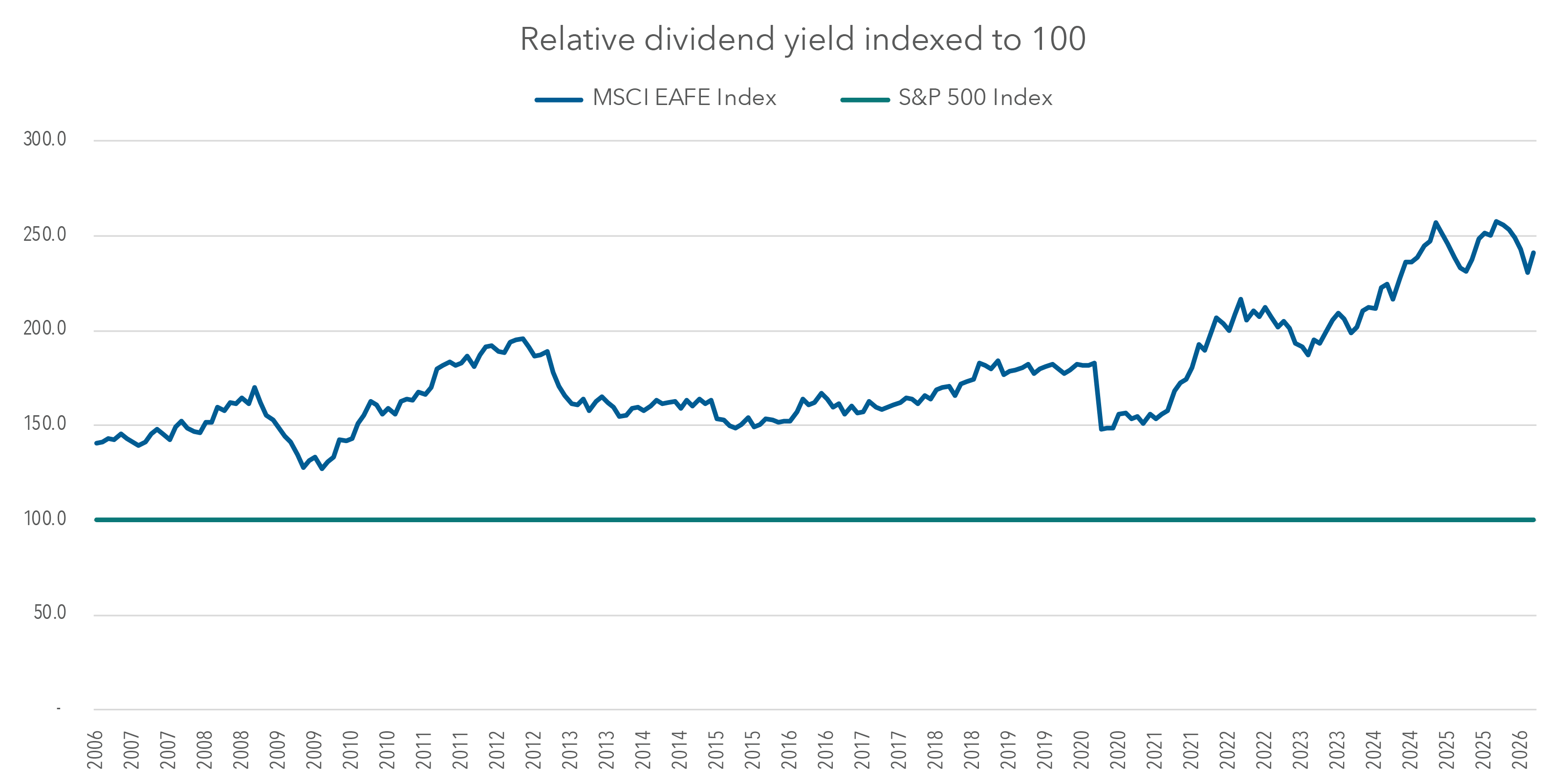
Source: FactSet. As of March 31.2026. Relative dividend yield is calculated by dividing the dividend yield of the MSCI EAFE Index by the dividend yield of the S&P 500 Index. Dividend yields are based on the last 12 months. Past results are not predictive of results in future periods.
“Despite this very attractive backdrop, passive exposure to developed international equities alone may not be enough. The real opportunity lies in distinguishing signal from noise — finding the right companies, sidestepping value traps, and recognizing turning points early. These are the areas where active management can potentially deliver its greatest value,” says Wen.
Resilience in a higher-inflation world
The case for developed international equities appears even more attractive in a higher-inflation environment.
Many sectors that are well represented within developed international markets — including utilities, energy, industrials and consumer staples — often have pricing power that helps them pass rising costs on to consumers. This ability can support margins and earnings during periods of elevated inflation.
At the same time, many developed international companies pay meaningful dividends, which can provide investors with a tangible source of return when market conditions become more uncertain.
"Dividend-paying companies can offer both income and a measure of stability when capital appreciation becomes more difficult to achieve," says Wen.
Building a more balanced portfolio
Developed international equity ETFs are more than a diversification tool. They can serve as a strategic core portfolio allocation, helping investors broaden opportunity, reduce concentration risk and gain exposure to mature economies around the world.
By focusing on developed markets, investors can access global companies, attractive valuations and income-oriented businesses while potentially avoiding some of the additional volatility associated with emerging markets. Combined with the cost efficiency, transparency and flexibility of the ETF structure, developed international equity ETFs can provide a simple and effective way to diversify beyond North America.
"In a world where inflation, interest rates and market concentration continue to create uncertainty, an actively managed developed international equity ETF can play an important role in helping investors build more resilient portfolios," says Wen.
Warner Wen is a product manager at Capital Group. He has 14 years of investment industry experience (as of 12/31/2025) and joined Capital Group in 2024. He holds an MBA from Rollins College Crummer Graduate School of Business, a master's degree in finance from the Schulich School of Business at York University and a bachelor's degree in electrical engineering from Peking University.
Copyright © Capital Group