




by Chris Fasciano, Chief Market Strategist, Commonwealth, LPL Financial
Today's blog is written by Chris Fasciano, chief market strategist at Commonwealth. He represents Commonwealth in various media appearances, advisor speaking events, and Commonwealth conferences. He also oversees and mentors a dynamic team of investment research analysts who specialize in equity and fixed income markets. Prior to this role, Chris spent 10 years as one of the firm’s portfolio managers, involved with asset allocation and fund selection. With a deep background in small- and mid-cap stock research, Chris is uniquely positioned to analyze the latest economic data and offer valuable insights on navigating today’s volatile markets. Chris Fasciano is a guest writer and is not affiliated with LPL Financial.
The Federal Open Market Committee (FOMC) is meeting to deliberate on short-term interest rates and will announce their decision this afternoon. Expectations regarding whether the Federal Reserve (Fed) will raise rates again after September's increase have shifted dramatically over the past month. Markets moved from expecting another 25-basis-point hike immediately after September's meeting to largely anticipating no change at today's meeting, with attention shifting to December.
While the Fed does control short-term rates, they do not control the yield on the 10-year Treasury bond. This yield has been in the news lately for a surge higher and then a quick move lower starting with the October 14 Consumer Price Index release and gained steam as investors sold stocks and moved to safer investments. But yields that are currently being seen in the market are not out of line with historical levels.
What is the Fed Currently Focused On?
The key driver of the Fed’s September interest rate increase was accelerating inflation. Recent inflation data showed continued upward pressure at both consumer and producer levels. In isolation, that data would argue for maintaining the Fed's tightening bias. However, a softer than expected September employment report likely buys the Fed some breathing room and reduces the urgency to be aggressive in raising rates. And while the Fed isn’t beholden to political calendars, it must at least be acknowledged that mid-term elections are taking place next week. Historically, the committee has shown a reluctance to make policy changes immediately before major elections unless economic conditions clearly warrant action. However, this doesn’t mean that the Fed won’t continue to focus on inflation moving forward.
Fed Chair Kevin Warsh has made it clear that the Fed intends to rein in inflation. It has been over five years since inflation was below the Fed’s target rate of 2%. While much of the recent inflationary pressure can be attributed to tariffs and higher energy prices due to the war in the Middle East, those factors are beginning to impact other components of inflation like core goods. This suggests that even if geopolitical pressures ease, inflation could remain elevated enough to warrant additional policy tightening absent a meaningful economic slowdown.
Even if the Fed does hold rates steady, Warsh’s comments after the meeting will be key for investors. Does he indicate support for another rate increase in December or suggest that policy rates are sufficiently restrictive? While he has largely avoided explicit forward guidance, investors will carefully analyze his comments for clues about the policy path ahead. Investors will also look closely for any insights into the debate within the committee and whether the policy decision has any dissenters. Both could lead to the market drawing a conclusion one way or the other as to what is in store for the final meeting of the year.
Equity and fixed income markets could initially react to any information that they determine to be hawkish or dovish regarding future policy decisions.
The Treasury Market is More Important for Long-Term Investors
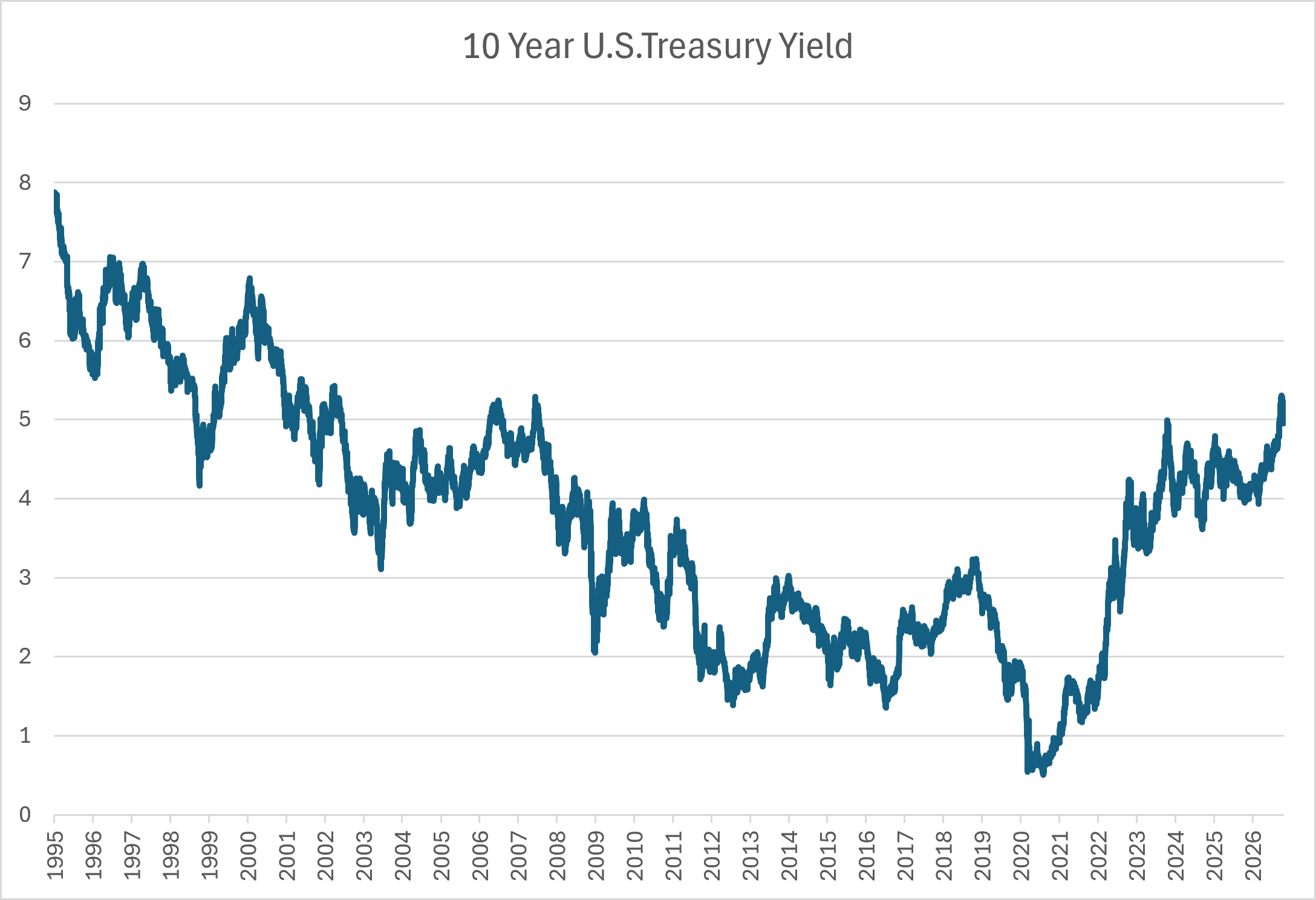
While Fed decisions justifiably attract significant attention, long-term investors often place greater emphasis on the 10-year Treasury yield. Recent movement in this market has attracted a fair number of headlines recently as the yield has reached levels not seen since 2002. On the surface, that seems like a significant development. But it also misses the fact that from a historical perspective, the yield on the 10-year from the aftermath of the Global Financial Crisis (GFC) through 2022 was abnormally low.
It is important to not let recency bias lead to a view that low rates are needed for strong equity market returns. Pulling back and looking through a longer-term lens, it becomes clear that stocks can perform well in different rate environments.
Current Rates Are Not a Historic Anomaly
Source: LPL Research, Bloomberg 10/26/26.
Disclosures: Past performance is no guarantee of future results.
The “Current Rates Are Not a Historic Anomaly” chart illustrates that 10-year Treasury yields since 1995 have been at similar levels to today, if not even higher for some long stretches.
While equity investors benefited from strong returns in the low-rate period following the GFC, those unusually low rates in and of themselves were not a prerequisite for positive stock market performance. One only needs to go back to the 1990s to see yields in the 4–6% range. Despite this, that period had strong U.S. economic growth and strong corporate earnings. Those underlying fundamentals of growth are the keys to generating strong returns over time. They drove markets higher in the 90s and are key reasons that markets are near all-time highs today.
Yields at today’s level have the potential to offer other benefits for investors.
Higher Yields Could Be the New Normal and That isn’t Necessarily a Negative
The unusual experience of 2022, when both stocks and bonds declined simultaneously, remains fresh in investors' minds. But the starting point for this cycle’s Fed rate increases is much different. This was covered by my colleague, Sam Millette, in his recent article “Why Today’s Bond Market Differs From 2022.”
Additionally, higher Treasury yields present options for investors, particularly income seekers. Treasury yields above 5% provide income opportunities that many investors have not seen in more than a generation. At the same time, unlike 2022, bonds at current yield levels may once again serve as effective portfolio diversifiers for equity investors. That possibility was on display last Thursday, when the 10-year yield dropped 19 basis points on the sell-off in technology stocks. Bonds acted as the safe haven investors had come to expect over many years and multiple market cycles.
While much of the market's attention remains focused on each Fed meeting, long-term investors may be better served by keeping an eye on broader fundamentals. Economic growth, corporate earnings, and attractive starting bond yields have historically mattered far more for long-run diversified investment outcomes than the precise timing of individual rate decisions. Today's higher-rate environment may look unusual compared with the last decade, but viewed through a longer historical lens, it is far from unprecedented.
Copyright © LPL Financial