



by Ryan Boyle, Senior Economist, Northern Trust
Reasonable minds can disagree about the ideal scope of government, but no one argues against nations providing for their defense. As conflicts emerge and tensions rise, defense spending will take a larger role in all nations’ budgets, with effects that will flow across the economy.
While no one wishes for war, spending on national security creates jobs and may make nations more productive in peacetime. Research that starts in the defense sector can pay off broadly; the internet and GPS began as defense technologies.
The broader benefit (or drag) from this spending is known as a multiplier effect: does a dollar spent on defense generate more (or less) than a dollar of gross domestic product (GDP)? The defense spending multiplier can be greater than one, but not in all circumstances.
Import dependencies can turn defense spending into an economic drag. Military contracting is a concentrated sector. Major defense firms have been through decades of consolidation; smaller nations often lack domestic producers of arms and defense technology. More imports leave less upside to the domestic economy, with benefits accruing externally.
Procurement expenses must also be paid for upon receipt. If the expense is paid through higher taxes, it weighs on economic activity immediately. Funding with debt defers the downside but adds to longer-term burdens, especially in a higher-rate environment.
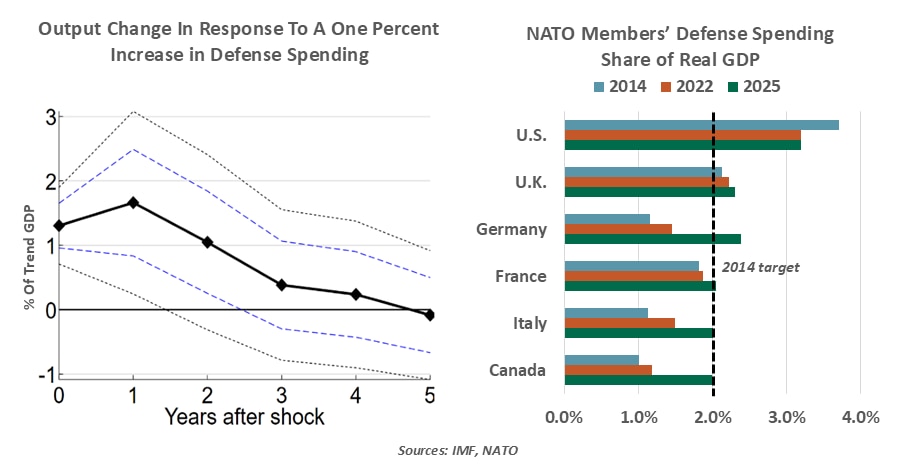
A comprehensive study of European defense spending since 1989 by the International Monetary Fund shows a sequential multiplier trend: A nation’s total output increases, peaking in the first year after a spending boost, with the effect fading to zero within five years.
Productive potential notwithstanding, defense investments are made in preparation for a darker turn. If conflict arises, the economic outlook for involved nations changes rapidly to a wartime footing. Government expenditure rises dramatically to recruit soldiers and acquire supplies, crowding out public spending on other budget categories. Though disruptive, the net effect is a near-term stimulus. Real GDP in Russia has grown in most quarters since 2022 (though Ukraine has not estimated its GDP since 2023).
Significant economic damage is done to nations near the war but not a party to it. Their trade routes may become unreachable; their residents may flee areas near the battlefront. This risk is most clearly manifest today in Middle East nations whose commerce has been impacted by the Iran conflict: Saudi Arabia’s GDP fell by 6.1% in the first half of 2026 and is still reeling.
Several areas of the world are set for substantial increases in their defense spending. Members of the North Atlantic Treaty Organization (NATO) agreed last year to expand their target military spending from 2% of GDP to 5% by 2035. Of that new higher threshold, 1.5 percentage points may be allocated to “broader defence- and security-related areas,” which can include infrastructure, communications networks and civil resilience.
Investment in defense can confer broader benefits
Rearmament in the U.S. is coming into focus. The Iran conflict has consumed over three thousand advanced U.S. missiles. Each will cost at least $2 million (and at least 42 months) to replace. Improvements to shipbuilding capacity, cyber capabilities and greater deterrent weaponry will also add to spending demands.
The U.S. Department of Defense requested a record-high $1.5 trillion budget for fiscal 2027. The approved value will likely be lower, but no less than last year’s $839 billion appropriation. With a heavily domestic defense supply chain, this spending will be accretive to U.S. economic activity. However, this will add to the U.S. debt burden just as borrowing costs come under closer scrutiny.
As fiscal pressures increase, policymakers will look for opportunities to cut budgets. Defense spending will be the least likely to face reductions. In the absence of national security, economic security cannot be achieved.
Copyright © Northern Trust