



The banking industry's next AI transition has already begun, and it does not look like anything that came before it. A new McKinsey report by James Kaplan, Rich Isenberg, Vik Sohoni, and Vishnu Kamalnath, with Shilpa Khatana, argues that financial institutions are moving decisively past AI copilots into what the authors call agentic coworkers1 — systems that do not merely assist, but plan, execute, and own outcomes end to end. The stakes are materially different. "A copilot that gets something wrong creates rework," the authors write. "An agentic coworker that gets something wrong can change a production system, expose client data, trigger a downstream compliance event, or cause a cascading failure across a chain of dependent agents before anyone notices."
That distinction is the report's sharpest edge, and it bears weight well beyond the technology department.
A New Division of Labor
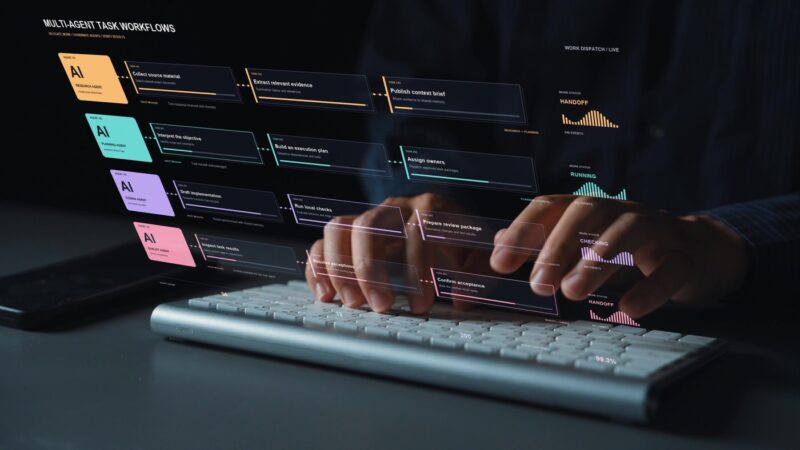
The McKinsey team defines an agentic coworker not as a chatbot with a wider prompt, but as a coordinated system of agents, skills, and tools commissioned to perform a business role. Unlike a copilot, it keeps context across cases, plans and executes across multiple steps and systems, and operates persistently. The authors are explicit that this represents "a fundamentally new operating model for how work gets done in banks" — one that requires redesigning workflows and roles together, not simply inserting agents into existing processes.
The report identifies five foundations for making this transition work. The first is safe autonomy. Agentic coworkers can hallucinate — "invent API endpoints that do not exist, misstate regulatory obligations, fabricate test outcomes, or take plausible but wrong steps in production systems." Constraining agents to approved tools, scoped permissions, and tested rollback paths is not optional. The second foundation is governed identity. Every agentic coworker needs a unique credential, a named human owner, and a formal registry entry before it touches anything. The authors warn plainly: "Agent sprawl is technology debt that surfaces silently until it becomes a regulatory finding."
The third foundation reframes a concept that has become shorthand. Human-in-the-loop, the authors argue, is not a checkbox but a design discipline calibrated to risk tier. High-stakes decisions require human approval before execution. Medium-risk workflows warrant sampling. Low-risk automation requires exception handling only, but with a named accountable owner at all times. Autonomy expands only as performance, edge cases, and controls are validated, and the authors depict this as a three-stage progression from human approval of every action to supervisory monitoring alone.
The fourth foundation is enterprise context. Speed without institutional knowledge produces confident errors. "An agentic coworker refactoring payments code without knowing architecture standards, or triaging AML alerts without understanding the bank's risk appetite, will move fast in the wrong direction." The authors distinguish three memory layers that keep coworkers grounded: episodic (what happened before for this client), procedural (how the work should be done), and semantic (the bank's own definitions, thresholds, and regulatory vocabulary). Proprietary context cannot be purchased; it must be built and owned. "Buy what's commoditized," the team writes, "and own what competitors cannot replicate."
The fifth foundation is a common AI gateway. As agent populations scale, each coworker cannot manage its own controls. A centralized layer must enforce policy, validate identity, redact sensitive data before it reaches external models, log every prompt and tool call, and meter token consumption. The economic unit that matters, the authors note, is "the total AI expenditure required to produce a completed workflow result" — cost per case resolved to regulatory standards, not a single opaque AI bill.
What Advisors and Investors Should Take Away
Five implications cut across the report with direct relevance to the advisory and investor community:
- Accountability does not transfer to algorithms. Regulators are applying existing supervisory frameworks to agentic behavior today. The institution deploying the agent remains fully liable for its output.
- Proprietary institutional context is a durable competitive advantage. Banks that invest in building their own knowledge layers — credit policy, risk parameters, AML typologies — will outperform those that buy generic orchestration and assume it is enough.
- Human capital requirements are evolving, not shrinking. As routine execution migrates to agents, demand will rise for judgment, exception handling, relationship management, and agent-orchestration skills. Workforce redesign must be proactive.
- Governance infrastructure is the moat. The case study of a leading North American bank shows that the first coworkers prove the pattern; subsequent ones inherit the controls. Early investment in agent governance compounds.
- The economics of AI will become more transparent. Gateway-level token metering will reveal the true cost of AI per workflow. Firms that price this intelligently will allocate AI spend to highest-value use cases; those that do not will absorb compounding cost surprises.
The McKinsey team closes with a clear warning: "Skip them, and the bank will either throttle low-risk work with ad hoc review or discover that an unsupervised coworker has already acted." The era of the agentic coworker is not a future planning exercise. For banking technology organizations, it is the present operating reality.
Footnote:
1 Kaplan, James, Rich Isenberg, Vik Sohoni, Vishnu Kamalnath, and Shilpa Khatana. "The Rise of the Agentic Coworker: A Banking CIO's Guide to the Next Wave of AI." McKinsey & Company, October 2026, https://www.mckinsey.com/capabilities/tech-and-ai/our-insights/the-rise-of-the-agentic-coworker-a-banking-cios-guide-to-the-next-wave-of-ai/.