



by Hubert Marleau, Market Economist, Palos Management
On Friday last week, Tom Lee, head of research at Fundstrat and “par excellence” forecaster of the stock market, said that he was very comfortable with his bullish stance because the CBOE Volatility Index was back to normal levels, stock prices had risen on bad news, and higher oil prices had not been less damaging than consensus expectations, suggesting that the “war bottom” had been reached. Based on his technical analysis and market observations, he claimed that the S&P 500 could reach 7400 this year.
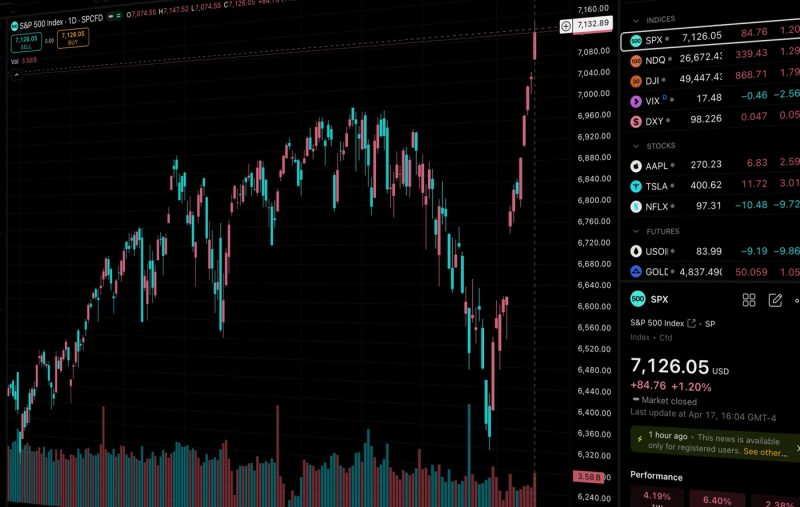
Well, there you have it. In less than 3 weeks, the S&P 500 climbed to a new all-time high of 7023 on Thursday last, after hitting correction territory, on signs that the U.S. and Iran might extend the ceasefire, thereby helping the markets unwind war-driven risk premiums. In this connection, the international price of oil dropped from $113 to $95, and that of gold and copper both increased roughly 11% to $4866 and $ 6.08 respectively, suggesting that investors should not stand in front of the rally. On Friday, the S&P 500 flew higher to 7126, after the Iranian foreign minister declared the Strait of Hormuz "Completely Open”, registering a whopping weekly gain of 4.5%.
Indeed, there are good technical arguments for this to continue because many speculators are overhedged for chaos and/or chasing performance they have not captured, creating a scramble for stocks to rebuild positions.
However, a lot of things will need to go right in the economy from here on to maintain the expansion of corporate earnings, which rose at a very fast pace during the past 2 quarters to fresh record highs, offsting to offset a looming “stress test for the global energy supply chain” or a possible, albeit unlikely, renewed flare-up in the Middle East. Luckily, S&P 500 earnings look promising amid the resilience of the US economy, with consumers still spending and businesses still healthy, magnified with fiscal stimulus, deregulation, strategic stocking of energy and minerals, ongoing reshoring of indutries, low initial job claims, tax refunds, a pick up in manufacturing, AI-driven capital investment, the Fed’s asset purchase and accelerating money supply as CEOs of the major money centre banks attest. Yes, consumer sentiment plunged to a record low in April, but it reflected fears over the Middle East conflict rather than recessionary concerns. The message from recent economic data is clear: the US economy is winning. The New York Fed Staff Nowcast is estimating that Real GDP rose 2.3% in Q1/2026 and predicting that it will increase 2.8% in Q2/2026.
The aforementioned factors explain why Wall Street analysts have raised estimates noticeably for both S&P 500 revenues and earnings for both 2026 and 2027. In a recent note to its readership, Yardeni Research showed that consensus estimates for 2026 and 2027 revenue per share (RPS) were $ 2177 and $2343, projecting gains of 8.5% and 7.6%, with corresponding earnings per share (EPS) of $323.73 and $377.94, anticipating gains of 19.3% and 16.7%.
In spite of a popular belief that the stock market is totally irrational and crazy, private foreign investors, banking on the idea that the “Roaring 20s” has returned, have been robust buyers of US stocks and bonds, totaling $1.5 trillion over the last 12 twelve months. It is true that foreign official holdings of US treasuries have remained flat around $4.0 trillion since 2012, but private foreign investors have more than compensated for this with a surge in holdings of these to a record $5.5 trillion.
Copyright © Palos Management