





When Roger G. Ibbotson and Rex Sinquefield published their foundational study of long-run asset returns in the Journal of Business in 1976, they arguably changed investing as a profession. Fifty years later, Ibbotson has returned with something even more ambitious — a 398-page monograph, Exponential Wealth: Centuries of Stock and Bond Returns, published by the CFA Institute Research Foundation, with Laurence B. Siegel as executive editor. Twenty-five of the most authoritative contributors, four sections, twenty-one chapters, and more than two centuries of data on stocks, bonds, bills, and inflation — this is the Stocks, Bonds, Bills, and Inflation (SBBI) legacy, greatly expanded.
The Power That Stunned a Generation
Ibbotson is direct about what made that 1976 paper so disruptive: "Today, we have an array of technological financial tools at our fingertips, making it almost impossible to look back and fully understand the impact of Rex Sinquefield's and my 1976 article 'Stocks, Bonds, Bills, and Inflation: Year-by-Year Historical Returns (1926–1974).'" The insight was not merely empirical — it was psychological. Investors simply had not grasped what compounding meant at scale.
"It seems obvious 50 years later, but, for example, with a 10% return compounded over 50 years, $1 grows to more than $117. This concept astounded investors and made them realize that simply investing in an overall stock market index could create tremendous wealth over a long period." — Roger G. Ibbotson, Chapter 1: Introduction
The monograph opens with this rhetorical frame deliberately. Ibbotson and Siegel want readers to hold the century-scale picture in mind before engaging the technical apparatus that follows. "Indices are really important," Ibbotson writes: "They give you the long-term history and tell you collectively how stocks and bonds have performed." Total return indices — capturing both capital gains and dividends reinvested — are the instrument. "Creating stock and bond market total return indices had a tremendous impact on the business world. Investors were interested to know what kind of long-term return to expect from the stock market, and they were just beginning to realize the enormous impact of compounding, which, as we know, leads to exponential growth of wealth."
A New Dataset for a New Era
One practical impetus for the monograph is the discontinuation of the legacy SBBI database that Ibbotson and Sinquefield's work spawned. With Morningstar — which had long distributed that data — stepping back, a gap opened. This book fills it, introducing the new Ibbotson Equity and Bond Indices, constructed from CRSP data and extended by the Coleman Fisher Ibbotson (CFI) Bond Indices. Morningstar's CEO Kunal Kapoor contributes a letter acknowledging the handoff, and the methodology chapters detail exactly how the index reconstruction handles total returns, dividend reinvestment, and survivorship at each historical juncture.
Section 2 covers the core US record: equity indices, statistical properties, the full history of Treasury yields, bond yield methodology, and the equity risk premium. Section 3 reaches further — pre-1926 US data back to 1815, global markets across 126 years, London exchange returns from 1870 to 1929, commodity futures from 1871, Japan from 1952, and China from 2005. The breadth is intentional: a single-country century is a narrow basis for forecasting, and Ibbotson's collaborators — Elroy Dimson and Paul Marsh among them — bring the same long-horizon rigor to non-US markets.
Behavioral Obstacles and the Aggregation Problem
Siegel's foreword offers an honest counterweight to the compounding narrative. The arithmetic of patience is persuasive in retrospect; living through it is another matter. "People tend to have little money to invest at market lows and more money to invest at market highs," he observes, naming procyclicality as a structural obstacle between investors and the returns the indices promise. This is not a footnote — it shapes how the book's forecasting chapters should be read.
Siegel also flags the "fallacy of aggregation" embedded in passive indexing: if every investor holds a cap-weighted index, dividend reinvestment requires buying from other index-holders, creating a circularity the aggregate market cannot escape. Total market returns are real; every investor simultaneously capturing them through a passive vehicle is a logical impossibility. The monograph does not retreat from indexing's virtues — it sharpens the conceptual picture.
Popularity, Premiums, and the Road Ahead
Section 4 extends the historical record into a framework for the future. Chapter 18 introduces Ibbotson's "Popularity and Premiums" model — a behavioral extension of the Capital Asset Pricing Model that explains why assets command or surrender risk premiums based on investor sentiment and attention rather than systematic risk alone. Chapter 19, by Paul Kaplan, applies parametric forecasting across the 2026–2050 horizon. The book's final chapters synthesize equity and bond return forecasts derived from this extended model, closing the arc from 1792 to mid-century projection.
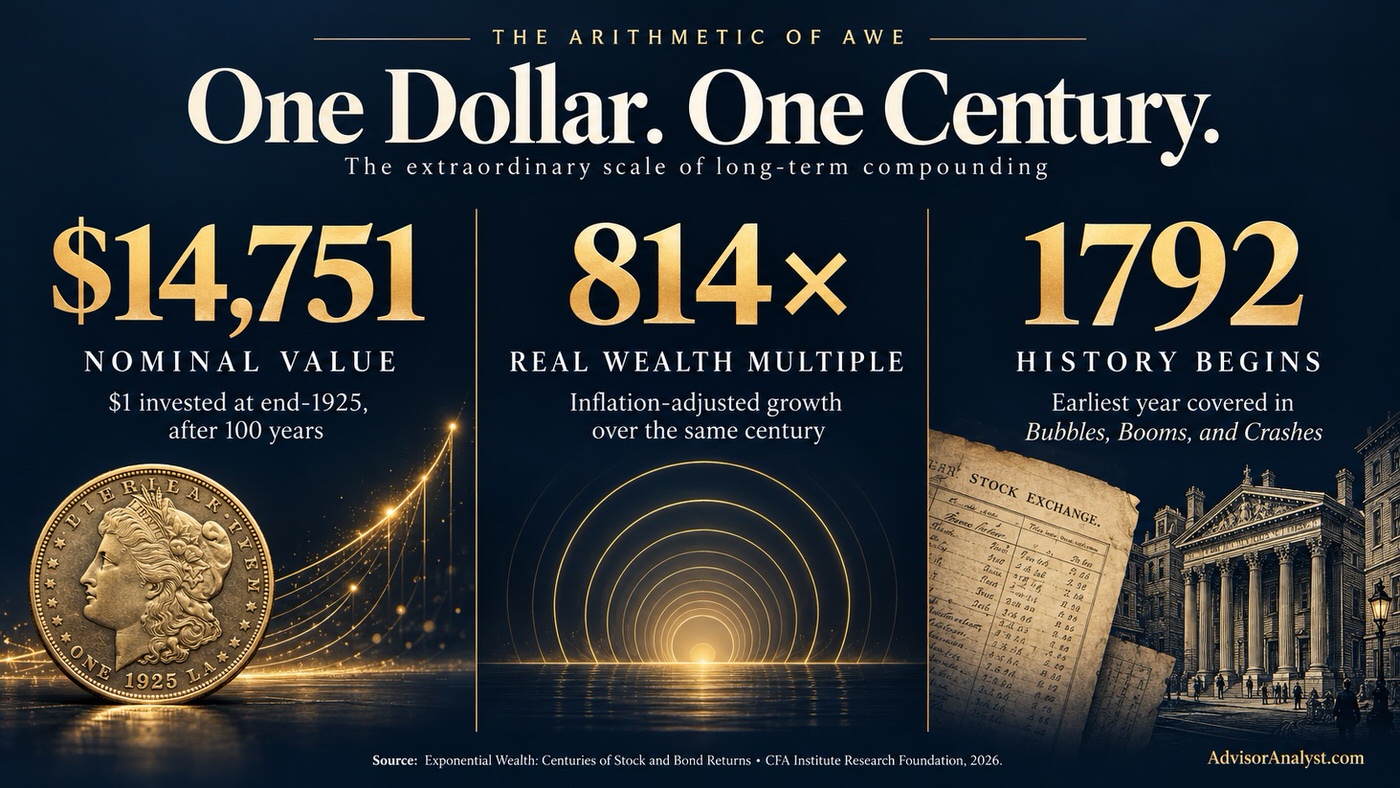
Throughout, the authors surface Bubbles, Booms, and Crashes: a chapter tracing US market dislocations from 1792 to 2024, read together with the efficient market hypothesis (Fama) and its limits. History here is not merely illustrative — it is the data generating process that any forecast must account for.
5 Key Takeaways for Advisors and Investors
- Compounding is the argument. A century of equity data confirms that time, not market timing, is the primary driver of wealth accumulation. The nominal 14,751-to-1 gain — 814-to-1 in real terms — is an empirical anchor for every long-term client conversation.
- Total return indices are non-negotiable benchmarks. Price-only returns dramatically understate long-run performance. Advisors comparing client outcomes to the right benchmark must use total return series, including reinvested dividends, not price appreciation alone.
- Procyclicality is the enemy. Investors systematically under-invest at lows and over-invest at highs. Behavioral coaching — keeping clients invested through drawdowns — may add more value than any tactical allocation shift.
- Global diversification rests on evidence, not theory. Two centuries of UK, Japanese, Chinese, and commodity futures data provide non-US validation of equity risk premiums. The premium is not a US artifact; it is a characteristic of risky productive capital across economies.
- Popularity and premiums offer a forward framework. Asset prices reflect not just cash flows and risk, but investor sentiment. Ibbotson's Popularity model suggests that out-of-favor asset classes command higher expected returns — a signal advisors can incorporate without abandoning evidence-based discipline.
Ibbotson's monograph arrives at a moment when the foundations of long-run return forecasting are being actively contested. Equity risk premiums are debated. Bond yields have reset. AI's productivity effects are uncertain. Against that backdrop, Exponential Wealth performs a service that is easy to underestimate: it places the current moment inside a longer frame, with data precise enough to be genuinely useful. As Ibbotson puts it, the lesson of compounding "astounded investors" in 1976. This book exists to ensure that fifty years on, it still does.
Footnote:
1 Ibbotson, Roger G. Exponential Wealth: Centuries of Stock and Bond Returns. Executive Editor: Laurence B. Siegel. CFA Institute Research Foundation, 2026. https://rpc.cfainstitute.org/sites/default/files/docs/research-reports/rf_ibbotson_2026_exponentialwealth_monograph_online.pdf