




by Russ Koesterich, CFA, JD, Portfolio Manager, BlackRock
Summary
In this article, Russ Koesterich explains how strong fundamentals have supported stocks, but rising bond yields may soon begin to challenge market valuations.
Key takeaways
- The stock market has remained resilient despite higher yields, supported by strong economic growth and robust corporate earnings. However, bond yields have risen significantly from their June lows, and the market may be nearing a point where rates become too high for investors to ignore.
- Historically, stocks struggle when yields become unusually elevated. More specifically, Russ points out that when yields have risen more than two standard deviations above their 3-year average, S&P 500 returns have often turned negative. Current yields are not far from this threshold.
- Higher yields typically reduce equity valuations by increasing discount rates and providing a more attractive alternative to stocks. So far, strong earnings growth, particularly among technology companies, has helped offset this pressure. That said, it remains to be seen whether strong earnings will be enough to prevent a market pullback.
Stock market resilience has been well documented. Despite repeated oil spikes and growing AI anxiety, the S&P 500 recently hit an all-time high. Investors have looked past the headwinds and instead focused on a stable economy and stellar earnings. But in doing so they have also had to overlook one other issue: interest rates.
Yields have risen sharply from the June lows; 30-year rates recently hit a 19-year high. As higher rates both raise the discount rate on future earnings, thereby lowering the present value of those earnings, as well as provide competition for stocks, higher rates should generally be associated with lower equity returns.
Historically, that holds up with an important caveat. Investors generally look past small moves in rates, particularly when the economy and earnings are strong. However, larger moves have proved harder to ignore, as was the case in 2022 and Q3 of 2023. Thus far, rates have been mostly contained, allowing earnings to drive stocks higher. That said we are on the cusp of a rate move large enough to dislodge stocks.
High but in range
Presently U.S. 10-year yields are roughly 0.40% percentage points above the spring lows. The move has been driven by a rise in real or inflation-adjusted interest rates. The rise in U.S. yields follows a broader pattern of rising global yields, driven higher by surging oil and supply pressure. Yields on government bonds, including in the United States, are now at the upper end of their 10-year range (see Chart 1).
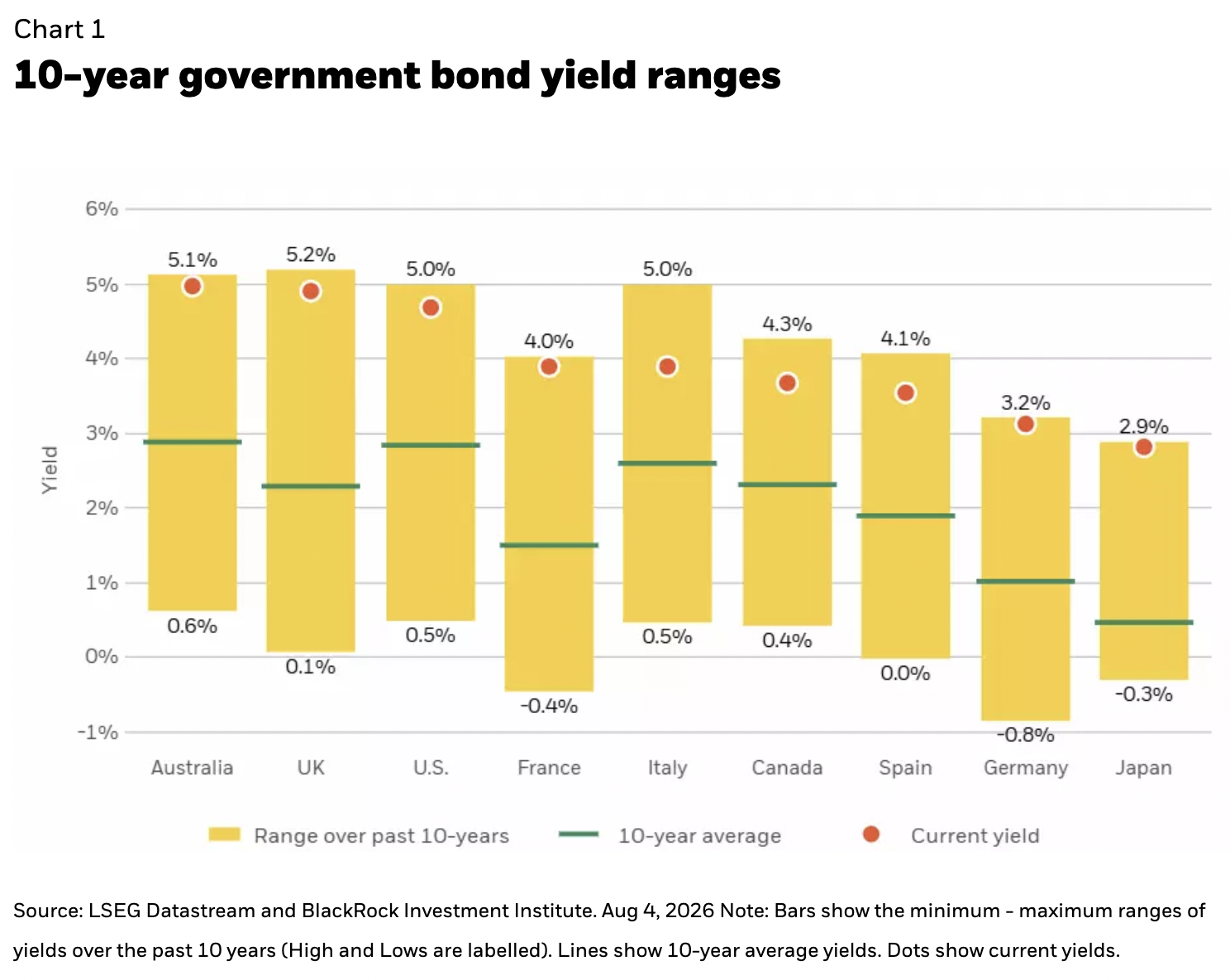 In the past, the relationship between stocks and bonds depended on where yields were in relation to recent history. Looking back on over 60 years of data, how far above or below bond yields are from their 3-year average has been a reliable determinant of equity returns. When yields are more than 2 standard deviations (a measure of volatility) below average, monthly price returns have averaged slightly less than 2%. When yields are close to average, monthly stock returns are also close to normal, at around 1%. Stocks generally start to get hurt when yields are 2 standard deviations or more above average. In those instances, monthly price returns for the S&P 500 average around -1.70%.
Today we’re not far from those levels. During the past 3 years, U.S. 10-year yields have averaged roughly 4.3%. Should yields climb above 4.8%, around the early August peak, that would put rates at the threshold that has typically been associated with negative stock returns.
None of which suggests a mechanical relationship between interest rates and stock returns. While yields are higher, surging earnings have left the stock market, and technology companies in particular, cheaper than they were at the start of the year. But while the market has thus far been able to ignore rising rates, we’re not far from the point where they have generally started to bite.