



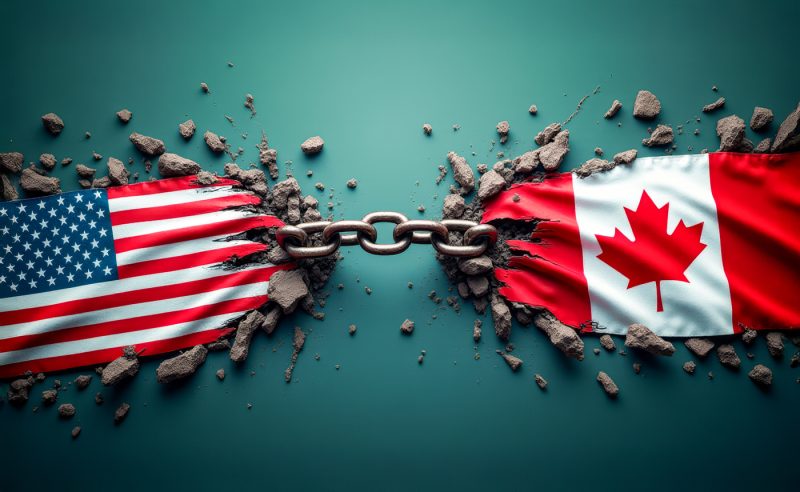

In a recent episode of The Open Outcry Podcast, BMO Global Asset Management's Bipan Rai sits down with Jason Daw, rates strategist at RBC Capital Markets, to take stock of where Canada stands after the latest escalation in the trade war with the United States. Recorded September 1, 2026, the conversation spans the resilience of the Canadian economy, the Bank of Canada's constrained path forward, the Federal Reserve's shifting posture under Chair Kevin Warsh, and the growing pressure on long-end yields across developed markets.
The backdrop is sobering. Canada has walked away from trade negotiations with the United States. The Section 338 tariffs, first threatened over a month prior, are now in force on $20 billion worth of Canadian exports. Auto tariffs threaten to reach 50% by January 1, 2027. Canada's retaliatory dollar-for-dollar measures are set to begin September 8. And in an odd rhetorical flourish, the U.S. has unilaterally renamed Lake Ontario to Lake America. The provocation barely moved markets. That detail alone tells a story.
Resilient, But Not Bulletproof
Against that charged backdrop, Daw's opening assessment is measured and data-grounded. "I think the Canadian economy has been very resilient," he says. "It's been hit by two different shocks. The first one being the population shock. And that's where growth went from 3% in population to 0%. That's arguably been the most important one. The trade shock has been very secondary."
The trade data supports his view. Canada's trade balance today is higher than it was in 2023 and 2024. Total export volumes exceed Liberation Day levels. Aluminum exports are running above pre-tariff baselines. The auto sector, deeply integrated with U.S. supply chains, has held roughly steady. Only steel has clearly suffered, where U.S. domestic capacity gives American producers a genuine structural edge.
Employment in trade-exposed sectors has been stagnant but not collapsing. "When you look at how employment has behaved in trade-related sectors, it's been stagnant, but there's been no layoffs," Daw says. That absence of layoffs is doing significant economic work. Canada's households are heavily leveraged, a point Rai underscores pointedly. If job losses were to materialize at scale, the deleveraging pressure on an indebted consumer base could be severe. For now, that scenario remains hypothetical. Canadians, not particularly worried about their jobs, continue to spend at a rate consistent with nominal income growth net of inflation. "If people aren't worried about losing their job, then they can kind of consume at the normal rate of nominal income growth minus inflation," Daw explains.
Aluminum, Autos, and Asymmetric Leverage
The sector-by-sector picture is nuanced. On aluminum, Canada holds the upper hand. The U.S. has not built new smelting capacity in decades, and Canadian aluminum has few global substitutes. Industry complaints from American businesses about aluminum tariffs have been vocal. On autos, the picture is more complex but still reasonably stable. The Canada-U.S. auto supply chain is deeply symbiotic, with semi-finished vehicles and components crossing the border repeatedly before final assembly. "All the car plants in Michigan, they rely on the Canadian car plants in Canada, and it's a very symbiotic relationship," Daw notes. A unilateral decoupling is not achievable in the short run, which provides a natural floor.
Fiscal Space as Strategic Patience
One underappreciated element of Canada's negotiating posture is its fiscal capacity. Daw frames Prime Minister Carney's willingness to walk away from a bad deal as partly a function of balance sheet. Canada's projected deficit sits at approximately 2.5% of GDP, modest by any contemporary standard, and potentially better given commodity royalties. "Could that be bumped up to 3.5%, an extra percentage point of GDP over a 12 to 18 month horizon? You know, for sure there is that fiscal space," Daw says.
Critically, Canada can deploy that fiscal response quickly. A majority federal government, unlike the U.S. Congress, does not need months of negotiation to authorize spending. Contingent measures, such as business loans and extended employment benefits, are already in place. The strategic logic is to wait out the Trump administration and position for a more normalized trade relationship under a future government. "With a stroke of a pen, the federal government can deploy as much or as little fiscal policy as needed to solve the problem," Daw says. As for longer-term normalization, he is cautiously optimistic. "We're probably somewhere in the middle, but I think we're closer to the starting point pre-Liberation Day than where we are now."
The Bank of Canada: Constrained but Not Dovish
On Bank of Canada policy, the episode cuts against the grain of what OIS markets are pricing. With just over 50% odds of a hike priced by year-end, Rai and Daw both find that rich. The Bank's September decision, a non-forecasting round with no MPR, will likely produce nothing other than a slightly more dovish tone given fresh trade uncertainty.
RBC's base case calls for the first rate hike in Q1 2027 and approximately 100 basis points of cumulative tightening from the lower bound of neutral to the upper bound. But Daw is explicit about the conditions that need to be met. "We need above-trend growth. That's the first condition. The second condition is that there needs to be evidence that this above-trend growth is sustainable." The Bank's reaction function, unlike the Fed's, runs primarily through growth rather than inflation. Canada's prolonged trade war constrains the output gap and, in turn, dampens the inflation risk that might otherwise force the Bank's hand sooner.
The Fed: Warsh Talks Tough, Data Decides
Turning to the Federal Reserve, Rai's pre-conversation roundup from Jackson Hole is essential context. Chair Kevin Warsh, in what Daw's team described as sounding "more like a normie Fed speaker," offered hawkish breadcrumbs while stopping short of commitment. He reaffirmed the 2% PCE inflation target. He reframed maximum employment as a responsibility not in conflict with price stability. But his phrase "financial conditions are not likely restrictive" stopped deliberately short of specifically characterizing monetary policy, a nuance Daw reads as meaningful given the speech was a prepared statement, not an open Q&A.
RBC is not calling for a September hike. "I would put it under 50/50, at least right now sitting here today," Daw says. The vote at the July meeting was 9-3 to hold, and recent data on inflation, labor markets, and retail sales has come in soft. "If inflation comes in hot, the Fed will be hiking with or without Warsh. And if inflation is moderating, the Fed will be on hold with or without Warsh." The next CPI print on September 11 will provide the first real signal.
Long-End Yields: Fundamentals Win
The final thread concerns the long end of sovereign curves, under pressure globally from supply, deficit concerns, and corporate issuance. Treasury Secretary Bessent's buyback announcement provided only a short-lived yield decline. "The decline in yields was fairly temporary. It's back to realigning with the other fundamentals," Daw observes, pointing to Japan's failed yield curve control as an instructive historical parallel. If the buyback program comes in at $4 to $5 billion, markets will likely be unimpressed. Meaningful impact may require $10 billion or more, or the next quarterly refunding announcement in November. At 3% real yields on the 30-year, Daw concedes that level is "a bit punchy," adding that "it might be worth taking the other side of that."
Key Takeaways for Advisors and Investors
1. Canada's economic resilience is real but fragile. The economy has absorbed tariff shocks better than feared, but the critical risk factor remains the labor market. Layoffs in trade-exposed sectors could trigger a household deleveraging episode given elevated consumer debt.
2. Fiscal policy is Canada's most underappreciated buffer. With a deficit of only 2.5% of GDP and a majority government that can deploy stimulus quickly, Ottawa has more room to maneuver than markets appear to price. This fiscal capacity underpins Canada's willingness to hold firm in trade negotiations.
3. The Bank of Canada's path is data-conditional, not imminent. Above-trend growth, sustained over multiple quarters, is the threshold for tightening. Advisors should not treat OIS-implied year-end hike odds as a base case.
4. The Fed's next move is an inflation story, not a Warsh story. Regardless of the Chair's communication style, the FOMC's decision at September and beyond will be driven by CPI prints, not rhetoric. September 11 data is the key near-term event risk.
5. Long-end sovereign yields reflect structural forces that policy cannot easily override. Rising term premiums, deficit financing needs, and corporate duration issuance are secular dynamics. Interventionist measures like buybacks offer at best temporary relief. At 3% real yields, selective long-duration positioning merits consideration as an asymmetric opportunity.
Editorial Team, AdvisorAnalyst.com
Footnote:
Rai, Bipan (host) and Jason Daw (guest). "Canada's Tariff Stress Test." The Open Outcry Podcast, episode 44, BMO Global Asset Management, 1 Sept. 2026, bmoetfs.ca/articles/the-open-outcry-podcast-canadas-tariff-stress-test-september-1-2026.