



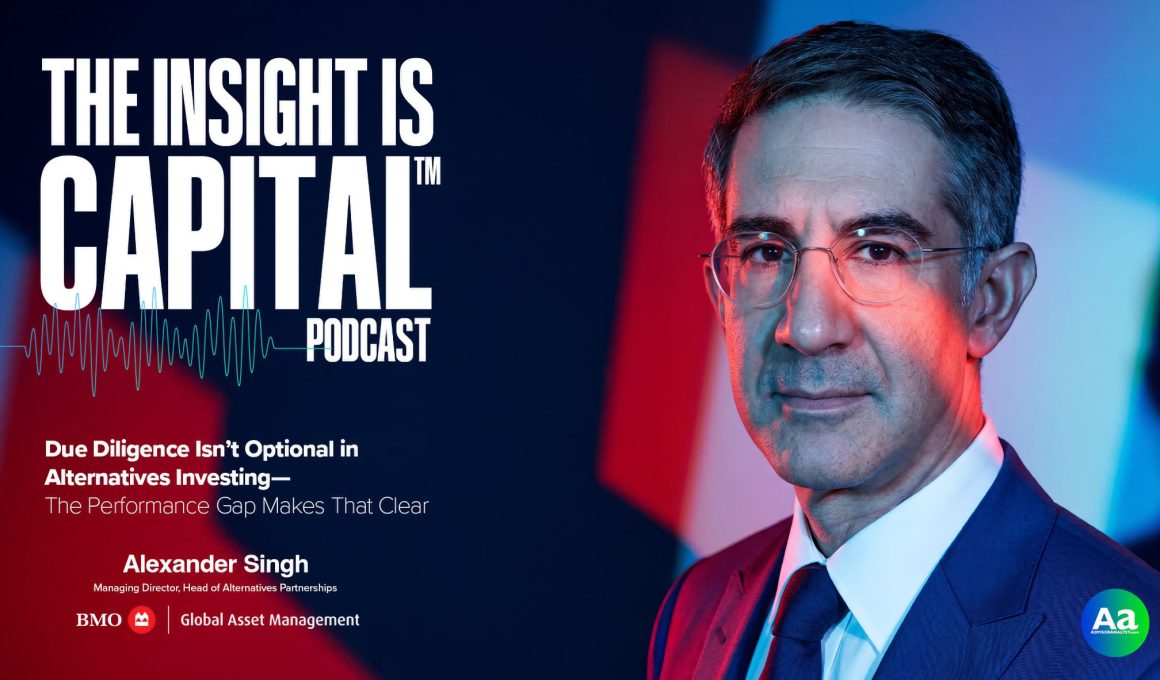
Due Diligence Isn’t Optional in Alternatives Investing—The Performance Gap Makes That Clear, with Alex Singh, BMO GAM
Pierre Daillie: [00:00:00] Half of Canadian financial advisors are now actively offering alternative investments to their clients. That sounds like progress, and in many ways it is. But here’s the uncomfortable question. Underneath that statistic, are advisors actually reducing risk or are they adding a more sophisticated looking version of the same concentrated exposures they were trying to escape?
Because access to alternatives and genuine diversification are not the same thing. The 60 40 portfolio has been the backbone of wealth management for a generation, stocks for growth, bonds for ballast, except since 2022, stocks and bonds have been moving together more than they moved apart. The correlation that 60 40 was built to avoid has started showing up inside the 60 40 itself.
And here’s the number that should stop every advisor in their tracks. The performance gap between a top quartile alternatives [00:01:00] manager and a bottom quartile one can exceed 30 percentage points in private markets and alternatives. Manager selection isn’t just important. It’s everything. So why are so few advisors and investors treating it that way?
I’m Pierre Daillie, and this is Insight Is Capital. My very special guest today is Alex Singh, Managing Director and Head of Alternatives Partnerships at BMO Global Asset Management. Alex leads the investment strategy, side manager research, due diligence, and making sure everything on the BMO Alternative Suite platform continues to earn its place.
Along with the team, they also bring the advisor facing lens, translating that rigor into clarity that investment advisors and counselors can actually use with clients. That’s what we’re gonna get into today.
Announcement: This is Insight is Capital. Join us in our fireside chats with some of the most fascinating people in finance to discuss their insights on [00:02:00] life markets, macro investment strategy, and much more.
Pierre Daillie: Alex, welcome. It is terrific to have you here for this conversation today.
Alex Singh: Thanks for having me here.
Pierre Daillie: Thanks so much for joining us.
Alex Singh: Pleasure to be here.
Pierre Daillie: So Alex, I think before we get started, I think it would be great if you could tell us a little bit about the arc of your career, how you got started in the industry and the business and what you’re working on these days.
Alex Singh: Sure. Happy to do it. so I started my career, as a lawyer. I was, in private practice at a large firm, then made my way into a hedge fund where I was the general counsel and experienced alternative asset management inside, a growing firm, that was primarily backed by institutional global investors.
And we were investing in Canada, on a number of hedge fund strategies on their behalfs, both in the public and private markets. then had the opportunity to, [00:03:00] help. A couple of families build their alternatives, exposure, in merchant banking settings. and so that was both investments, as well as building strategies and building products for investors, working both with family offices and institutions.
and then, had the opportunity about four and a half years ago to come to BMO Global Asset Management to build the alternatives for private wealth business, which we’ve been doing over the past, over that period. which has been amazing. It’s, been, a, progress to be able to bring to the private wealth investor high quality institutional alternatives.
that, that should in principle, do many of the things that you suggested at the beginning. With the backdrop of, that 60 40 correlation that you mentioned, and, unpacking some of those, points you made about risk. and, what, what does, what do [00:04:00] alternatives do for the private wealth investor and how do they do it?
And yeah, we’ve been really happy with the progress that we’ve made so far. it’s become a large business for us. investors like it, yeah. And, happily things are going in the right direction.
Pierre Daillie: It must be really amazing to be at the forefront, especially in the last five years, where suddenly you’re able to start making alternatives available to retail wealth, as opposed to having, being purely available only to large institutions and very large investors.
so thank you for sharing that. For Alex, for those of our listeners who are meeting you for the first time, help us understand how the platform operates. What are the key functions of the team and how do they connect through the process?
Alex Singh: Yeah, so I think you, you keyed on to something important there in terms of providing access to the [00:05:00] private wealth investor, in, a way that helps them both get access, but get access in the right way. And, and achieves the objectives broadly across alternatives, of, diversifying risk and generating income. and, re really permitting folks to, to remove that correlation while giving them, enhanced performance in some of the strategies as well. So those are three primary objectives for us. we designed the, platform in a way that. Effectively allows us to do the diligence on the managers to curate, the, landscape, which is, broad and wide and you mentioned a stat earlier about the dispersion, the manager dispersion performance dispersion between top and bottom managers, which is a really important statistic to, to keep aware of, and, to really cut [00:06:00] through what is, a very large. Investment research and diligence function to understand how a manager works, why they work, and then that, to bring that to bear for the investor in a format that is easy for them to use.
So we call that investor friendly. And so we, we view our role as doing those two primary things. One is to find the right content. And then two, to put it in the right package so that it can be easily consumed by the investor. with your point in mind, which is, shouldn’t all investors have access to alternatives to do exactly those things, to enhance performance, to diversify returns, to diversify risk, and to provide alternate sources of income. and, I’m sure we’ll talk later about the, public markets backdrop as well as the, the fixed income backdrop that you mentioned and, the why. but those are fundamental to, to, also why we built [00:07:00] the business in this way. And so on the investment side of things, I’ll separate our business into sort of the investment side and the sales distribution side on the investment side.
We start at the top of the funnel, which is, what do clients need, and why do they need it? And, what do they have access to? and then we, design a strategy, with those advisors in mind, through conversations with them. We engage with them quite actively. and, then we go through who are the providers of that content.
There are lots of global players, there are lots of global players who’ve been doing this for a long time. What’s most appropriate for this investor at this stage in their journey? So if you think about, you could have a very broad private equity strategy that has access to, multiple strategies, multiple managers, multiple vintages, meaning what, at, what age was the, investment made?
Was it 10 years [00:08:00] ago? Was it one year ago? Is it geographically diversified? So you have that on one, one end of the spectrum. On the other end of the spectrum, you say, I’ve got a Canadian private equity manager who invests in the lower middle market. And so what’s the right strategy for the private wealth investor in this space and, that takes us down the funnel from you.
Strategy of what should they have access to, who provides it. And then we ultimately, diligence a number of those managers as we go down the funnel to say, we think this is the right strategy for them. We think this manager has the repeatability, the consistency, the track record, but also the desire to support what we believe is a perpetual business.
And that’s the investment side that brings us down to ultimately a product. an investment product that, that, as I mentioned, is a perpetual one. and that’s, that, that marries back to my earlier point about the structure. [00:09:00] So we’ve gone through the investment side and the structure side is how do we deliver this in a format that private wealth investors can consume this easily.
How do they buy it frequently? How do they have the ability to rebalance out of it, or redeem out of it? Should they so choose? How do they use it across all of their account types, whether they’re non-registered or registered? and alongside that investment process, we have a sales and distribution function, which, is focused on education, working with the advisors to, to make sure they understand the why and then, and ultimately the how. and then that sales and distribution team compliments our, traditional, wholesaler and traditional sales team, which is, high touch with the, with the advisors. And, that sale and distribution team is there for the whole journey as well because they, they do the investor service, they report, they communicate, right?
they [00:10:00] help people continue to understand the why and the how on an ongoing basis. And so those are the two kind of main pillars of how we execute on this business.
Pierre Daillie: I can’t help thinking that. How important, how equally important both aspects are to the whole process when you consider that, number one, it’s a long, it’s a, at the outset anyways, for an advisor that’s just becoming introduced to alternatives, they need to learn and understand what those alternatives are, what role they play in a portfolio, what they actually do in terms of.
Being uncorrelated? Are they diversifier? Is there return enhancement? Is it a, is it, a, risk redu risk re, reduction in risk? and then when you, consider, some of the complexity that comes with either private assets or alternatives like [00:11:00] infrastructure, there’s a lot of myths and preconceptions that need to be dispelled. but there’s a lot of communication, ongoing communication that’s required in order to keep the advisor informed so that the advisor can keep their client informed on an ongoing basis as to what’s going on, what’s affecting the market, what’s either way, whether it’s very positive or, sometimes negative.
Sure. and the timeframes. And to remind, and to remind the investor. that some of those assets are illiquid, some of those assets have different, timeframes associated with them. They’re either very long term or they’re mid medium to long term. so that the investor, ultimately the end investor can stick with their plan.
Alex Singh: Yeah.
Pierre Daillie: And not be. Thrown off side when the market is under pressure.
Alex Singh: Yeah, I, think that’s right. it’s, it, was a deliberate [00:12:00] choice to make sure that, we’re getting the investment side of things. composed with the people who have done, institutional, diligence and institutional, investment management for a long time.
So that, that was deliberate. And it was also very deliberate to have experts on the distribution side, to support that journey. ’cause we, we, absolutely agree that is required and I think, A lot of, folks talk about how education is the important part and, sometimes you get questions about whether the education phase is over.
by no means is it over. there’s a lot of education to happen. and I think that’s gonna be ongoing for a very long period of time. and, that’s not to say that, it can’t, we’re not gonna get to a point where people really get that sophistication.
But it, is complicated. and not everybody grew up with these strategies in their, practices. And [00:13:00] it’s an important, it’s a really important part of this, and I think as you, mentioned, as public markets and, other investment tools, change, The requirements for what you might need out of alternatives also changes. and you mentioned the backdrop of, higher correlated markets. some of the stats that we’d like to remind folks of is that, we think 80% of the investible landscape, which is companies with over a hundred million in, in, in annual revenue, is in the private markets,
Pierre Daillie: right?
Alex Singh: And so in, in a lot of respects, if investors aren’t accessing the private markets, we think they’re missing. On a really big part of the investible economy, and then in a market like we have had for the last number of years, and you have a very high concentration of the market, or at least the index part of the market.
In a few number of tech names,
Pierre Daillie: [00:14:00] right?
Alex Singh: And so your exposure to the market, depending on how it’s constructed, could be overly concentrated in, in a few names. and then lastly, what we’ve seen over the, the last number of years is that the public markets, for new companies going public are, increasingly, less profitable.
So we, so you think about, comparison to the nineties where about 80% of companies were profitable, that went public. in, in the last few years, that number is closer to 30, 35% of those companies that are profitable when they go public. And so not only are the private companies not going public that are at, what we consider to be investible size over a hundred million in revenue.
But in addition, the ones that are going public. Are not in that same category of profitability. So what does the investor want? What should the investor want? especially outta public versus outta privates. And so, that is then you juxtapose that with, [00:15:00] a, lot of robust data that has gone behind, the, thesis that, if you add diversified private markets to a 60 40 portfolio.
You’re enhancing return and lowering risk, and the data’s quite clear on that. And we, start with that premise. we talk to people a lot about, how the institutions and the pension funds, including our Canadian pension funds, who are very significant allocators to, to privates and alternatives.
why? why, are you, why are they in those strategies and how do they use them and what does that do for them? and, that education continues. and, then of course we, marry that with the disciplined investment approach.
Pierre Daillie: It is remarkable when you realize that 80 to 90% of companies with [00:16:00] revenue over a hundred million dollars are private.
But it’s even more, I think. And so, that investible universe, that addressable market of private companies, first of all is astonishing. When you, so as an investor, why wouldn’t you want to have access or take advantage of the opportunities that are available in that space? when you add to that, the fact that there’s a shrinking number of these companies going public.
And there’s an even greater proportion of companies that will never go public. they might just change hands at some point in the future. from one private owner to another.
Alex Singh: Correct.
Pierre Daillie: that’s also remarkable to be able to participate in those opportunities, those kinds of opportunities at that ownership level, at that layer.
and then the third thing is, if [00:17:00] ultimately you’re in the market. In the private side of the market where you do get to own or take ownership or participate in ownership of companies, the ideal place is to be, if they happen to go public, is to be the private owner, the participant of private ownership, long or well before it goes public.
Because the record of participating in IPO. Pricing is abysmal first of all, because usually when companies go public, and I think to your point about the profitability as well, when companies go public, they do so at almost full valuation. It’s exciting, sure. But it’s not very rewarding to be on the other end of that transaction when a company goes public.
But it is very exciting to be. On that J curve of ownership, where a company is coming into its own [00:18:00] maturing, growing, scaling, being, being run by a by, by a private management group. And so that, that really goes to the heart of why there’s such a great dispersion between top quartile managers and bottom quartile managers.
The whole thing depends on the management teams that are overseeing the private ownership. So what is it that should give our audience the most confidence about your due diligence process, in, in such a crowded global field? What is it that tends to separate the managers that make it onto your list?
and those that don’t?
Alex Singh: I think you’re, I think you’re right that, there are, there’s a wide dispersion between, top performing and bottom performing private equity managers. Let’s [00:19:00] focus on that for the moment. it’s roughly the same, with phenomenon in, in, in other private markets, asset classes, happens to be that the dispersion is actually widest in private equity versus credit and infrastructure and real estate.
but let’s talk about equity for a moment.
Pierre Daillie: Alex, it’s, it is the classic problem even with all active managers, whether they’re fund managers or private equity or alternatives, that there is dispersion.
Alex Singh: you’re absolutely
Pierre Daillie: right, because of the quality of the work that they do.
Alex Singh: Correct.
you’re right. the dispersion in privates are wider
Pierre Daillie: right
Alex Singh: than they are in publics. and, so it’s, really about. active management in private equity ownership, and so you, that, that, dispersion plays out because of that active management and, me meaning what does the private equity owner or partial owner of the [00:20:00] business do to grow and improve that company over time?
what bench strength do they bring to that company to, to help it with those improvements? some of those will be management changes. Some of them will be operational changes. but the scope of what those changes are is very wide. you can’t do that same level of change. As a public investment manager, right?
The management of the public company is really up to the public company. Shareholders have a say in that, but they’re not sitting alongside ownership at the table making joint decisions together. and so that active management in privates, is really important. but also finding the right manager or managers that, obviously take you away from the lower end of the, dispersion spectrum and, into the higher end of it, is, really important.
Part of the function that we serve, is to do that diligence is, to figure out who [00:21:00] the managers are that have consistency, that have repeatability, that have, a long track record of the people and the process and the governance to be able to do that, not just for the last 10 years or 15 years or whatever the time period is, but for the next, because as I mentioned at the beginning, a design principle is that these are perpetual, we’re looking to give people a solution that works, not that works this year. And so, that filters into our design. so what we’ve done, in private equity as an example, is to give investors a diversified strategy. It is diversified across multiple vectors. It’s diversified across managers, across sectors, across geographies, and across vintages.
All of those. Elements or vectors are really important to give investors a de-risked private equity exposure, [00:22:00] so it’s not betting on a single manager to provide that performance. It’s betting on multiple managers that all have long track records in the space, right? To be able to do that, and it’s the same across all of those vectors.
The being diversified across those vectors allows us to do a couple of things. One is to reduce the impact of a single bad situation on a portfolio. Of course, that also mutes the impact of a single star performer in a portfolio, but we think that balance is appropriate. But importantly with things like vintage diversification and sector and geography, is you don’t go too far down any single one of those so that your risk gets heightened.
we’re reading in the papers today. in the last month or two about software and over exposure to software,
Pierre Daillie: right?
Alex Singh: So in a diversified portfolio, you would limit exposure to that sector [00:23:00] to a certain percentage, whether it’s 10 or 15 or 20%, but you would, you’d put a limit on that so that you don’t get an entire fund or strategy that gets pulled away from what it’s intended to do by a sector where there’s sectoral.
Problems or constraints or limitations, that. Really inadvertently drag a portfolio away from what it should be doing. And so when we design a diversified portfolio, we seek to achieve that goal. And so ultimately we work with, a manager that has access to a wide variety. Of those private equity underlying companies and underlying strategies.
that’s how we, that’s how we deploy in, in, in private equity. it’s, really how we deploy and have, how we’ve built our strategies across all of the alternatives. and, if I step back, the reason why we’ve done that this way is because we’ve launched a big strategy for each of the alternative asset [00:24:00] classes.
And so we can give investors. A private equity solution because it’s diversified and a hedge fund solution because it’s diversified. And for investors at the beginning of their, alternatives journey, they have one solution that comes about because of that. and that’s really powerful for them because it reduces, some of the risks we’ve been talking about.
So we talked about manager dispersion, so that’s a risk, right? Manager selection is the greatest risk in. private markets, right? Getting the manager right. The second greatest risk is vintage. So did I buy the right strategy in the right year? And so when we deliver those strategies, we seek to mitigate both of those risks.
and then the last big risk that we talk about in private markets, is illiquidity. this is a very long-term investment class. I think we have to be very clear and transparent about. The fact that [00:25:00] alternatives are long-term, and this is not a trading situation. This is long-term allocation and should be thought of that way.
we’ve made the strategies alongside our partners available in, the, with, the frequent ability to buy and rebalance or sell. However, it’s an illiquid asset class. And, so that illiquidity has to be, thought about, when both constructing the portfolio. as well as when deploying into the portfolio, we think we’ve solved some of those, difficulties as you mentioned earlier, in terms of make it people easy for people to invest all in one go.
And we make it easy for them to redeem or rebalance when they so choose. there’s obviously constraints on the, on that, return of capital. but importantly. When you think about building those large portfolios that serve as a one stop in private equity, in my prior example, that [00:26:00] vintage diversity, that manager diversity, those things really help compose the portfolio in a way that it is going to behave.
in a, in an evergreen or perpetual manner, because you’ve got old deals and new deals and you’ve got deals in the US and Canada and Europe all at the same time that don’t all do the same thing at the same time. And so you really mitigate, the impact of any one of those large, single risks.
Pierre Daillie: when you talk about vintage, really underestimated risk. Sometimes people invest in something because they’re excited about it. they’re motivated by what’s going on, what the underlying story, how, where it is on the, curve. but long term, the timing could turn out to be terrible, right?
Yeah. Depending on the year that you got into a, a deal. but being able to scale into, let’s say, the same deal [00:27:00] over a number of years. Does away, does, has the way of, a way of doing away with some of that time diversification problem.
Alex Singh: I might say it a little differently. in that it’s less about access to the same deal at different times and it’s more about getting access to, many deals at the time in which they were invested in.
Pierre Daillie: Okay.
Alex Singh: So if we think about. 10 private equity firms that are each investing in 10 deals in a given year. So we’re in 2026, they’re all doing 2026 vintage deals. And as a private wealth investor, do I only want 20, 26 deals or do I want deals from 2016 and 2036? argument is that the private wealth investors should have a much greater diversity than a single vintage.
so let’s say, [00:28:00] the family office wakes up or the private wealth investor wakes up and decides, I’m gonna invest in private equity this year. You could go all in on 2026 and, you’d have to be really sure that 2026 was a good vintage to make your private equity deals, and you don’t know yet whether it is.
Because you don’t know what’s gonna happen to 2026 in the future. you can actually look backwards and say, how, how are the 20 sixteens and the 26 20 nineteens? think about it like wine. You, can figure out whether a 2016 is drinking well or not. You can’t yet figure out if a 2026 is drinking well or not, because it hasn’t had enough time right to age to allow you to, make that, that call
Pierre Daillie: in any given year.
Alex Singh: it’s really, that, that, analogy fits. and so the argument is be more diversified than that. and there’s lots of examples of folks that have, woken up and said, this is the year in which I, [00:29:00] make private equity. And then in a couple years they say, yeah, I probably shouldn’t have put it all in this year.
Into this vintage. and so we really look at any one of our strategies to mitigate that amongst other risks.
Pierre Daillie: And you’ve designed it so that each client can scale into. Each one of your solutions?
Alex Singh: yeah, absolutely. that, on that side, on the scale side, absolutely. So we make our strategies, evergreen.
And evergreen means you can come in regularly. Sometimes it’s monthly, sometimes it’s quarterly. You can rebalance or redeem. Monthly or quarterly, depending on the situation. the market has moved towards us, those kind of standards of, monthly subscriptions and quarterly redemptions.
That’s roughly the market in North America and, Europe as well. what we wish to make it so that an investor can put in $25,000 [00:30:00] and be fully allocated. To private equity, or they could put in $250,000 or they could put in $25 million, and our strategies are built to support that range of sizes.
Pierre Daillie: What should investment advisors and counselors, know about how active the relationship remains after selection?
Alex Singh: They should be aware that we’re very active. We spend a lot of time. With our managers. we attend, at their offices on a regular basis. We attend at their annual meetings, and, due diligence.
in those settings, we. I have daily or weekly dialogue with every one of our managers with respect to what’s happening in the portfolio and how we’re reporting and what may need to change or not, or what has changed. so it’s a very active relationship, and that’s part of what makes the way we’ve designed and [00:31:00] scaled this business unique.
We have a real partnership with our managers. so this is not, a manager with a product on a shelf. there’s, there is lots of that in the Canadian marketplace and the US marketplace. and, there’s a lot of products, but that’s not what we do. What we do is we’ve created, a, handful of.
Deep relationships. And so it’s a, and it’s a real partnership and, we’re both economic partners in that. And so we’re, really, tied to each other to, to make sure that’s ongoing and we make changes. So it’s, active management. and we think that’s really important for advisors to understand how we do that.
and it’s also important for advisors to, to remain, let’s call it focused and disciplined on the why. there, there are times where, there, where there’s gonna be underperformance and folks are gonna go, why did I, [00:32:00] do this relative to public markets? And, we want folks to remain educated and remain, fully aware of the fact that this is a long-term investment and is a long-term asset class.
And the goal of it is not to, always outperform the public market. The, goal of it is to do a couple things at the same time. It’s to reduce that volatility and reduce risk while performing well. and to reduce folks exposure to single markets. obviously that argument is, easier to make when public markets are not performing, than it is when public markets are performing,
Announcement: right?
Alex Singh: And so we’re, in a, we’re in a market now where public markets have done well for the past three years, until Q1 of, 2026. our expectation is that Q1 2026 will be a good proof point, for, those, for those comparators. but yeah, [00:33:00] remaining, attuned to the, role of alternatives in one’s portfolio we think is really valuable.
and, and taking a long term view.
Pierre Daillie: Alex, when you speak with advisors today, what’s, your simplest why? what’s your simplest why? Alternatives, why now? M message.
Alex Singh: Yeah. I think we talked, we’ve touched on a few of them. Yeah. Part of it is, your exposure should be more diversified than in just Publix.
we think many alternatives can provide a lower correlation, lower volatility, and, meaning a smoother ride. And so we have some strategies that are designed for that smoother ride, meaning you’re not seeing the ups and downs every month or quarter. You’re seeing a much straighter line Exposure is really important.
So how do you get access to the [00:34:00] investible economy that we talked about? And one example that we talk about a lot is in infrastructure. So in the public markets today, it’s very hard to get access to modern infrastructure data centers. Logistics businesses, renewables at scale. we have this massive trend today globally on electrification, data consumption, need for power, our collective consumption of data.
so how does one invest in those? We think modern infrastructure, which is. almost entirely done in, in, the private markets is a way to be on trend there, to be modern with your investments and to get exposure to the fastest growing parts of the economy. so it’s about exposure. It’s about diversification, it’s about correlation.
it’s [00:35:00] about, you called fixed income a ballast at the beginning. It’s about ballasting, the portfolio for that. it’s about weathering some storms. in, in, in times of, stress or distress. and, ultimately providing a, an entire portfolio that is broader and wider and has different investment styles, with a long-term approach that, by the numbers, increases return and reduces risk.
Pierre Daillie: We talk about ballast. And when you look at a 60 40 portfolio, the proportion of risk that’s being taken by investors today. and along with that, the market concentration, all of those factors, we’re talking about 80 or 90% equity risk in a traditional 60 40 [00:36:00] portfolio. So how do when we talk about ballast and uncorrelated.
investments, what typically makes up the ballast component of a portfolio that now has alternatives in it?
Alex Singh: we think private credit is a place where you can get, a replacement for fixed income at higher yields. of course that needs to be well constructed and well managed. And, the, same principles of design that we talked about earlier apply in that space.
private infrastructure is a very interesting asset class where you can, get access to, assets or businesses that are essential to the economy that have an inflation protection built into them Because of that essentiality. so whether you’re talking about [00:37:00] traditional infrastructure of bridges and toll roads and airports or modern infrastructure like data centers that I mentioned a minute ago, those assets have become or are already essential.
And so there’s this baked in need for them. So your downside on those opportunities is really limited by virtue of their essentiality. so that’s a, that can definitely act as a ballast. and many of them, deliver income. the more modern ones can be structured in a, more tax efficient way, but generally speaking, they, help.
and, with a portfolio of hedge funds that is geared at an absolute return profile. Lower correlations, lower beta, lower drawdowns, meaning how far something pulls off. we think those are really effective strategies as a fixed income replacement. multi-strategy hedge funds especially.
and actually that’s the asset [00:38:00] class by institutions today. That’s in the highest demand. Multi-Strat hedge funds are higher than any other asset class in demand by institutions today. we, launched an absolute return multi-Strat hedge fund about a year ago, which has been very popular, for those reasons.
And it accesses, a wide group of, what we would consider to be top. Caliber hedge funds that have stood the test of time, in a, diversified way. and those strategies can, in fact we call that one the smooth ride strategy, because it really
Pierre Daillie: makes sense
Alex Singh: really. It really, it really is meant to perform that way.
and, again, we talked earlier about what’s the use of these funds, so we actually. Talk about that fund as being much more about the correlation, drawdown, and, volatility reduction than we do about the return profile, right? And so maybe I’ll tie that [00:39:00] back to your earlier point about what do investors want.
So we want investors to be thinking that it’s about those three things, and then return comes outta that. we’re still working on that. lot lots of folks are looking for performance, but we think performance is not just about returns. Performance is about all those other attributes as well.
And we and we’re, yeah, we’re, helping our, clients, with that journey
Pierre Daillie: for those investors who are actually looking to preserve multi-generational wealth. they’re not sitting there talking to their neighbors about their portfolios. They’re compar, comparing their portfolios.
that’s, the individual who these strategies were really designed for. when you’re talking, for example, to advisors, the, very large part of, the wealthy [00:40:00] class. in North America at least, is entrepreneurial. and if anyone understands the private assets class and the alternatives class, it’s the entrepreneur.
Yeah. Because they’ve been building a business of their own, whether it’s, a, startup or family enterprise, a long run family enterprise, and they understand where the pitfalls are and. Where the lending problems are and where the equity problems are, and building wealth and transferring it and, structuring it properly.
and, so they don’t have a lot of room for more. Entrepreneurial risk or more equity risk than they’ve already taken, or they’re still continuing to take. They need to have some of that offset
Alex Singh: when the markets do things like they did, as you mentioned in 2022 and since 2022 with a lot of volatility and a lot of, [00:41:00] movement off of highs, that case becomes easier.
and then I think that actually marries with your other point. And so when you think about the higher net worth client, perhaps that, that ran a business or runs a business, they’ve done well in the private markets.
Pierre Daillie: Exactly, yeah.
Alex Singh: and so they understand the private markets. And so what we’re talking to them about is diversifying.
We’re saying you have a lot of single exposure to a single company and you have had for a long time, or maybe you’ve left your company and you don’t have that anymore, but you did. so we’re, taking, all of your eggs out of one basket. and, I don’t think that would be a different approach to how the advisor is constructing their public markets portfolio or their private markets portfolio.
We’re saying, let’s do roughly the same thing. Let’s, build a diversified, balanced portfolio with exposure to the whole economy, not just a part of it. and [00:42:00] I think, but also recalling that, you can, those, that high alpha, that high, return, is really important.
So is your tech performance a high beta or, high alpha. and so I think helping people understand those distinctions and helping them understand what they want, and at the end of the day, we collaborate with the advisor to, to have them meet their client’s needs and we try to deliver them great solutions that fit in a number of circumstances.
Pierre Daillie: Walk us through the origin story of the platform. What problem were you solving? what were the non-negotiables on how you designed it and. how did that thinking shape the sequencing of the lineup?
Alex Singh: our non-negotiables are the scalability of the strategies, fair fees, [00:43:00] diversification, and reduced risk.
and as a, as design principles with those in mind. Alongside what we talked about earlier, which is delivering solutions to folks that are perpetual. So you need, resilience, you need repeatability, you need as a result of that, you need people process, and a philosophy towards investing that you believe is really ingrained in the manager.
So that, With the departure of an individual or a team, even the, investment prowess remains, right? And so that’s really important, as a design, philosophy for us. And so with a way that’s been executed [00:44:00] for us is to bring, broader strategies to market as opposed to niche year ones.
And we talked about. manager dispersion earlier and why that’s so important. And so what we’ve done is created, strategies that are, in line with that philosophy. so we have a multi private markets fund, and so that gives investors exposure to each of private equity, private credit infrastructure, real estate, and royalties in one solution.
And so it makes the manager there makes relative value calls as between those asset classes in order to deliver the desired performance. separately from that strategy, we have a private equity only fund that we talked about earlier, but again, it’s very diversified across manager, geography sector. it’s got hundreds of companies in it.
and, actually more, more than hundreds of companies, hundreds of managers in it with hundred, with each of [00:45:00] them, many companies invested. we have, a, an infrastructure strategy that is, perhaps a little more directional. it’s towards value add infrastructure, that modern infrastructure that I described earlier.
So data centers and, logistics and what we call our grandchildren’s infrastructure. versus a core strategy, which is our grandparents infrastructure. we think that’s a, an appropriate lean, in this market. the, hedge fund strategy that I described earlier, is very diversified across manager and strategy and geography and type.
So again, focus on a return profile and outcome profile, which is smooth ride. and so each of those are very purposeful, purposefully designed, to achieve those objectives that I mentioned at the earlier about resilience and repeatability. And, [00:46:00] and, and we think about private credit.
Similarly, diversification, really important. not having, single sector or single loan exposure as an example. That is, too high. so really it’s, those, and it’s, frankly, it’s not that many products. Yeah. At the end of the day, or at the end of the build of this platform, we’re not talking about more than half a dozen
Pierre Daillie: right.
Alex Singh: Products, maybe, a bit more as things as time marches on, but, we don’t think, that many are really necessary in order to achieve the desired, outcomes that, folks are looking for. and there’s lots out there.
Pierre Daillie: Yeah.
Alex Singh: So, in, in, part cutting through some of the noise there. We think is, helpful.
Pierre Daillie: And how would you describe, you said each fund has its own job, its own role in a portfolio. How would you describe, what those jobs are Like? What, is the best, what is the [00:47:00] easiest way to think about the job that each fund
Alex Singh: Yeah.
Pierre Daillie: plays.
Alex Singh: so the non-private markets fund that I described.
because it goes across each of the asset classes, plays a role for advisors that are, let’s say at the beginning of their alternatives journey. And they want a manager that is hands-on making those relative value calls as to whether the best use of the next dollar is in real estate or infrastructure.
Or private equity secondaries or private equity primaries or directs. we think that’s a all encompassing, all in one kind of really stable portion of, one’s portfolio that actually, in a diversified way acts to both reduced risk and increase return. Versus a 60 40.
And actually versus a 40 [00:48:00] 60 and versus a 2080 and an 80 20.
And,
Pierre Daillie: it’s,
a core position.
Alex Singh: It it, does, it has that effect. Yeah. On return and, risk as measured by volatility in every one of those scenarios. So it’s a, it’s a great strategy that way. private equity is a return enhancer. and, as a company, by, more risk.
Versus a more diversified strategy. But our, purpose with that is to help enhance returns. we do it through a diversified way, but it is a return enhancer private credit. perhaps, obviously as an income generator, can be, certainly a a enhanced return over fixed income.
It’s properly constructed, but we think it’s a great source of, fixed income, above public market, fixed income [00:49:00] and infrastructure I described. It’s got that inflationary protection to it while generating, high single digit returns, which we think is compelling and, properly constructed absolute return hedge funds.
it gives you that smooth ride. it, it should smooth out your public market exposure because underlying those hedge funds, of course, is public markets, public market securities, whether, equity or credit, but deliver it in a format where you’re not gonna have the volatility.
and, that’s why we, that trend that we talked about earlier about institutions going into multi-strat hedge, that’s why
Pierre Daillie: you can see where it’s very important that. There’s very, there’s a lot of clarity in understanding what each vehicle does in a portfolio, where it fits, how it fits, what the position sizing should be, and that’s where you and your team come in and can help, [00:50:00] investor, advisor, decide on what the proper weight should be, right?
for each or any one of those holdings. what do people miss when they say. Things like alternatives are I liquid? Private equity is always best returns for highest risk, or hedge funds are expensive and opaque, or infrastructure is boring.
Alex Singh: that’s a starting point. we, really, we start with education.
and so we spend a lot of time, trying to understand how people think about these asset classes. And so when, it comes to. Private companies and private investments in private companies. we talk to advisors and clients and our peers about
Announcement: what’s in your daily life,
Alex Singh: how much of your daily life is, interactions with public companies versus interactions with private companies.
And do you work in a private company? Do you work in a public company? [00:51:00] and all those things. And, your, what do your friends do? and as it turns out, Lots of folks have lots of exposure to private companies and they’re not risky.
And also, they may not be the highest returning.
So I, it’s really about, I think, moving beyond those generalizations and helping people understand that, that private company that you’ve worked for, that your friends have worked for 25 years is still a private company and it’s still doing very well, and it’s not risky. and that’s the type of investment that you can be exposed to through this market.
so it’s about, I think you’re right, myth-busting. and, each one of those, examples that you gave has its own response. you, you’d not be surprised to know that, we’ve answered all of those questions before. and you [00:52:00] can answer each of them differently. So maybe I’ll give you a couple of stories that, that, I’ve interacted with over the years.
Yeah, please. That are fun. And so I remember speaking to, an advisor who, most of her clients were, elderly women whose husbands had passed away. She said, I, used to have these, couples and then my clients have aged. and, this is what’s happened. And she said, for whatever reason, a lot of my clients, they were private business owners.
And so we started talking about why, is it that even her clients that are late. elderly, should be exposed to private markets. We talked about illiquidity, we talked about long-term exposure and we centered around this topic that they actually [00:53:00] understand that private markets very well.
They understood single private markets because their, families owned a business and now they have sold that business. and diversification will help them. And if you think about. Investing in private equity or private markets today versus in the past. If we give a solution that allows people to come in regularly and rebalance regularly or exit regularly, that really helps them get exposure to a market that they understand, to give them actually the smoothness of a solution that they might want.
over a period of time, despite what age they enter into that portfolio, none of these folks were looking or needing liquidity
Pierre Daillie: right?
Alex Singh: The next day or the next month. and so it, it was really interesting to unpack that, story in the situation for even an advisor that thought, really I can’t put these folks into this asset class.
And we came outta that [00:54:00] discussion saying actually. This deserves a spot in the portfolio for all the reasons we just discussed. and, even the, grandchildren’s infrastructure versus the grandparents’ infrastructure. we came up with that line, with our investment partners, on the infrastructure side because we wanted to convey to people that, you want to invest for your grandchildren, for your children, and your grandchildren.
we know how we consume. Differently than how our parents did. And we give the example of, hey, do, we all think that data consumption is going up? And the answer is, yeah, the data’s consumption going up. And you give people the example, you pull out the photos app on your phone and you scroll down and you see where the, that the data’s going somewhere.
Coming from somewhere. You say, yeah, we clearly need to invest in this part of the economy so that we have more access. To it and it’s more powered and so that it works properly for each of us. And so we try to [00:55:00] do a bunch of storytelling around some of the myths, to, help folks with that, journey.
And we think it’s, we think it’s powerful and, it’s certainly taken a lot of reps, like at our, at each of our, dinner tables, let’s call it. but what we think that’s been productive so far and people, seem to get it better now than they ever have, which is great.
Pierre Daillie: Un unless you touch on it.
I really enjoyed your questions. do you know anybody that works at a, do you work at a private company? Do you know anybody that works? Have do you work at a publicly traded company? Things like that. I think when you put it in those terms, it becomes, it suddenly becomes more interesting because you realize it’s not actually invisible.
But if we don’t stop to take a closer look, then we don’t know, because we’re not reading about it every day. We’re not hearing about it every day. It’s not in the news. but when you can actually bring it down to, [00:56:00] to the dinner table and have, interesting conversations about, what?
Both private and public companies are doing and bring them into the light. I think that’s, that makes it re relatable and more interesting.
Alex Singh: Yeah, and I think you’re right to, to key onto the fact that we all live it every day. if you own a, home or if you are part of a family where someone owns a home, you’re a private real estate investor.
And you have a relatively illiquid asset that will take time to sell. And for many people, that’s the biggest investment that they have. And so when you think about that both as positioned in your entire portfolio and alongside your whole portfolio, I think it changes the way one thinks about liquidity.
Illiquidity, [00:57:00] what do I own? Is it risky, is it not? And so you’re right, it’s the framing of, what do I have, what do I not have? and if we’re talking about Canadians, and you own a home, you own a home in Canada, so you’re your Canada, exposure is pretty high. So what does the rest of your portfolio look like?
Is it global or is it Canadian? And I think these types of questions are interesting to have. and again, they filter into how we think about getting folks exposure to those, what we think are really attractive, parts of the investment landscape that, everyone should have access to.
Which, I think what kicked us off,
Pierre Daillie: Alex, thank you. Thank you very much for your, incredibly valuable time and your insight. it’s been, great chatting with you. Thank
Alex Singh: you. Thanks. Thanks for having me. It was a pleasure, pleasure chatting with you and it was great to, to [00:58:00] unpack, a lot of, really important topics.
Thank you.
Listen on The Move
Half of Canadian financial advisors now offer alternative investments to clients. But access and genuine diversification are not the same thing — and that distinction is the heart of this conversation.
We sit down with Alexander Singh, Managing Director and Head of Alternatives Partnerships at BMO Global Asset Management, to unpack what it actually takes to build an institutional-quality alternatives platform for private wealth investors. Singh brings a rare vantage point: former lawyer, hedge fund general counsel, merchant banker, and now the architect of one of Canada's most deliberately designed alternatives platforms in wealth management.
Our conversation covers the three defining risks in private markets — manager dispersion, vintage concentration, and illiquidity — and why the performance gap between top and bottom quartile managers can exceed 30 percentage points. Singh explains how BMO GAM's Alternatives platform was built around four non-negotiables: scalability, fair fees, diversification, and reduced risk — and why perpetual, evergreen structures change the calculus for private wealth investors entirely.
From the case for modern infrastructure (data centers, logistics, renewables) as the new portfolio ballast, to why multi-strategy funds are the most in-demand institutional asset class today—this episode is a masterclass in how to think about alternatives investing.
CHAPTERS
00:00 — The uncomfortable question behind the alternatives boom
01:48 — Alex Singh: from lawyer to hedge fund to BMO GAM
03:46 — How the BMO alternatives platform is structured
09:39 — Why advisor education in alternatives is far from over
12:31 — The 80% of the investable economy that lives in private markets
15:23 — Why the IPO market is no longer the opportunity it once was
18:20 — Manager dispersion: the defining risk of private equity
21:14 — Diversification across managers, sectors, geographies, and vintages
23:40 — The three big risks in private markets and how BMO mitigates them
26:40 — Vintage risk explained: why timing your entry matters more than you think
29:44 — Evergreen structures: investing from $25,000 to $25 million
32:43 — The simplest "why alternatives, why now" message for advisors
35:09 — What replaces bonds in a modern alternatives-inclusive portfolio
37:05 — The smooth ride strategy: absolute return multi-strat hedge funds
42:06 — The origin story and non-negotiables behind the platform design
46:21 — Each fund's job: return enhancement, income, ballast, smooth ride
49:57 — Myth busting: illiquidity, opacity, and the private markets misconceptions
54:39 — Grandparents' infrastructure vs. grandchildren's infrastructure
Key Takeaways
1. Access is not diversification. Adding alternatives to a portfolio doesn't automatically reduce risk — manager selection, vintage diversification, and structural design determine whether alternatives actually do the job they're supposed to do.
2. The performance gap is not a footnote. The spread between top and bottom quartile private markets managers can exceed 30 percentage points — making manager selection the single greatest risk in any alternatives allocation.
3. 80% of the investable economy is private. Advisors and clients who limit themselves to public markets are working with a fraction of the available opportunity set — and missing the fastest-growing parts of the economy entirely.
4. Evergreen structures change the calculus. Perpetual, open-ended alternatives vehicles allow private wealth investors to scale in regularly, rebalance, and maintain liquidity management — removing the all-or-nothing vintage timing problem that has historically kept private markets out of reach.
5. Every fund has a job. The most effective alternatives allocations are built with purpose — return enhancement, income generation, inflation protection, or volatility reduction — and confusing those roles is how portfolios end up with alternatives exposure that doesn't perform the function it was added to serve.
#AlternativeInvestments #PrivateMarkets #PrivateEquity #WealthManagement #FinancialAdvisors #PortfolioConstruction #HedgeFunds #PrivateCredit #Infrastructure #InvestmentStrategy #BMOGlobalAssetManagement #InsightIsCapital #ManagerSelection #AlternativesEducation #6040Portfolio #EverythingAlts #PrivateWealth #InvestmentDiversification #CanadianInvestors #AssetManagement