





The label "emerging markets" has served its marketing purpose for 45 years. Alex Kozhemiakin, a member of Lazard Asset Management's Emerging Markets Debt team, argues in a new research piece1 that the label has also obscured something important: the assumption embedded in it that developed markets have arrived at a stable plateau. That assumption is no longer defensible.
Assets With an Asterisk
Kozhemiakin proposes a different definition: "Emerging markets are assets tied to the economies of risky countries. They are assets with an asterisk next to them, a reminder that country risk is present." The asterisk matters because it preserves a duality the conventional label flattens. When investors hold emerging markets debt, they are holding fixed income, yes, but they are also holding exposure to country risk — sovereign credit, politics, geopolitics, and structural economic fragility. The same logic applies in equities: a large Latin American e-commerce company operates like any other online marketplace, but it carries the asterisk because it operates in Brazil, Mexico, and Argentina.
The more consequential insight is what this framing does to developed markets. The emerging-developed dichotomy, Kozhemiakin argues, "lulls investors into believing that developed countries have reached a stable plateau from which they cannot fall." Replace the binary with a continuum of country risk, and the picture changes: any country can become more or less risky over time.
Counting Country Risk
Kozhemiakin introduces a concrete, measurable proxy for country risk: the "triple-down day," a trading day on which a country's main equity index falls, its 10-year government bond yield rises, and its currency weakens against the U.S. dollar. The simultaneous decline of bonds, equities, and currency is the signature of country risk expressing itself across an entire market at once.
Counting triple-down days across OECD countries over the 20 years to 2025 produces a ranking that challenges received wisdom. The U.S., Japan, the U.K., and Germany recorded the fewest. But Italy ranks fifth, and Greece, Portugal, and Spain all recorded more triple-down days than Chile or the Czech Republic. The U.K.'s five highest annual counts all fell between 2021 and 2025, peaking in 2022 during the Liz Truss premiership. In 2022, 2024, and 2025, the U.K. recorded more triple-down days than Portugal, Spain, Korea, Hungary, or Greece averaged over the full 20 years. The developed label offered no protection.
The Iran War Test
The energy shock that followed the outbreak of the Iran war in March 2026 provides a cleaner test. Normally, more triple-down days would be expected in emerging markets than in developed ones. In March 2026, Europe's developed markets matched or exceeded them. Germany recorded the most of any country in the sample. The U.S. recorded one of the fewest. The explanation is structural: country risk is multi-faceted, and the facet that dominated in March 2026 was national energy security. Germany, highly exposed to external energy shocks, sat at the top. The U.S., nearly self-sufficient in energy, sat near the bottom. The Iran war did not create the vulnerability; it revealed it.
Developed Markets Are Converging on Emerging-Market Behavior
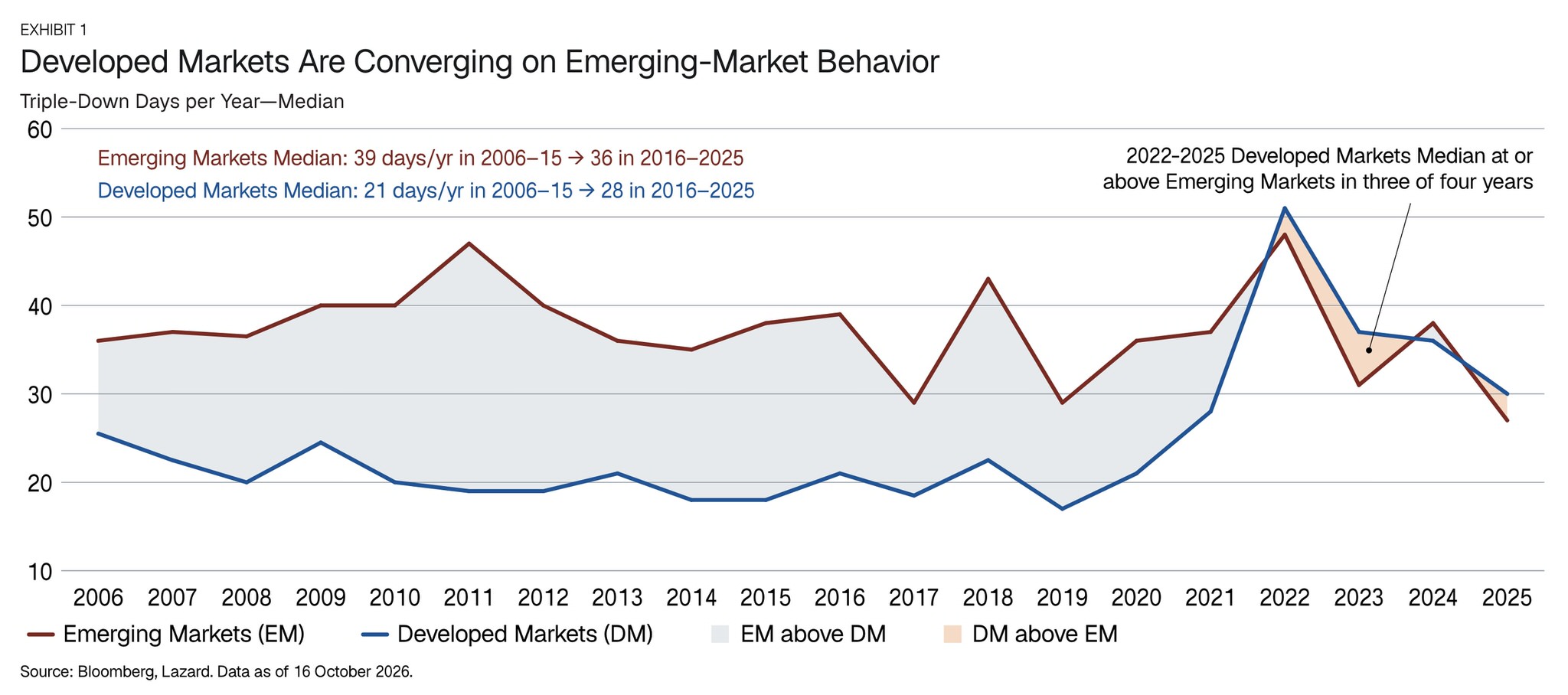
The longer-run trend is more consequential than any single episode. Triple-down days have risen in developed markets over the past decade while holding steady or falling in emerging ones. For every developed market in the sample except Italy, Spain, and Portugal, March 2026 looked more extreme relative to its 20-year average than to its 10-year average. The convergence is not coincidental: Kozhemiakin traces it to four deteriorating drivers. Sovereign debt levels in developed countries jumped during COVID-19 and have not reversed, with higher rates compounding the servicing burden. Political risk has risen as income inequality within large economies deepens and independent monitors document sustained democratic backsliding in both emerging and developed countries. Geopolitical risk has increased as a multipolar order replaces post-Cold War unipolarity, with miscalculation more likely in a fragmented world. And structural fragility is more visible than before: the 2026 energy shock, like the supply-chain disruptions of 2021 and 2022, exposed supply-side vulnerabilities that hyper-globalization had masked.
What It Means for Portfolios
The investment conclusion follows directly. "If we see country risk rising in the countries that have historically exhibited less of it," Kozhemiakin argues, "we believe there is a greater role in a portfolio for assets tied to countries that have historically exhibited more of it." For U.S. investors with a pronounced home bias, that bias has historically been rewarded. The question is whether the conditions that rewarded it still hold.
On emerging markets debt specifically, Kozhemiakin notes that EMD and EM equity are largely exposed to different countries. The main EM equity index is dominated by Taiwan, South Korea, and China, which together make up 70% of the MSCI Emerging Markets Index. An investor who holds EM equity and considers the emerging markets box ticked has diversified in name only. The J.P. Morgan EMBI Global Diversified spans roughly 70 countries with capped weights; the local-currency equivalent covers around 20, with minimal overlap with the equity heavyweights.
The term "emerging markets," Kozhemiakin concludes, asks investors to sort the world into two boxes. Country risk asks them "to measure where each country sits on a continuum and in which direction it is moving."
5 Key Takeaways for Advisors and Investors
- The developed/emerging binary is analytically obsolete. Country risk exists on a continuum. Any country can move in either direction, and several developed markets have been moving toward greater risk over the past decade.
- Triple-down days offer a measurable, cross-asset signal. When bonds, equities, and currency decline together, country risk is expressing itself. Tracking this frequency over time reveals trends that sovereign credit ratings and GDP labels obscure.
- Germany and the U.K. are not safe-harbor proxies. The Iran war and the Truss fiscal episode demonstrated that developed market status provides no immunity from acute country-risk episodes, especially where energy dependence or institutional fragility is elevated.
- EM equity and EMD address different risks. A portfolio with EM equity index exposure is primarily a bet on North Asia. Adding EMD adds genuine geographic diversification across roughly 70 sovereign issuers, most of which have no overlap with EM equity index heavyweights.
- Home bias in U.S. portfolios deserves scrutiny. The conditions that historically rewarded U.S. overweights, relative fiscal stability, geopolitical insularity, energy self-sufficiency relative to peers, are no longer as differentiated as they were. Country diversification is now a more urgent portfolio tool, not a peripheral one.
Footnote:
1 Kozhemiakin, Alex. "Country Risk on a Continuum." Beyond the Numbers, Lazard Asset Management, 11 Nov. 2026, www.lazardassetmanagement.com/us/en_us/research-insights/market-insights/beyond-the-numbers/november-11-2026.