



Something structurally unusual is happening in the global economy, and most market commentary is discussing only one corner of it at a time. Kyla Scanlon's comprehensive October 2026 essay1 names all three corners at once and, more importantly, shows how they reinforce each other. The argument deserves serious attention from anyone constructing portfolios in this environment.
The Triangle
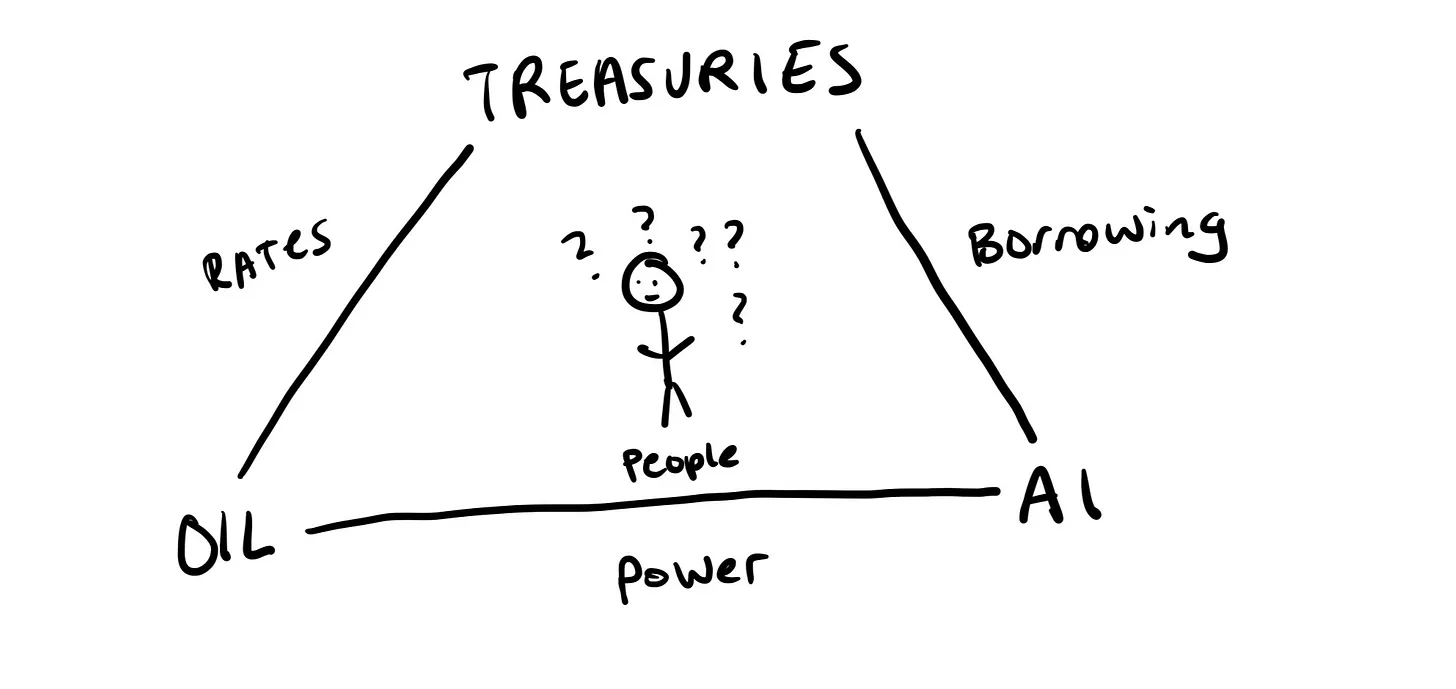
Scanlon identifies three interlocking forces: oil, artificial intelligence capital expenditure, and U.S. Treasury markets. These are not independent phenomena. They form a closed loop. War-driven energy disruption pushes inflation upward, forcing rate hikes. Higher rates drive up the government's interest bill, compelling more Treasury issuance. That issuance competes for capital at the same moment AI hyperscalers are borrowing at a scale unprecedented in peacetime. Two enormous borrowers, drawing from the same pool, keeps long-term rates elevated. And AI's enormous energy appetite circles back to the original constraint: oil.
Scanlon's term for the dynamic is "shrugflation." The mechanism that is supposed to cool an overheating economy, expensive money, simply does not reach the two biggest borrowers. "The government borrows at whatever rates are," she writes. "The AI companies feel like they have to keep borrowing in order to survive." Economist Carl Benedikt Frey, as quoted in the piece, frames the AI side plainly: "These companies are essentially in an AI arms race. If they don't invest, they are acknowledging defeat."
The Energy Constraint Is Real
The oil shock is not a temporary disruption. Since the war with Iran, shipping through the Strait of Hormuz has been throttled to roughly 80% of pre-war capacity. Diesel hit a record $6.53 per gallon in September, up 77% in a year. A logistics professional quoted by Scanlon captures the transmission mechanism: "chaos increases prices." Everything that moves by truck, rail, or ship absorbs this cost, and everything sold in a store is the sum of those movements.
This is not something the Federal Reserve can resolve with rate policy. The Fed cannot broker a peace deal at the Strait. What rate hikes accomplish here is rationing capital away from rate-sensitive sectors, primarily housing and autos, while the actual sources of inflationary pressure, oil disruption and AI buildout, remain fully operational. Torsten Slok's "Dutch disease" framing, cited approvingly by Scanlon, captures this precisely: a rate-insensitive boom draining capital, power, and labor from everything else.
The AI Debt Structure Is Fragile
The scale of AI financing is difficult to absorb. Carlyle estimates more than 80% of anticipated AI capital expenditure through 2032 requires external financing. Anthropic's IPO prospectus, as Scanlon reports, shows $4.6 billion in revenue against $12.65 billion in spending and over $500 billion in cloud and infrastructure obligations. Jefferies says it can "no longer be assumed" that the models will ever be profitable.
The risk is spreading. SpaceX is raising $40 billion in debt to buy Nvidia chips. Insurance companies and pension funds are being drawn in as buyers of AI-linked bonds. "Spreading risk doesn't make it smaller," Scanlon observes. It redistributes it toward annuities and retirements. Separately, BlackRock has noted that "heavy sovereign borrowing is increasingly competing with extraordinary private financing needs, particularly from AI, pushing prospective capital demand toward levels rarely seen outside crises."
What This Means for the Economy
The wealth effects of the AI buildout are real but narrow. Median net worth for families under 35 is down 23% since 2022. For families 75 and older it is up nearly 40%. The gap, as Scanlon frames it, is not generational but structural: owners versus non-owners. "If you rent, your median net worth is about $10,000. If you own, it's over $450,000." AI spending, concentrated in a small circle of companies, amplifies this divergence. Consumer sentiment, as measured by the University of Michigan, sits at its second-lowest reading in the survey's history. Scanlon quotes Dillard to land the point: "No people, no significance. This is all I have to tell you."
Five Key Takeaways for Advisors and Investors
- Rate sensitivity is no longer uniform. Housing and auto exposures face genuine headwinds while AI-linked capex and sovereign borrowers remain largely indifferent to rate levels. Sector positioning should reflect this asymmetry.
- Energy is the binding constraint. "The physical grid could emerge as the ultimate constraint," as Goldman Sachs is quoted observing. Infrastructure and energy-adjacent holdings merit re-evaluation.
- AI credit quality deserves scrutiny. Oracle's credit default swaps have reached record highs. The insurance and pension exposure to AI-linked debt is growing. Due diligence on fixed income portfolios should account for indirect AI credit risk.
- Concentration in equity indices is extreme. More than half of stocks in the S&P have fallen at least 20% since June even as the index holds near all-time highs. Earnings breadth is narrow. Active management and diversification across sectors are not optional in this environment.
- Consumer-facing businesses face a structural squeeze. The double compression of diesel costs and elevated borrowing rates is compressing margins and discretionary spending simultaneously. Client portfolios with heavy consumer cyclical exposure warrant reassessment.
Footnote:
1 Scanlon, Kyla. "The Shrugflation Triangle: How AI, Oil, and Treasuries are Impacting the Economy." Kyla's Newsletter, 14 Oct. 2026, https://kyla.substack.com/p/the-shrugflation-triangle-how-ai. Accessed 14 Oct. 2026.