



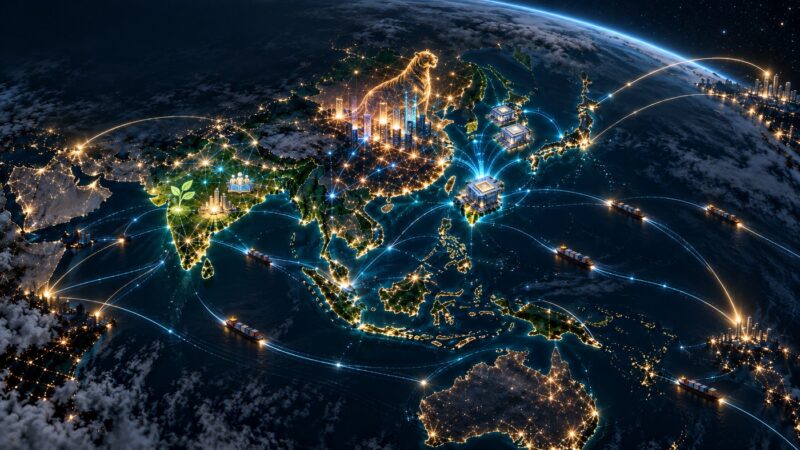

Three North Asian semiconductor companies are on track to generate a combined $965 billion in profit across 2026 and 2027. They already represent a third of the MSCI Emerging Markets Index. They drove roughly 80% of the asset class's returns since January 2026. And most advisors still frame their clients' EM allocation as a diversification tool or a catch-up growth trade. The frame has not kept pace with the asset class.
Kevin Carter, Founder and CIO of EMX ETF and creator of the EMQQ framework for digital adoption in emerging markets, joined us on Insight Is Capital to make that gap explicit and to explain where the investable value sits from here1.
The Benchmark Is Doing Its Job. That's the Problem.
Carter opens with a clarification that reframes the entire conversation. The MSCI Emerging Markets Index is functioning precisely as intended. It is market-cap-weighted, it tracks the universe it was built to track, and it is delivering return. What has changed is the underlying market.
"The problem that is in emerging markets is these state-owned enterprises, which are sometimes as much as a third of the index. These are government banks and government oil companies and government-owned airlines, for heaven's sake. These haven't grown their earnings in 20 years."
That picture has now shifted. The Mag 3, Carter's designation for TSMC, Samsung, and SK Hynix, have replaced stagnant state enterprise as the index's growth engine. At the end of Q2 2026, those three names held a combined 33% weight. "There's never been, to my knowledge, a broad index that is as concentrated as the MSCI Emerging Market Index has become."
The valuation case is striking. Collectively, the Mag 3 trade at mid-single-digit PE multiples. The forward PE on 2027 earnings for Samsung and Hynix sits around 3.5 times. "In the case of Hynix and Samsung, I believe that their forward PE, the PE on the 2027 number, I think it's like 3.5." For companies generating this volume of profit at this growth rate, that multiple does not square with bubble language.
Korea Was the 30-Point Trade. Check Your Index.
The single most actionable data point Carter raises is verifiable in minutes. Since January 2026, iShares' EM ETFs, IEMG and EEM, which track the MSCI index, returned approximately 65%. Vanguard's VWO, which tracks the FTSE Emerging Markets index, returned roughly 30%. One index includes Korea. The other does not.
"The iShares Emerging Markets ETF beat the Vanguard Emerging Markets ETF by 30 percentage points. Why? Because Vanguard uses the FTSE index. And FTSE doesn't include Korea."
The implication is not subtle. Advisors who selected the lower-cost vehicle made a basis-point decision that translated into a 30-point performance miss over 18 months. That gap traces entirely to Samsung and SK Hynix, two of the three companies now driving the asset class. Carter's observation is that most investors who held the Vanguard fund "don't even realize this."
The CapEx Flows East Before It Reaches the Model Layer
The hyperscaler CapEx cycle, now regularly discussed in terms of hundreds of billions of dollars annually, has a destination that North American equity allocations do not fully capture. Carter's argument is structural: the capital being committed to AI infrastructure by US cloud providers flows directly to Asian hardware manufacturers before it ever reaches the model or application layer.
"All that CapEx that we're worried about getting spent, it's going straight to Asian hardware makers."
TSMC is at the center of that chain. Nvidia's chips are fabricated in Taiwan. The memory inside every AI data center comes from Korea. Supply is constrained through at least next year. Carter's moat case for TSMC is blunt: "If the aliens finally decided to land and they surrounded TSMC's headquarters and they said, we're gonna blow this whole place up unless you pay us $20 trillion. Well, the countries and companies of the world would probably pay $20 trillion to keep that thing from falling into alien hands."
At the model layer, China's open-weight ecosystem has moved faster than most North American observers have registered. DeepSeek launched in January 2026 and announced its model cost $6.5 million to build, triggering a 30% single-day drop in Nvidia's share price. Moonshot's KIMI K3 launched earlier this year and matched the performance of leading US frontier models at a fraction of the per-token cost. Carter's newest strategy, the China AI Tigers ETF trading under ticker TGRZ, focuses on the six laboratory startups that Beijing has formally designated the AI Tigers, all of which trace to a single computer science program at Tsinghua University in Beijing.
Token volume data has now crossed a threshold. "As of now, the Chinese models have just passed the US models in terms of total token use. So China's now in the lead that way."
India Is Building the Use Case That Pays
India's positioning in the AI cycle is deliberately distinct from the hardware or model competition. Nandan Nilekani, chairman of Infosys and lead architect of India's digital public infrastructure, has argued publicly that the models already built are sufficient for a decade and that the real challenge is not development but deployment.
Carter summarizes the Nilekani view plainly: "The models are all going to be a commodity and we don't need to spend a trillion dollars building a model, we being India. It's not that they need to get better, it's that people have to figure out how to use them."
What that means in practice is AI applied to agricultural decision-making for India's fragmented smallholder farming sector, and AI applied to close the education quality gap in second and third-tier cities. The thesis is that India becomes the world's most consequential AI use case laboratory. The leapfrogging dynamic Carter has tracked across emerging markets for two decades is the engine: consumers and institutions in the developing world adopt the latest technology generation without the legacy infrastructure drag that slows adoption in developed markets. "They went straight to the iPhone 15, just to make a point."
Where Things Stand, and What Changes the Picture
The Mag 3 account for roughly a third of the MSCI EM Index, the majority of its recent return, and are on track to generate nearly a trillion dollars in combined profit across 2026 and 2027. China's open-weight models have surpassed US models in total token use. India is converting its digital public infrastructure into an AI deployment platform at scale. A pipeline of several hundred IPOs, concentrated in Hong Kong and Shanghai, is lining up to bring the next generation of AI-linked companies to public markets.
The named trigger is the Hong Kong listing calendar. When Moonshot, the company behind KIMI K3, files and comes public, and when DeepSeek moves through its registration process, the investable EM AI universe expands sharply and the current concentration story changes character. Carter notes that the Mag 3 currently represent 65% of any constructed EM AI index by market cap. That share compresses as the IPO pipeline clears. The entry point for a more diversified EM AI allocation, one that adds frontier model and robotics exposure alongside semiconductor hardware, is a direct function of that calendar. Carter expects it to move materially within the next six to twelve months.
Five Key Takeaways for Advisors and Investors
- Check today whether your client's EM ETF tracks MSCI or FTSE. If it tracks FTSE, Korea is absent. That single structural difference cost 30 percentage points of return relative to the MSCI equivalent since January 2026. This is verifiable on any fund factsheet.
- The Mag 3's 2027 forward PE is approximately 3.5 times. TSMC, Samsung, and SK Hynix collectively trade at mid-single-digit multiples. Before forming a view on EM valuation, confirm whether that number is consistent with your client's current understanding of what they own.
- $965 billion in combined profit across 2026 and 2027 is the number that reframes the asset class. The Mag 3 are expected to generate that figure, equivalent to three times Amazon's cumulative career earnings. This is the scale of the supply chain benefit flowing from US AI CapEx to North Asian manufacturers.
- When Moonshot files for its Hong Kong IPO, assess whether your client's EM exposure captures the model layer or only the hardware layer. Chinese open-weight models now lead US models in total token use. That transition has portfolio implications that a standard MSCI-tracking EM vehicle does not reflect.
- A purpose-built EM AI strategy and a standard EM index vehicle are no longer proxies for the same thesis. Carter's TGRZ provides direct exposure to the China AI Tigers LLM universe. A Mag 3 ETF is currently in registration. Advisors with clients who have explicit AI infrastructure exposure goals should verify whether the instrument they are using maps to the thesis they intend to express.
Kevin Carter is Founder and CIO of EMX ETF. His China AI Tigers strategy trades under ticker TGRZ on US exchanges. A Mag 3 ETF is currently in registration. Pierre Daillie is Managing Director and Co-Founder of AdvisorAnalyst.com and host of Insight Is Capital. September 2026.
Footnote:
1 "The World's AI Supply Chain is in Emerging Markets | Kevin Carter." AdvisorAnalyst, 17 Sept. 2026.