




by Kathryn Forrest, Equity Investment Director, Capital Group
Market concentration across global equity benchmarks has become a key topic of conversation over the past several years.
First, it was the dominance of U.S. stocks in the MSCI All Country World Index (MSCI ACWI), which was accompanied by rising prominence of the information technology (IT) sector and Magnificent Seven in the S&P 500 Index. Attention has now shifted to another group of companies in IT tied to artificial intelligence (AI), particularly in the semiconductors and semiconductor equipment industry.
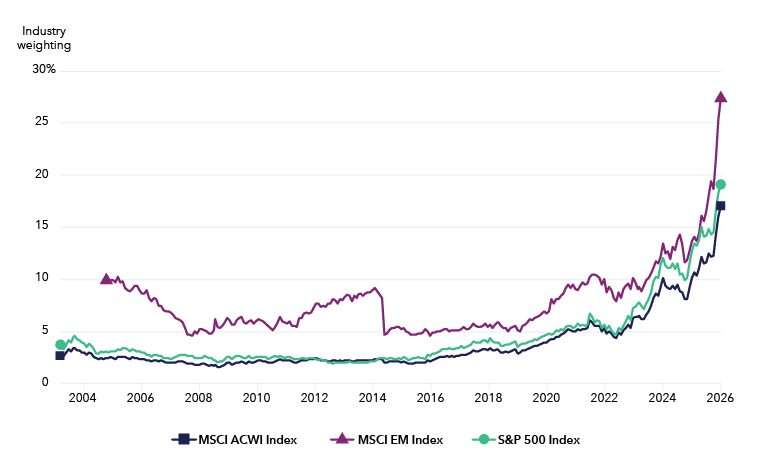
As of June 30, 2026, this industry represented 19.2% of the S&P 500, up from just 2.8% as of June 30, 2016. The trend extends beyond the U.S., with the industry representing 17.0% of the MSCI ACWI, up from 2.4% over the same 10-year time period, while semiconductors and semiconductor equipment now account for 27.3% of the MSCI Emerging Markets Index.
Markets increasingly powered by chips
Source: Capital Group.
“For investors, the question is not whether AI and semiconductor companies are important, as many are exceptional businesses helping to drive innovation, productivity and earnings growth. Instead, the key question is how to think about concentration when building a portfolio for long-term goals,” says equity investment director Kathrin Forrest.
Here are three things investors should consider when investing in concentrated markets:
1. Concentration and certainty are not the same thing
Today’s concentration reflects investor enthusiasm around AI and the infrastructure required to support it. Recent earnings growth helps explain why. According to FactSet, the IT sector is expected to deliver one of the strongest earnings growth rates in the S&P 500, with semiconductors and semiconductor equipment companies contributing a significant portion of that growth.
“There are valid reasons for this optimism, but concentration and certainty are not the same thing,” says Forrest.
According to her, today’s benchmark weights and valuations increasingly reflect a single set of assumptions about how the future will unfold. That does not mean those assumptions are wrong, but it does mean investors should recognize how much market leadership is tied to a relatively narrow group of companies and outcomes.
History also reminds us that market leadership evolves. The companies that dominate one era do not always lead the next. Technological change creates opportunities, but it also introduces competition, disruption and shifting expectations. Even powerful long-term trends require ongoing analysis and disciplined investment decisions.
Some of the questions investors should be asking: Is current AI spending sustainable? How much demand growth reflects lasting business rationale versus competitive necessity? And can margins remain strong as more capacity comes online?
“These are not arguments against AI. They are reminders that great themes still require careful research,” she says.
2. Revisit your objectives
The rise in benchmark concentration also creates an opportunity for investors to revisit what they are trying to achieve.
For some investors, matching the return pattern of a market index may be entirely appropriate. For others, objectives may include generating income, preserving capital, funding retirement, supporting future beneficiaries or building long-term wealth with a different risk profile.
“Equities remain a core building block in many investors’ portfolios,” says Forrest. “But not everyone is solving for the same thing.”
This distinction matters because a highly concentrated benchmark may not necessarily align with every investor’s goals. The most heavily weighted companies are often associated with high growth expectations, but long-term returns can come from many sources.
“Earnings growth is one driver. Valuation expansion, dividend income and share buybacks can also contribute meaningfully to shareholder returns. In some cases, these characteristics are more prevalent outside the most crowded parts of the market,” she says.
“This highlights an important difference between a great company and a great stock. A company can be successful and widely admired while its future return potential is constrained by already-high expectations embedded in its share price,” Forrest says.
By focusing first on objectives rather than benchmarks, investors can make more informed decisions about where they may want to deploy their capital.
3. Look beyond the spotlight
Despite the attention focused on AI semiconductors and semiconductor equipment leaders, the global opportunity set remains far broader than benchmark weights suggest.
Compelling opportunities can often be found in less visible areas of the market. These may include turnaround stories, companies benefiting indirectly from AI adoption, or businesses that have been overlooked because they are perceived as being on the wrong side of technological change.
Finding these opportunities requires investors to look beyond a narrow set of themes and consider a wider range of return drivers. This means zooming out to look beyond the next quarter or two, digging into research across a broad range of companies both inside and outside the spotlight, and inviting diverse perspectives to avoid a single point of failure.
This is where active management can play an important role. Active strategies can move beyond benchmark concentrations, balancing conviction with diversification and seeking opportunities across a broader investment universe.
The AI ecosystem remains a powerful long-term growth opportunity, and investors may be wise not to avoid it. But investors may also benefit from ensuring that portfolios are not overly dependent on a single theme, industry or set of assumptions.
Forrest notes, “In concentrated markets, diversification requires intentionality. By combining exposure to powerful secular trends with a broader range of opportunities, investors can build portfolios that are better-positioned to navigate an uncertain future while remaining focused on their long-term goals.”
Kathrin Forrest is an equity investment director at Capital Group. She has 21 years of industry experience and has been with Capital Group for four years (as of 12/31/25). She holds a master's degree in economics from Wayne State University and holds the Chartered Financial Analyst® designation.
Copyright © Capital Group