



by Russ Koesterich, CFA, JD, Portfolio Manager, BlackRock
Summary
Russ Koesterich explains gold’s recent fall and lays out his argument for why investors should continue to hold a modest position in their portfolios.
Key Takeaways
- After skyrocketing to an all-time high that peaked in January 2026, gold has fallen 25%, struggling against the backdrop of a strong U.S. dollar, higher real rates, and investors’ preference for AI-driven growth stocks.
- In recent years, gold benefited from both momentum and safe-haven demand, but today, gold has fallen out of favor, replaced by assets that exhibit strong earnings or cash flow.
- While the near-term outlook for the yellow metal is unclear, the long-term case for owning some gold remains intact, particularly in the current environment of ongoing geopolitical uncertainty and high government debt levels.
Equities continue to grind higher, while bonds are mostly range bound. The asset class that cannot get out of its own way is gold. Year-to-date the precious metal is down roughly -7% and off -25% from its recent, all-time high. After following stocks higher for much of the past two years, today gold cannot get a bid. What changed?
Dollar, Rates and Earnings
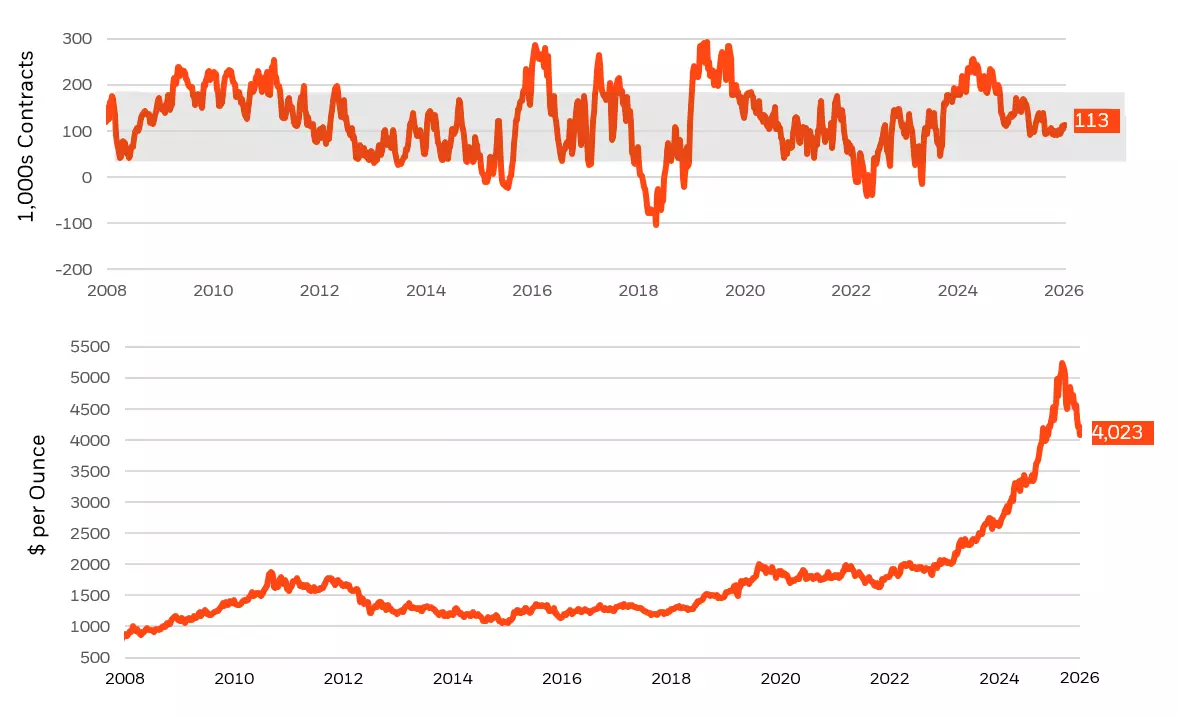
Gold’s decline followed a precipitous climb. Between late 2024 and January 2026 gold more than doubled (see Chart 1). During that period gold morphed from safe-haven asset into a momentum trade. In other words, rather than providing downside protection, gold added risk to a portfolio.
While part of gold’s recent decline can be attributed to the rapidity and magnitude of the previous gains, the macro environment has also shifted in ways unfavorable to gold. First and foremost, the dollar bottomed out in late January, just as gold was peaking.
Despite increasing chatter of a “debasement trade” the dollar has rallied sharply since the January lows, with the Dollar Index (DXY) up more than 6%. Concerns over a global energy shock, a resilient U.S. stock market and a dramatic reversal in expected Federal Reserve policy have all led to a stronger dollar.
A strong dollar is generally a headwind for gold, as the asset is often viewed as an alternative to traditional currencies. Since the pandemic, the correlation between the dollar and gold has been roughly -0.55, indicating a strong, negative relationship.
As the dollar has risen, so have long-term interest rates, especially real or inflation adjusted rates. Real 10-year yields, derived from the TIPS market, have gone from around 1.65% in early March to 2.20% today. This shift in the rate regime has been another obstacle for gold. As an asset with no cash flow, gold returns are typically lower when real interest rates are higher.
The third headwind could arguably be summed up as follows: Gold is not an AI stock. Even within the stock market, performance has increasingly been driven by an increasingly small set of AI companies experiencing outsized earnings growth. As an asset with no earnings, investors are treating gold the same way they’re treating slow growth, stable companies, by basically ignoring it.
Hold some gold
Short of a reversal in rates and/or the dollar there is no obvious catalyst for a quick rebound in gold. During the recent war in the Middle East, investors looked past gold’s traditional role as a geopolitical hedge. That said, the structural reasons to hold gold remain intact. Debt and deficits remain at historic levels, debasement remains a long-term risk and while gold did not work in March, geopolitics have not become any more stable. All of which still argues for maintaining a modest gold position in portfolios.
Copyright © BlackRock