





Most US stocks are lagging the benchmark, sharpening the case for careful security selection.
US stocks have continued to climb, but the gains have been far from uniform. In most sectors, a majority of companies have trailed the index. For investors, we believe the divide between a resilient index and uneven stock-level outcomes makes selectivity and fundamental research more important.
Investors in US equities have enjoyed solid gains in 2026, with the S&P 500 up 12.8% through September 30. That resilience is striking against a backdrop of AI-driven volatility, geopolitical turmoil and macroeconomic uncertainty.
Uneven Patterns Across Market Sectors
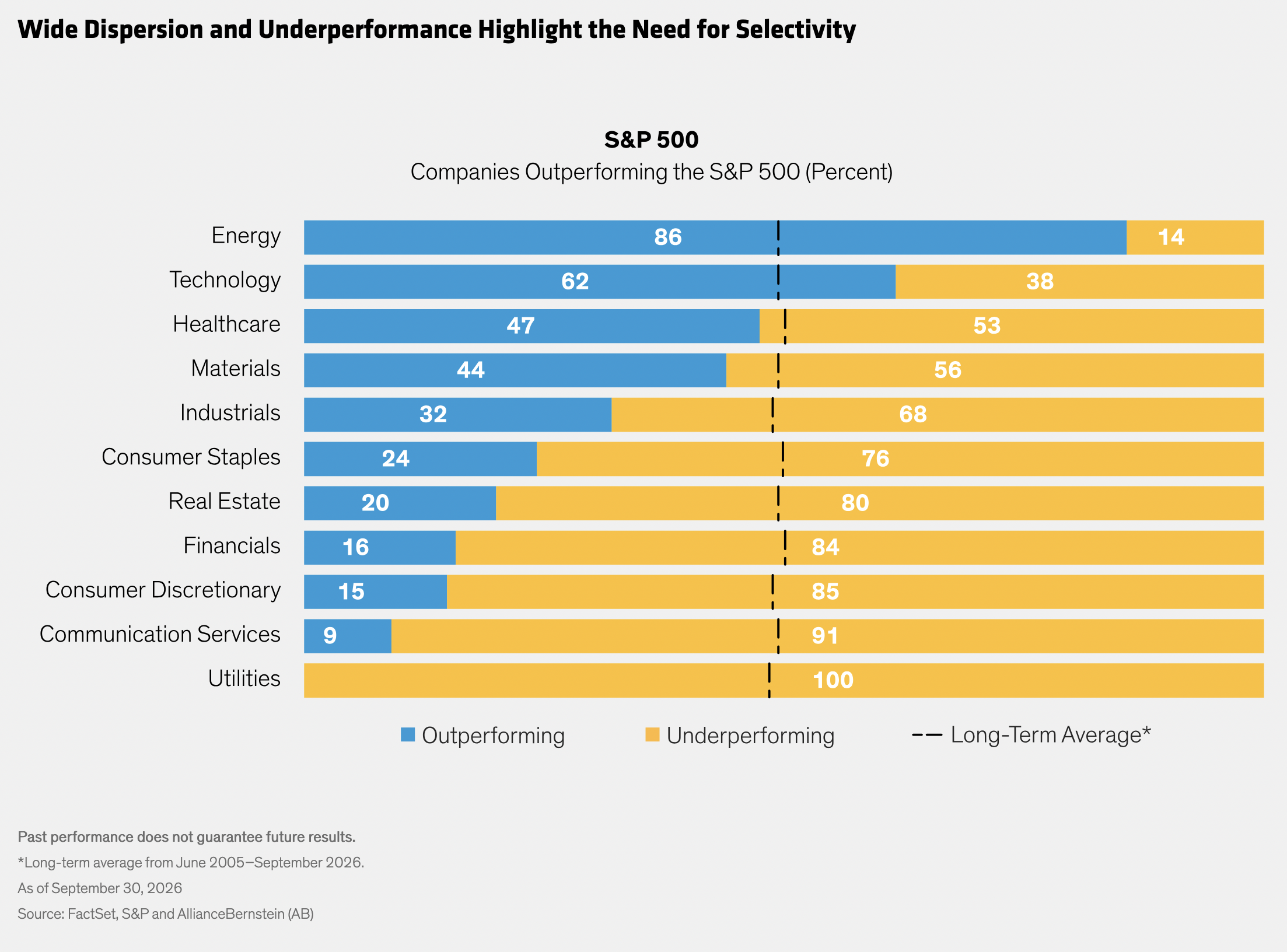
But beneath the surface, the market tells a very different story. In 9 of 11 sectors, a majority of companies underperformed the S&P 500 this year, as of September 30 (Display). Today’s imbalance is striking relative to history: over the long term, most sectors have seen a roughly even split between outperformers and underperformers.
Utilities contained the most extreme underperformers, as the sector is especially susceptible to rising interest rates. Communication services, consumer discretionary and financials were also weak. Energy was the clearest exception, with 86% of companies outperforming, while technology was the only other sector where a majority of stocks outperformed. Persistently higher oil prices and the AI trade have been respective tailwinds for these sectors.
Search for Quality Businesses with Durable Potential
What does this mean for investors? Wide variation across and within sectors suggests that broad thematic exposure, sector positioning or passive allocations may miss high-quality companies with the strongest fundamentals, resilience and earnings durability. The more uneven the market becomes, the more consequential individual stock choices can be.
Fundamental research can help investors separate durable businesses from companies carried mainly by market enthusiasm. That distinction is especially important as uncertainty around AI and interest rates complicates diversification. A strong index may suggest that the market is rewarding companies broadly; the stock-level evidence shows otherwise. In a market this uneven, we believe disciplined stock selection can help investors distinguish durable, long-term return potential from momentum that may prove fleeting.
Copyright © AllianceBernstein Research