


by Hubert Marleau, Market Economist, Palos Management
Last week I wrote: “What is most important is that the AI boom remains powerful, accelerating the expected year-over-year increase in S&P 500 earnings per share for Q3 to 27%, after registering blockbuster gains of 30% and 25% in Q1 and Q2, respectively, while fabulous earnings are broadening across corporate America. Analysts expect all 11 S&P 500 sectors to deliver positive y/y growth in both revenues (11.6%) and earnings (30.6%). And this phenomenon is not about to stop, according to Yardeni Research, which came out this week with its earnings-per-share prospects for the S&P 500 over the remainder of the decade, projecting $450 per share in 2028, $475 in 2029, and $500 in 2030, which supports a S&P target of 10,000 before the end of 2029. It should be added that the street is more bullish on earnings per share, forecasting $419 in 2027 and $489 in 2028. These elevated long-term growth assumptions are enough for me to keep my year-end target to 7,925 and 8,700 for 2027. Take note that avoiding a recession is critical for a bull market. Truist’s economists expect economic growth of 2.2% in 2026 and 2% in 2027.”
The Economic Week of October 11
US stock futures edged higher on Monday morning with the cash market closed for Columbus Day, ahead of third quarter earnings reports from the major Wall Street banks, which were expected to be very strong, and before the BLS’ consumer price index print was expected to show an acceleration in inflation.
First, top-line inflation for September rose 0.6% m/m, accelerating the annual rate to 3.7%, above economists’ expectations, as did the core consumer price index, climbing 2.6% on an annual basis, marking 67 consecutive months of above-2% inflation. Importantly, inflationary pressures were broad-based, with 52% of CPI categories recording above 3% y/y and 70% above 2%. (Incidentally, the September wholesale inflation report reinforced the inflation message as it blew past expectations, rising 1.3% m/m.)
Second, big money banks reported solid results for Q3, beating estimates and confirming strong consumer spending and fixed capital formation that have translated into strong lending growth, with low delinquencies and funded by private deposits and investment balances, all reflecting the resiliency of the economy.
Thirdly, fresh data on retail sales, manufacturing activity and new orders for services showed that the Americans were still enjoying a rip-roaring economy. The Atlanta Fed’s GDPNow is still estimating an annual growth rate of 3.6% for Real GDP in Q3, while the staff model of NY Fed is predicting 2.8% for Q4.
The Bond Market Tells
The Wall Street Journal’s survey of forecasters believe that higher interest rates will define the rest of the decade, blaming the U.S. fiscal trajectory and the Fed’s recognition that it must set its policy rate to combat inflation, coupled with intense competition for capital from both the public and private sectors. Nonetheless, the 71 analysts who submitted projections in the survey from October 2-7 expected the benchmark 10-year yield to end 2026 at 5.10%, falling to 4.96% halfway through 2027 and 4.78% by the end of 2027.
Over the past two weeks, 10-year US Treasury yields fell sharply by 23 bps to 5.07%, in spite of two hotter-than-expected inflation reports that would have normally pushed duration yields higher. What is even more surprising is the decline in the neutral rate from 5.06% to 4.87%, and of the monetary sensitive 2-year notes from 4.82% to 4.71%. This has happened because the plunging price of CoreWeave's bellwether bonds to junk status, which reflected the sentiment that the AI investment binge by neocloud operators had gone too far, putting the estimated need in revenues to cover costs was out of whack, had been exacerbated by Anthropic’s announcement that revenue growth had slowed in Q3 to 45% y/y. The reaction was theatrical, pricing the reality that the AI financing machine had sputtered, which can only lead to lower demand for capital, lower economic growth and less inflation.
The Stock Market Outlook
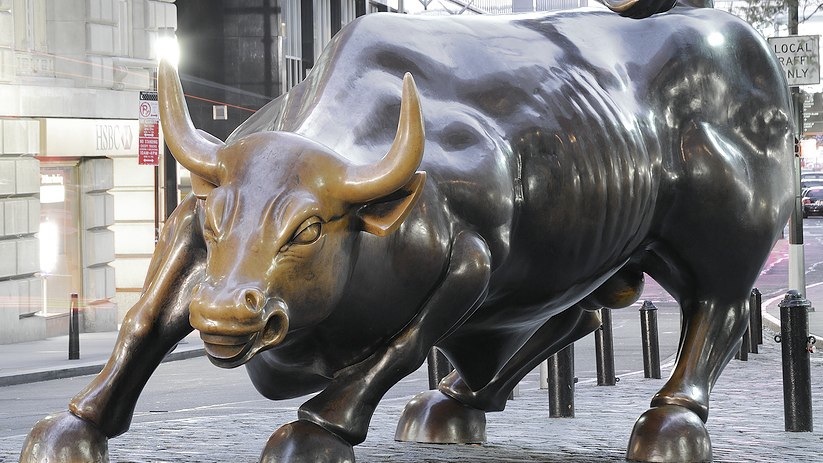
The S&P 500’s relentless bull rally turned 4 years old on October 12, 2026, 118.4% higher than it was back then (3,577), having added almost $40 trillion in market value. Despite the enormity of this run, it is still less than the 184% average gain for bull markets since the 1950s. Nonetheless, in terms of length and size, it has been put into question by pundits as to whether this can go on, given the high price for crude, the potential for more rate hikes and the sustainability of AI infrastructure investments. Stocks finally reacted, especially tech stocks, forcing an S&P 500 weekly decline of 2.0% to 7,659, which may not last for three reasons.
First, the energy bill as a % of N-GDP is 3.00%, 50% higher than the historical average of 2.0%. Investors should acknowledge that of the oil price at $97.50 a barrel, roughly $22.00 of it is represented by a geopolitical price premium, according to Goldman Sachs. This war premium could vanish quickly with a truce in the Middle East.
Second, recent speeches by numerous Fed officials are saying that there is no urgency in raising rates, suggesting that there is room to assess economic developments before taking further monetary policy action. As it stands now, the odds of an October rate hike are only at 17%.
Thirdly, while I acknowledge that the heavily indebted AI infrastructure providers will struggle to expand, the traditional hyperscalers (Meta, Microsoft, Amazon, Google and Oracle) will likely continue with their ambitious goal to dominate the industry, spending $892 billion in 2026 and $1.1 trillion in 2027. Their strong balance sheets and operating cash flows make them insensitive to the financing problems of their much weakened competitors.
Moreover, history offers a reassuring outlook. Since 1950, bull markets that made it as long as the current one tended to do well in their fifth year, delivering an average gain of nearly 19%, according to Carson Investment Research. As a matter of fact, Goldman Sachs flipped bullish on stocks for the rest of 2026, citing supportive earnings growth, which is expected to rise 29.6% in Q3, followed by an 18% increase in 2027. Potential valuation expansion for de-rating should therefore decline, even though there remain plenty of concerns over high volatility risk stemming from energy prices, credit jitters over financially weak companies in the AI chain, and uncertainty over the midterm elections.
In this connection, an emphasis on a cautious barbell strategy of growth stocks and rate-sensitive proxies may be the right investment approach for the time being. I suspect that many sideliners, who missed the bull run, may reach out for laggards, feeling compelled to try their luck on them, realizing that, contrary to the 2000 tech bubble, brought about by forward P/E expansion, our current situation is all about earnings expansion. This big difference keeps me in the bullish camp.
On Politics
Philosopher Arthur Schopenhauer said: “When some political pamphlet is making a great commotion, you should remember that whoever writes for fools finds a large public.”
Copyright © Palos Management