



by Carl Tannenbaum, Vaibhav Tandon, & Ryan Boyle, Northern Trust
The U.S. economy has traveled farther than most forecasters expected. Strong household spending, healthy labor markets and continued business investment have kept the expansion on course.
The road ahead, however, appears less smooth. Inflation has reemerged as the dominant concern, prompting the Federal Reserve to resume tightening. At the same time, higher bond yields, geopolitical tensions, trade frictions and uncertainty surrounding the AI investment cycle have made the outlook more vulnerable to downside surprises.
No single risk appears sufficient to derail the expansion. But the accumulation of headwinds raises the likelihood of slower growth, stickier inflation and greater volatility in the months ahead.
Following are our thoughts on the outlook.
INFLUENCES ON THE FORECAST
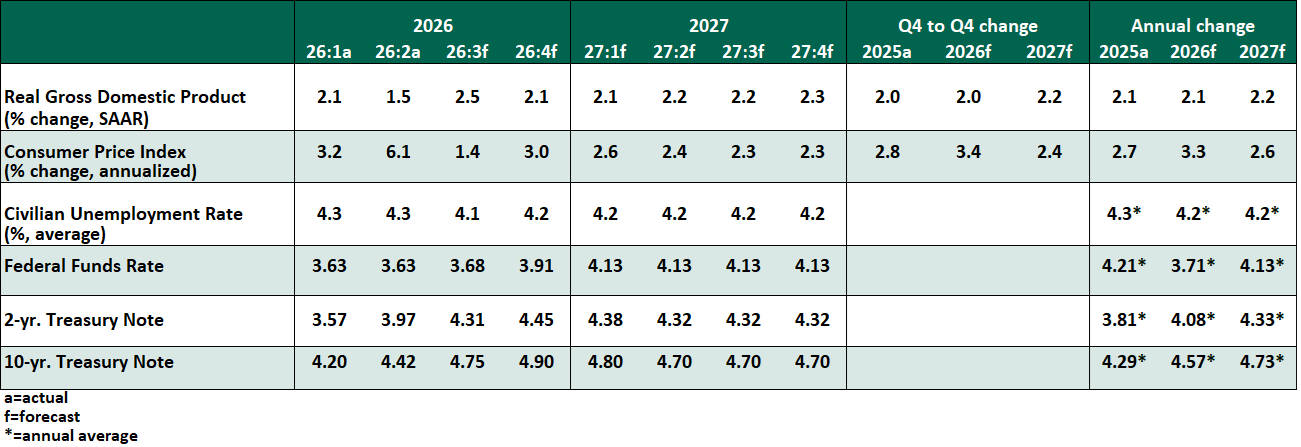
- Inflation remains stubbornly elevated, with risks increasingly skewed to the upside. The headline consumer price index held at 3.4% year over year in August, as energy costs remained firm. Although core inflation has largely moved sideways on an annual basis, higher diesel prices are beginning to raise freight and shipping costs. As transportation expenses work their way through supply chains, rising input costs could generate broader price pass-through in the months ahead. Inflation expectations are edging higher once again, while escalating trade tensions, including a new falling-out with Canada, risk further frictions.
- The Federal Reserve could not ignore persistent inflation and the sharp rise in long-term interest rates. Price stability has reemerged as the central concern for policymakers, prompting the Federal Open Market Committee to unanimously raise the Federal Funds Rate by 25 basis points at this month’s meeting. Policymakers signaled more tightening is in store.
- The combination of elevated inflation and resilient activity has reduced confidence that policy is sufficiently restrictive to return inflation to target within a reasonable timeframe. Therefore, we expect another rate increase in October. If inflation remains uncontained, an additional hike will follow.
- The U.S. economy is operating at a restrained pace. Recent gross domestic product (GDP) data suggest that domestic demand remains resilient, even as inventory investment, trade flows and government spending provide less support than they have in recent quarters. AI-related investment remains an important source of momentum. However, questions are mounting about whether the revenues, productivity gains and customer demand generated by AI will arrive quickly enough to justify those massive investments.
- The U.S. consumer continues to demonstrate remarkable resilience. Household spending has been supported by healthy balance sheets, rising financial wealth and steady income growth, allowing demand to withstand elevated borrowing costs and inflation. Consumption should continue to support economic activity, but its momentum is likely to soften as living costs increasingly constrain lower-income households.
- The labor market has taken a back seat in policy discussions as employment conditions remain healthy. The August employment report exceeded expectations, with non-farm payrolls rising by 162,000 and the previously reported July decline revised to a modest gain. The unemployment rate held steady near 4.1%, despite an increase in labor force participation. Wage pressure remains well contained, with average hourly earnings rising 3.1% year over year. Labor demand is unlikely to reaccelerate meaningfully. This further supports our view that second-round inflationary effects from higher energy prices will remain limited, and the Federal Reserve's remaining tightening cycle is likely to be modest.
- Treasury yields have moved sharply higher, with the 10-year Treasury rate hovering around 5%. Markets are demanding additional premium for elevated government borrowing requirements, inflation uncertainty and reduced confidence in the future path of monetary policy. Elevated borrowing costs will dampen housing activity, business investment and interest-sensitive areas of consumer spending.
Copyright © Northern Trust