




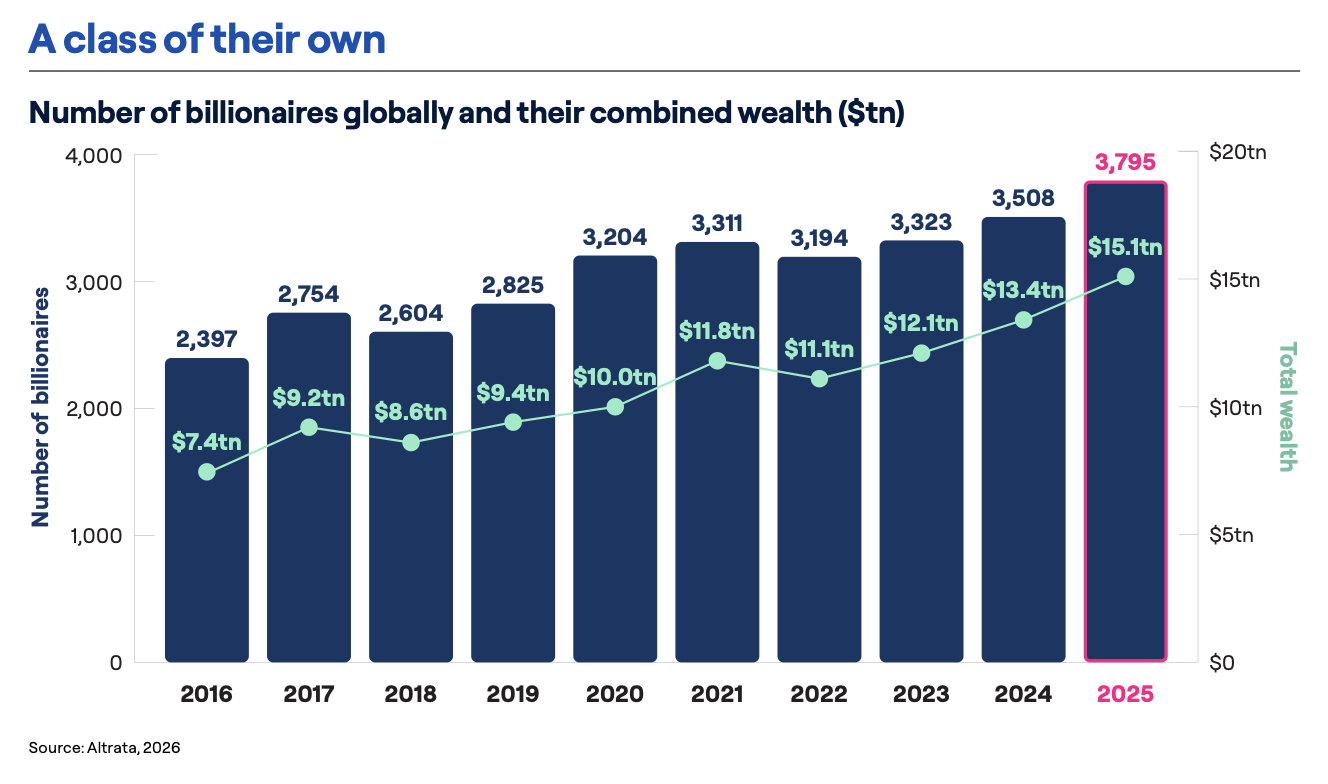
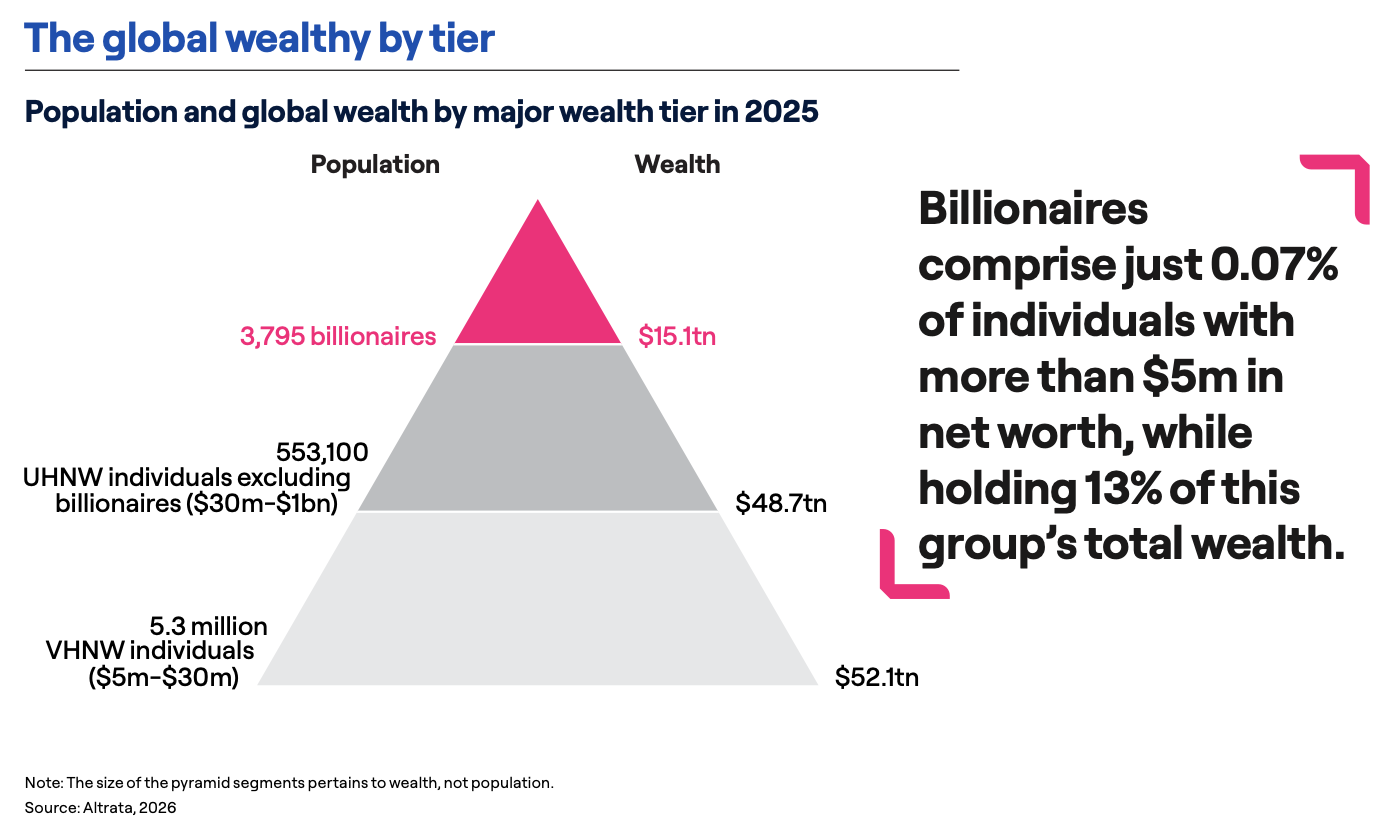
The numbers are no longer a footnote. The global billionaire population reached an all-time high of 3,795 individuals in 2025, with total wealth surging to a record $15.1 trillion, according to the Altrata Billionaire Census 20261, the 13th edition of the firm's definitive annual study. The report, led by Senior Director Maya Imberg and Director of Research and Analytics Maeen Shaban, is not simply a count of the very rich. It is a structural map of how extreme wealth is being created, concentrated, transferred, and repositioned in real time across the global economy. For advisors and investors serving or seeking to serve this demographic, the implications are substantial.
 The AI Supercycle Is the Defining Wealth Engine
The authors are direct about what drove 2025's record gains. Woodward et al. write that "an increasingly frenetic AI investment boom was a major driver of the rise in total billionaire wealth in 2025." The data behind that assertion is striking: among the 150 listed companies globally that contribute most to billionaire wealth, those that made a meaningful investment in AI outperformed those that did not by 23% in market capitalization growth over the combined 2024-25 period.
This is not a technology story in isolation. It is a concentration story. The 29 wealthiest individuals on earth, each with fortunes above $50 billion, held a combined $4.1 trillion in 2025, representing 27% of all billionaire wealth. That share stood at 7.2% in 2017. The authors describe the trend plainly: "Sharp fluctuations in AI-exposed tech stocks, and by extension, in individual billionaire wealth, will remain a feature of global markets in the coming years."
North America Widens the Lead
Regional divergence is becoming structural. North America posted 11.6% billionaire population growth in 2025, the fastest of any region, lifting its count to 1,337 individuals holding 45% of global billionaire wealth. The US alone is home to 1,265 billionaires, more than three times the level in China. The proportion of total billionaire wealth held in the US is even greater, at 44%.
Germany emerged as the fastest-growing billionaire country among the top 15, posting 20% growth, a sharp turnaround driven by currency appreciation and investor rotation toward European assets. China's billionaire population grew 13%, its strongest performance in five years. Meanwhile, London and Hong Kong were the only two top-15 cities to register population declines, weighed by real estate weakness and, in the UK's case, tax regime changes.
Wealth Is Becoming More Global, More Mobile, and More Multijurisdictional
One in five billionaires was born outside the country in which they now reside. Singapore leads at 66.7%, Hong Kong at 64.2%, and the UK at 47.7%. In London specifically, nearly 60% of billionaires are foreign-born. The authors note that "almost 40% of billionaires own or part-own commercial interests headquartered outside their primary country of residence," underscoring a decisive shift toward jurisdictional diversification as both a wealth-preservation and lifestyle strategy.
Sports Ownership Crosses from Passion to Portfolio
The report tracks a notable evolution in how billionaires deploy their passion assets. More than 200 of the world's billionaires currently hold a direct stake in a sports team or franchise. The authors write that "the blending of passion for sports and investment opportunities has shifted towards a more strategic portfolio focus." With expanding media rights, streaming revenues, global fan monetization, and rising institutional co-investment alongside billionaire consortia, sports franchises have crossed into mainstream alternative asset territory for the ultra wealthy.
$6.6 Trillion Is About to Change Hands
The succession dynamic may be the most consequential long-term theme in this report. Altrata's Wealth Transfer Model projects that $6.6 trillion in billionaire wealth will be passed on over the next decade. Nearly 5,000 direct beneficiaries, spouses and adult children, will receive these transfers, with women accounting for 90% of spouses in line to inherit. The average age of adult child heirs is 48, and 23% already work alongside their billionaire parent in the primary family business.
Five Key Takeaways for Advisors and Investors
1. AI exposure is not optional context. It is now the primary determinant of market-cap trajectory among the companies that anchor billionaire wealth. Understanding clients' direct and indirect AI exposure is a front-line advisory responsibility.
2. Geographic diversification among ultra-wealthy clients is accelerating. Multi-jurisdictional structures, cross-border holdings, and residency planning are increasingly standard, not exceptional. Advisors need cross-border competency or strong referral infrastructure.
3. Sports assets have graduated from trophies to portfolio allocations. The institutional co-investment trend alongside billionaire consortia signals a broadening market, with implications for alternative investment platforms serving UHNW clients.
4. The $6.6 trillion wealth transfer is the most significant client acquisition and retention opportunity of the next decade. The average adult heir is 48, already in the workforce, and often already embedded in the family enterprise. Relationships built now will define practices in 2035.
5. Concentration risk at the top of the wealth pyramid is real and rising. The superbillionaire class controlling 27% of all billionaire wealth, up from 7% eight years ago, means that volatility in a handful of AI-exposed equity positions can move macro sentiment. Advisors serving UHNW clients must stress-test portfolios for this concentration.
Footnote:
1 Woodward, Tom, et al. Billionaire Census 2026. Altrata, Aug. 2026, https://info.altrata.com/l/311771/2026-08-26/2977py/311771/17877743192KVu5F3z/Altrata_BillionaireCensus_2026_FINAL.pdf.