




by Russ Koesterich, CFA, JD, Portfolio Manager, BlackRock
Key takeaways
- The momentum trade is supported by strong earnings momentum, particularly in technology, semiconductors, energy and communications. Investors will note that companies with the strongest share price performance are also seeing the largest upward revisions to earnings expectations.
- Momentum strategies are heavily overweight technology, especially semiconductor stocks, because they have delivered both strong stock returns and exceptional earnings growth.
- While markets saw a sharp momentum sell-off in June and early July, this can largely be attributed to overcrowding and excessive leverage rather than deteriorating fundamentals.
- Assuming risks like a sharp rise in interest rates or a broader equity market downturn are contained, Russ argues that momentum stocks should continue to benefit from their outsized share of earnings growth.
Of all the equity investing styles, momentum is arguably the easiest to define and hardest to justify. Other styles, notably value or quality, are intuitive. But simply buying the stocks that have gone up the most seems at best odd and at worst a clear violation of common sense. That said, momentum has been outperforming year-to-date and is likely to continue to outperform for a simple reason: Today, price momentum reflects earnings momentum.
Most measures of momentum generally rely on some change in price over a specified time, often around a year. Despite a significant pullback in June and early July, ETF’s and baskets using this approach have been significant outperformers during the past 12 months and year-to-date. The reason they have been beating the market is that the style is currently weighted towards those names experiencing the strongest earnings momentum.
Strong performance during the past year has left the momentum style overweight in several areas: technology, particularly, semiconductors, along with energy. These sectors and industries have a much more significant weight in momentum baskets than in the broader market. They are also where most of the earnings momentum is centered (see Chart 1).
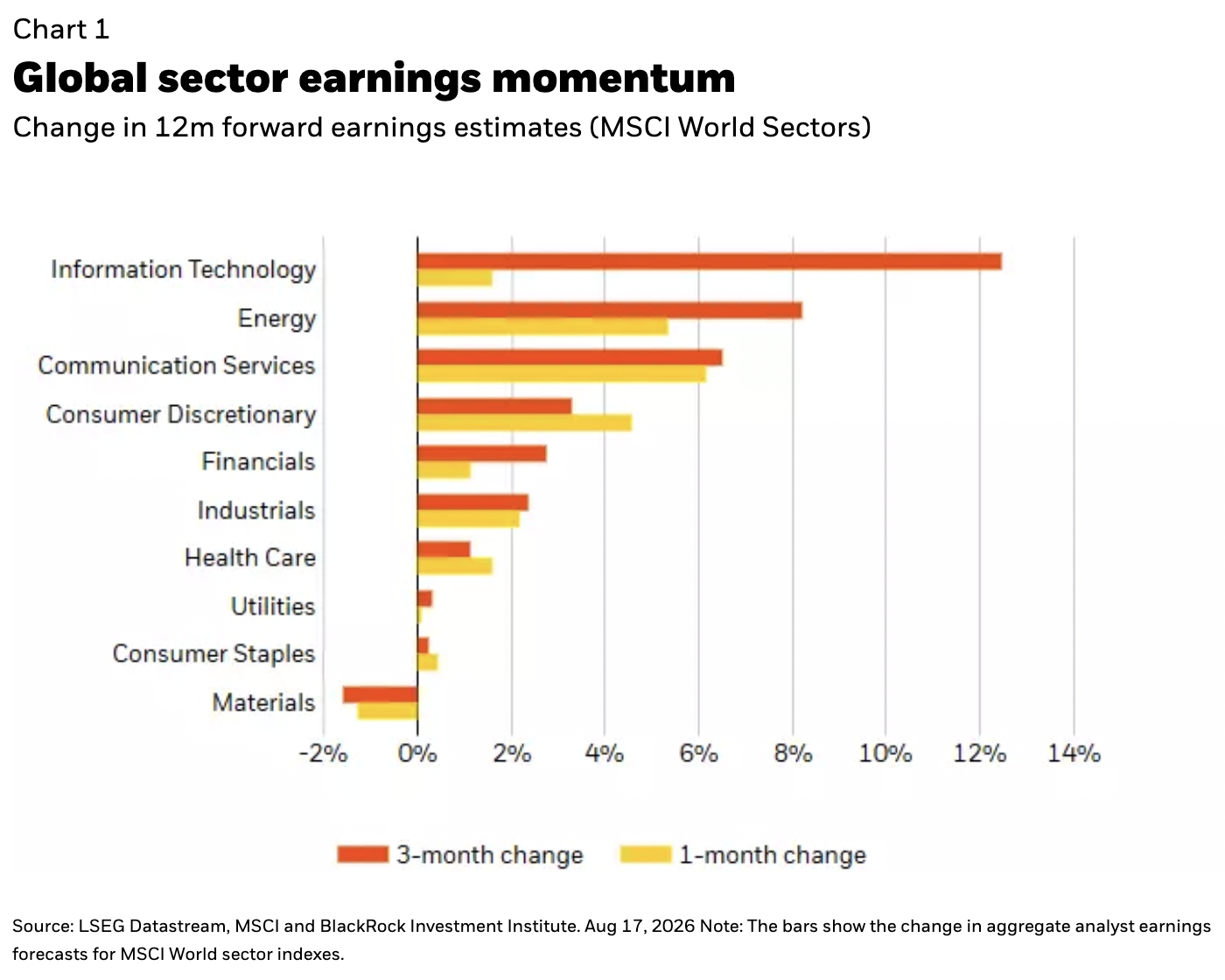 Three-month changes in earnings expectations have been strongest in technology, energy and communications, which include several mega-cap tech companies. Semiconductor companies, which are the largest industry in most momentum baskets, are experiencing particularly strong earnings. According to Bloomberg, the Philadelphia Semiconductor Index (SOX) is expected to deliver over 100% earnings growth this year.
Too Crowded?
While earnings are on the side of the momentum names, that did not stop a massive sell-off in June and early July. Baskets which both bought winners and went short losers dropped by 20% or more in a matter of weeks. The problem was too many people, with too much leverage, buying the same names.
Crowding is certainly still a risk. That said, many of the drivers, such as tech centered levered ETFs, that led to extreme positioning have corrected. At the same time the summer sell-off coupled with strong earnings growth has created an unusual dynamic where many of the momentum names are now also value stocks.
There is another, more generic risk to the momentum trade. Today, the momentum basket is geared to both an economic expansion and a strong stock market. The technology names tend to be more volatile than most stocks. Should the stock market take a more significant downturn, as it briefly did earlier in the summer, that volatility will work against the trade.
While there are real risks, assuming rates don’t melt higher from here, stocks can and should finish the year higher. With the economy still on solid ground, a strategy of betting on winners, who also happen to be those generating a disproportionate share of the earnings gains, can continue to work.
Copyright © BlackRock