



US Stocks Are Splitting into Different Market Rhythms

by Kurt Feuerman, Chief Investment Officer—Select US Equity Portfolios, Matthew Blickman, CFA, Portfolio Manager and Senior Research Analyst—Select US Equity Portfolios, Bryan Chang, Investment Strategist—Equities, AllianceBernstein
More US stocks are moving against the market, creating opportunities for equity investors.

Over the past year, more US stocks have begun to move against the broader market, adding a new wrinkle to the well-chronicled trend of high market concentration. The widening divide between individual stock movements and broader market trends cuts across sectors and industries. Understanding where market sensitivity sits can help investors distinguish between genuine disruption risk and mispriced companies with solid businesses.

Investors have become familiar with soaring equity concentration in recent years. Despite periodic bouts of market broadening, the 10 largest stocks in the index now account for nearly 40% of the S&P 500’s market capitalization—roughly double the concentration of a decade ago.

But for equity investors, high concentration doesn’t tell the whole story. A growing number of US stocks are also trading in opposite directions to the S&P 500 and its dominant AI trade. This is known as negative beta, and we believe it has important implications for how investors select stocks and diversify portfolios.

More Stocks Defy the Market

We’ve been tracking the negative beta trend for some time. By mid-year, stocks were increasingly moving to a different rhythm, leading to an unprecedented amount of negative beta. Since then, the trend has accelerated.

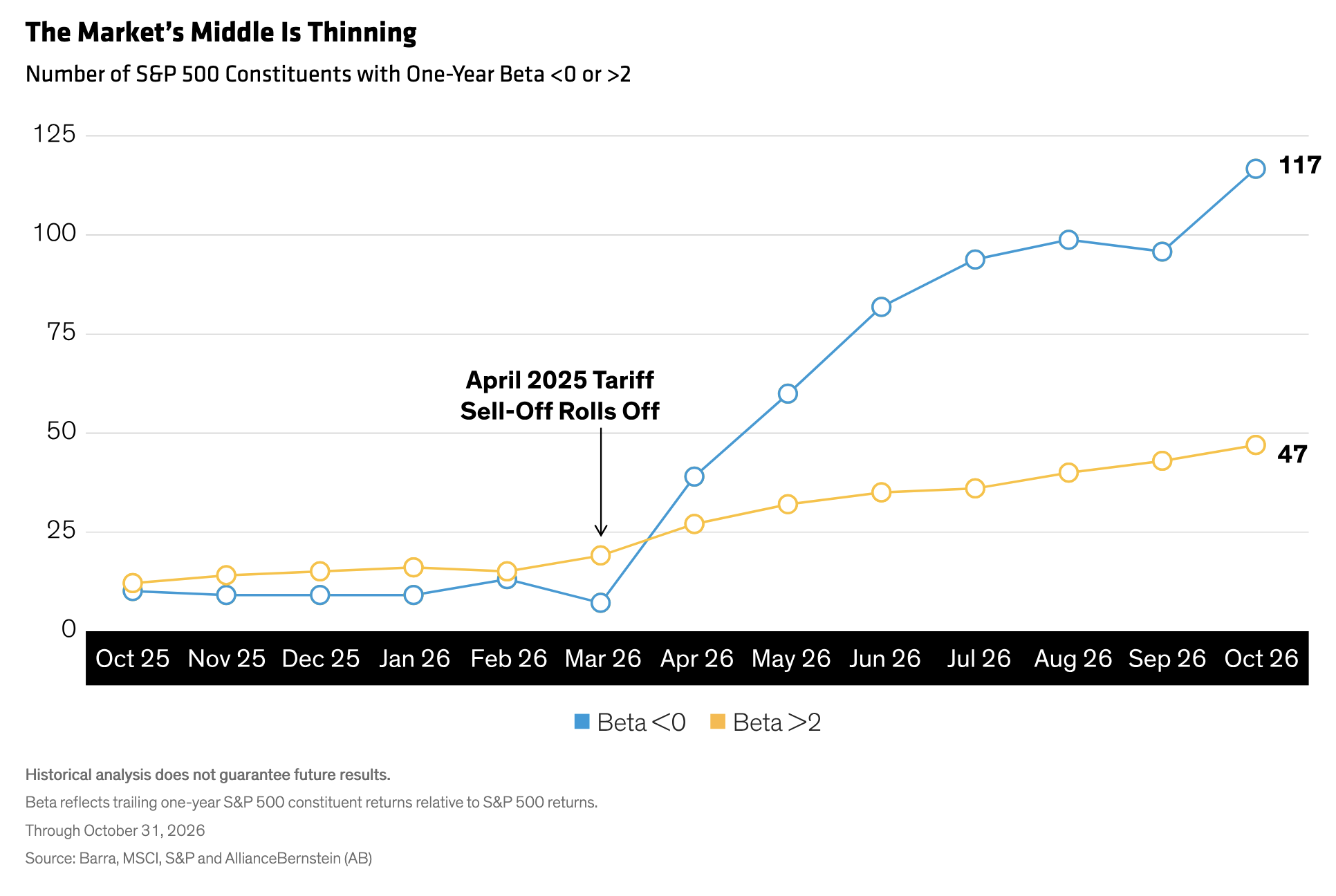
As of October 31, 117 S&P 500 constituents had negative one-year betas, meaning their stock prices tended to move against the market. That’s up from 83 in July. At the other extreme, 47 stocks had a beta above 2—more than double the number from a year earlier. Stocks with betas above 1 amplify market movements. This means that an increasing number of stocks are either moving against the market or amplifying market patterns. Either way, they’re marching to a different beat amid a thinning market middle (Display).


To be sure, some of the increase in negative-beta stocks reflects a measurement effect. The tariff-driven sell-off in April 2025 caused stocks to broadly fall together. Eventually, this rolled off the trailing one-year calculation, mechanically pushing many betas lower.

Still, the divergence has persisted. Of the stocks with negative beta at the end of June, all but four still had negative beta at the end of October. In our view, this persistence suggests the divide isn’t simply statistical noise and warrants a closer look at what’s happening beneath sector-level returns.

Sectors Tell Only Part of the Story

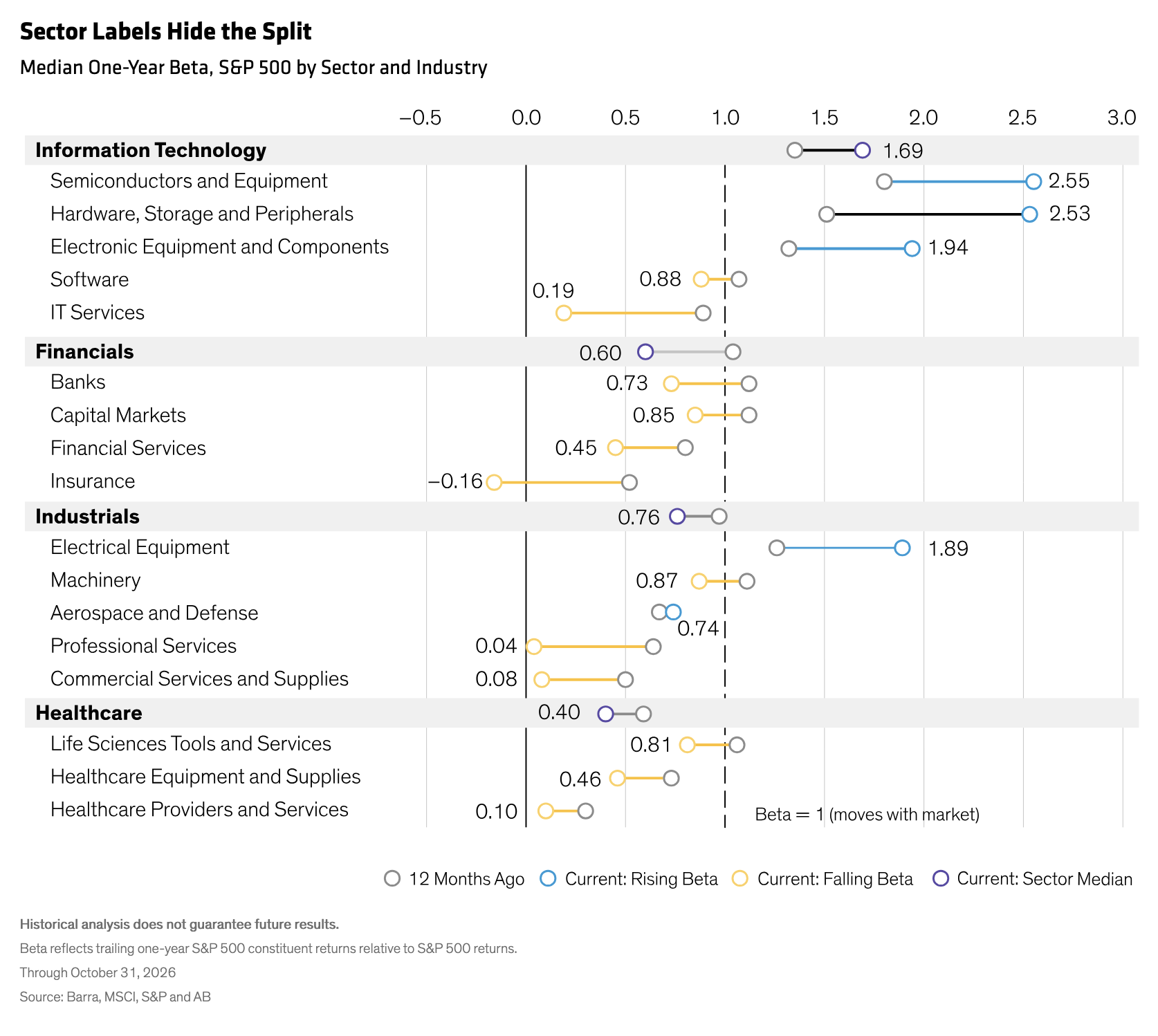
Sector-level observations can mask underlying trends. For example, in technology, the median beta has risen over the past year, mostly driven by semiconductors, hardware and electronic components—all of which became more sensitive to the market as investors embraced AI. Conversely, software and IT services have moved in the opposite direction as investors assess whether AI could disrupt business models and erode pricing power (Display).

We see similar divides in financials, industrials and healthcare.

Banks and capital markets firms continue to move broadly with financials as a whole, while the typical insurer now has negative beta.

Among industrial firms, electrical equipment companies tied to data-center energy demand have become more sensitive to the market, while professional and commercial services companies have moved closer to zero beta—indicating much less sensitivity to broad-market moves.

Within healthcare, many providers and service companies have decoupled from the broader market more than drugmakers and medical-device companies.

The takeaway: A sector label is no longer reliable shorthand for market exposure. Two companies in the same sector can now be marching to entirely different beats.

What’s Driving Negative Beta?

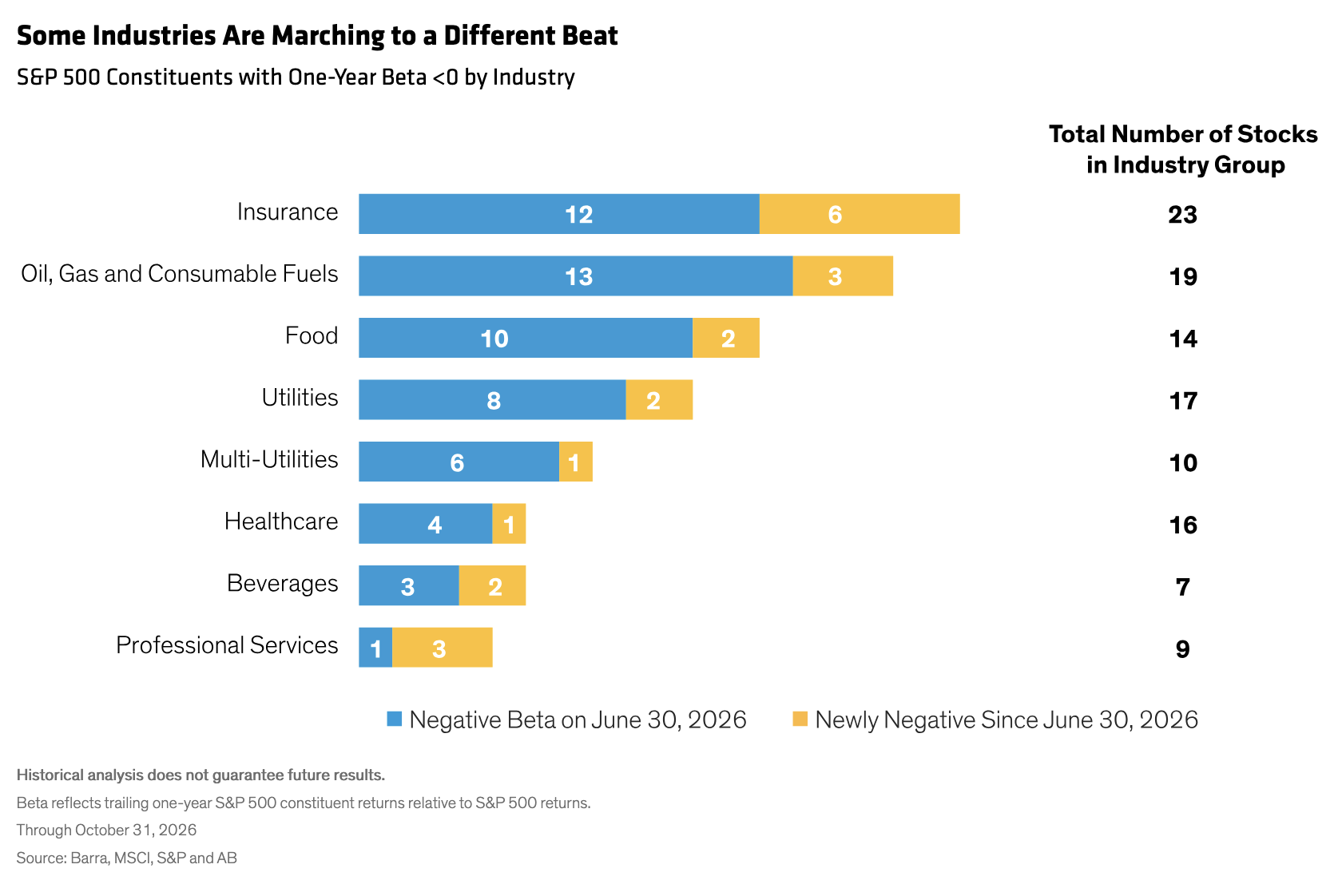
Negative beta is also concentrated: Just eight industries account for roughly two-thirds of the 117 negative-beta stocks (Display). But the reasons differ.

Defensive industries, such as utilities or food and beverage companies, are typically less sensitive to the market but have shifted from low beta to negative beta. Energy stocks are responding to oil-price dynamics. For many insurers, negative beta reflects their recurring premium income and earnings drivers that have little to do with AI capex.

There’s no single story. That’s why we view negative beta as a diagnostic signal that can help identify companies whose relationship with the market has changed, not a verdict on their investment merits.

The divergence also cuts both ways. With 47 stocks moving at more than twice the market’s magnitude, market sensitivity is becoming concentrated in a relatively small group of high-beta names. In other words, market risk isn’t evenly distributed.

Separating Disruption from Neglect

Some companies may move against the market because they face real fundamental challenges from AI disruption. Others may simply be neglected as investor attention and capital concentrate around AI infrastructure and other high-growth beneficiaries. Strong companies with robust fundamentals can still fall out of favor when they aren’t aligned with the market’s dominant narrative.

Beta can identify the divergence, but it can’t distinguish between impairment and neglect. That requires fundamental research into individual company business models. And because beta is backward-looking, it can change quickly. At the same time, that doesn’t mean today’s high-beta market leaders will necessarily falter.

Rather, the widening beta divide provides another lens for understanding where risk and opportunity reside. The AI trade may be volatile, but AI is here to stay and infrastructure beneficiaries may continue to lead. For active investors, that’s an invitation to look past sector labels for companies with sustainable earnings growth, strong balance sheets, attractive valuations and limited disruption risk—wherever they happen to sit.

The views expressed herein do not constitute research, investment advice or trade recommendations, do not necessarily represent the views of all AB portfolio-management teams and are subject to change over time.

Copyright © AllianceBernstein
Total
0
Shares
Previous Article

The potential year-end opportunity in cash-and-carry

Related Posts
Read More

The Week the AI Trade Lost the Benefit of the Doubt

A brutal week for technology stocks, read against a month of institutional research: what is breaking, what is holding, and the conditions that decide the next leg for portfolios
Read More

When the Greatest Macro Trader in the World Says He's Not Playing, Pay Attention

At the TomorrowX Summit1, this past week, legendary macro investor Stanley Druckenmiller sat down with Iliana Bouzali, Head…