

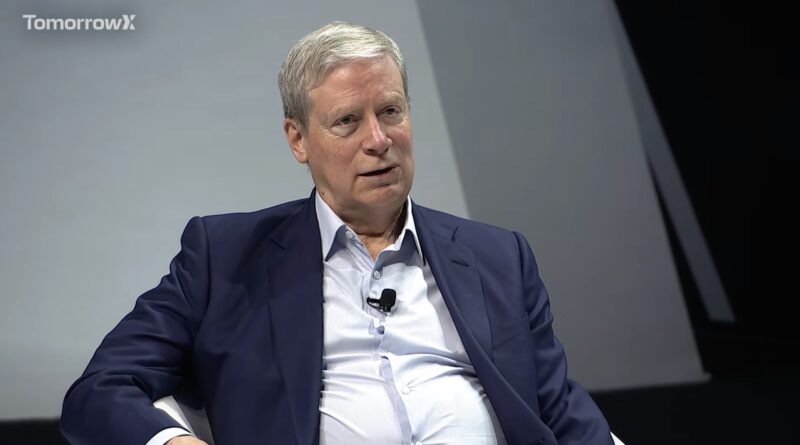

At the TomorrowX Summit1, this past week, legendary macro investor Stanley Druckenmiller sat down with Iliana Bouzali, Head of Global Derivatives and Structuring at Morgan Stanley, for a rare and unfiltered accounting of where he stands today and why he is, by his own admission, sitting entirely on the sidelines. The conversation spans portfolio positioning, the AI infrastructure cycle, fiscal risk, the future of cybersecurity, and the timeless principles that have kept Druckenmiller from posting a losing year across five decades of investing.
From Bullish to Flat: What Changed
Nine months ago, Druckenmiller was clear-eyed and committed. He was long equities, short Treasuries, long copper, and bullish on healthcare as a breakout theme. The setup was hard to argue with. "The economy was very strong," he says. "Looking forward, Fed funds were 3 and a half, nominal growth was 6%, so monetary policy was ridiculously loose." Commodities were breaking out. The advance-decline line was making new highs. Credit spreads were tight. Add an AI infrastructure acceleration just getting underway, and the picture was almost uniformly constructive.
Today, every one of those signals has reversed. "We have monetary tightening going on," Druckenmiller says. "We have commodities, which were breaking out in January, look like they've topped and are going down. In fact, we're now short copper." The advance-decline line peaked on August 14. Credit spreads are widening. Defensive sectors are leading cyclicals, a classic late-cycle rotation. His conclusion: "Everything is the exact opposite of the way it was then."
The result is a portfolio that is essentially flat on equities. "We are not long equities. We're not short equities." He wants to go short, he admits, but won't dare short the innovation cycle driving AI. "A lot of that stuff is oversold and washed out," he says, acknowledging that tactical positioning is stretched to the downside. So rather than force a view, he is doing what he has always done when conviction is absent: nothing.
The Art of Not Playing
The most distinctive aspect of Druckenmiller's approach is his willingness to step away entirely. His record is extraordinary. Bouzali puts it plainly: "You've never lost money. You've never had a down year." Druckenmiller accepts the compliment with characteristic precision: "That's correct, but it was the luck of the calendar. I had big drawdowns. I was just never down from December 31 to December 31."
What makes that record structurally possible is something Bouzali is careful to name. "We trade four asset classes," Druckenmiller explains. "Commodities, bonds, stocks, and interest rates. We don't feel the need to ever be heavily in one or the other." Bonds and currencies, he notes, tend to make their biggest moves precisely when equities are in bear markets, which gives him somewhere to go when equities offer nothing. He is disarmingly casual about how this came to be. "I probably did invent it, but I invented it out of necessity because I didn't know what I was doing back then."
Bouzali will not let him off that easily. "You invented that style, to be clear," she says. "You're not a mandate investor." The distinction matters enormously. Most institutional investors are constrained by mandate to remain invested in a given asset class regardless of conditions. Druckenmiller built a framework with no such obligation, and the freedom it creates, to do nothing in equities while remaining active in rates or currencies, or to exit entirely and simply wait, is a structural advantage that cannot be replicated inside a traditional fund structure.
He is blunt about the mechanics of that patience. "Duquesne has made their money in scoops over the years. So we go marginally up, like, 5 to 8% years, and then all of a sudden there'll be, like, a 3 or 4-year run." The discipline is in recognizing which phase you're in. "I'm not cold. I'm in an outstreak," he tells Bouzali. The difference matters. Cold streaks call for smaller bets and careful diagnostics. Outstreaks call for patience and capital preservation.
His risk management framework is equally unconventional. He does not use VAR, stress tests, or correlation matrices. "I look at my P&L, and if it's not behaving the way it should be, if it's not correlating properly, I'll start cutting back." The reason: in chaos, correlations break down, and no model survives that. "Crazy stuff just starts happening, and your P&L will pick it up."
Invest First, Investigate Later
Bouzali presses Druckenmiller on what would surprise an observer who followed him around for a month. His answer is disarmingly counterintuitive for someone with his reputation for rigor. He calls it "invest and then investigate." The process is exactly what it sounds like. "I'll hear an idea. I'm a technician, too, so I'll see a chart I like. I like the story. It makes sense to me. Or the person who's telling it to me, it's in their wheelhouse, and I can see certain passion. And I'll make not a giant bet, but a big enough bet to really hurt if I'm wrong."
He then hands the idea to his research team and waits two or three weeks before deciding whether to add to it or get out. The initial commitment, made with roughly 15% of the information a traditional investor would require, is not recklessness. It is a forcing mechanism. A position that hurts when it's wrong sharpens attention in a way that a paper thesis never can. "There's a lot of betting going on, sort of a lot of intuition with things that I probably have no business buying, but it's worked for me over time."
The streak framework operates alongside this. Druckenmiller is explicit that knowing whether he is seeing the market clearly is as important as any individual trade. "I believe in streaks," he says. "Same in my business. Sometimes I'm seeing the ball. Sometimes I'm not. What a big part of my job is to know whether I'm cold or hot." When he is hot, he plays big. When he is cold, he makes small bets and watches his average carefully. "If my average starts going up, then I figure I might be seeing it better, and I'll play harder." The P&L is not just a scorecard. It is diagnostic.
Together, the two approaches form a coherent whole: enter early with conviction and skin in the game, let the position and the P&L tell you whether you're right, and size up only when both are confirming. It is a framework built for a matrix investor operating across four asset classes, one that keeps intuition as the ignition but insists on evidence before full commitment.
Where the Next Opportunity Lives
Druckenmiller is not inactive intellectually. He is watching carefully for the next thesis to crystallize. Near-term, he is alert to economic disappointment in the second half of 2027, particularly as monetary tightening works through the system. That shapes his interest rate thinking. In equities, the shift he is anticipating is from infrastructure to use cases.
"We're looking for AI use cases as opposed to infrastructure," he says. Infrastructure, he argues, may offer a tactical trade given how washed out positions are, but it will not be the engine of the next leg higher. The more interesting territory is what AI actually does. "Ironically, maybe the most interesting use case is a lab," he observes, noting his conviction that leading AI labs will not remain in the token-selling business indefinitely. "If you have the number one intelligence in the world, you can start selling tasks instead of tokens, and you can create your own businesses."
Cybersecurity is another theme he names with striking directness. "Who's going to compete with these guys in cybersecurity? They created the problems, and now they're the ones that can have swarms of agents defending us from them." Healthcare completes the picture, backed by his three decades on the board of Memorial Sloan Kettering. With genetic sequencing, immunotherapy, and now AI converging, he makes a confident call: "I think we're going to beat cancer. I think it's going to be a managed disease, and I mean in 10 years, not 20 years."
The Slow-Moving Risks Nobody Is Watching
Asked what matters that is happening quietly beneath the surface, Druckenmiller names two things. First, the deterioration of K-12 education in the United States, compounded by immigration policy that is now threatening to cut off the talent inflow that has compensated for it. "I'm worried not only is K through 12 deteriorating, but no one's putting the adjunct to it, which is our immigration policy is threatening to stop the flow of that talent into the United States."
Second, fiscal risk. He has been sounding this alarm since 2011, when he toured college campuses warning that entitlement spending and demographics would eventually force a reckoning. The forecast was correct in direction but underestimated the degree to which zero interest rates, the reserve currency premium, and $5 trillion in COVID spending would extend the runway. "I'm worried that at some point we're going to be looking at what's happening in France in the United States," he says, adding: "I do think sometime in the next 10 years, we're going to get fiscal reform that will be engendered by a crisis in the financial markets."
What Separates the Great Ones
Pressed on what distinguishes the best investors he has known from merely very good ones, Druckenmiller lands on four traits: passion, intellectual curiosity, competitive intensity bordering on pathology, and discipline. "Every time you buy something, there's a seller on the other side," he says. "If you don't have an incredible work ethic, you're going to lose in our business." On discipline, he is careful to note it does not mean any single approach: "Their disciplines may be very different, may be different than mine, but whatever their discipline is, they stick to it."
He also names the trap that high IQ investors fall into most often: inflexibility. "Sometimes people with very high IQs forget the second part," he says, referencing his paraphrase of Mark Twain: "Put all your eggs in one basket and then watch the basket very carefully." Brilliant people, he observes, become so attached to their thesis that they stop watching the basket. When conditions change, they don't. That, more than anything, is what costs them.
5 Key Takeaways for Advisors and Investors
- Clarity, not activity, drives returns. Druckenmiller's willingness to do nothing when conditions are ambiguous is a core source of his long-term edge. Advisors and investors should distinguish between periods calling for conviction and periods calling for capital preservation.
- The macro regime has flipped. The conditions that made early 2026 constructive for equities, commodities, and risk assets have reversed almost entirely: monetary tightening is underway, commodities are rolling over, credit spreads are widening, and defensives are leading. The late-cycle signals are accumulating.
- AI infrastructure is maturing; use cases are the next leg. The infrastructure buildout may offer tactical opportunities but is unlikely to drive another multi-year scoop. The more durable opportunity is in applied AI: use cases, cybersecurity, and healthcare, where AI labs may pivot from selling tokens to selling outcomes.
- Fiscal risk is a slow burn with a sudden end. The U.S. deficit trajectory poses a structural risk that markets are discounting today but will not discount forever. Advisors should consider how portfolios would behave in a fiscal-crisis scenario over a 5-10 year horizon.
- Discipline and open-mindedness are not opposites. Druckenmiller's most important risk management tool is his P&L itself, which he uses as a signal to size up or down. The lesson: build in feedback mechanisms that force honest reassessment rather than relying on models or conviction alone.
Works Cited
1 iConnections. "Stan Druckenmiller: Why He's 'Not Playing' Right Now | TomorrowX Summit." YouTube, 17 Nov. 2026, www.youtube.com/watch?v=6r3D-CMJkuI.