



On the Open Outcry Podcast,¹ BMO Global Asset Management's Bipan Rai sits down with TD Cowen's Chris Krueger eight days before the vote, as markets fret over AI spending and the US 10-year yield is "tracking close to 5%." Rai sets the table with central bank decisions and hyperscaler earnings, then turns to what matters for Canadians. Krueger's answer is that the election is largely decided, while its consequences are not.
Is This Really Election Day?
Not anymore. Krueger dismantles the October surprise with one figure: "almost 30 million votes have already been cast." His verdict is blunt. "The cake is pretty well baked at this point." Rai notes that in prediction markets "we see 93% chance that the Democrats are going to take the House," with the Senate near 65%, up from roughly 40% this summer.
What Moved the Senate?
Krueger refuses to overthink it. "The price of diesel." American politics, he argues, runs on "cheap gas, cheap groceries, and cheap housing," and he says all three sit at record highs. The Iran war and tariffs hit farm states hardest, where Iowa and Kansas are "getting whacked on diesel prices" and retaliation. History adds weight, since a president's first midterm is rough on the party in power.
Is a Supermajority Possible?
No. "The odds are zero." Two thirds means 290 House seats and 67 Senate seats, and the Senate math cannot work. Democrats lost over 50 seats under Clinton and over 60 under Obama, yet Krueger believes "the high watermark for Democrats this cycle is probably closer to 40," because "the districts just aren't as competitive as they used to be." A Democratic House therefore cannot override a veto.
What Does It Mean for Canada?
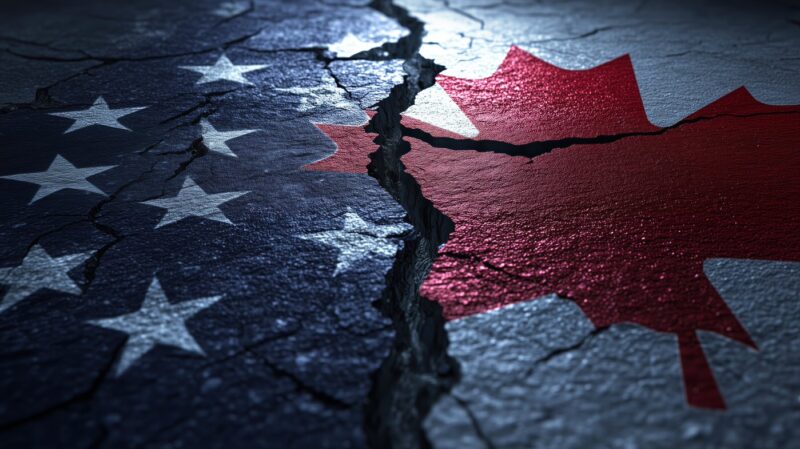
Rai flags trade as the topic Canadian listeners care about most. Krueger points to two Carney and Trump meetings, the APEC summit in Shenzhen and the December 14th G20 at Trump's Florida property. Without a deal, the tariff on Canadian autos and parts doubles from 25% to 50% on January 1, "that sort of Damocles hanging out there." House Democrats voted ceremonially to repeal the tariffs, so Canada gains friends, yet they "do not have that supermajority." Trump's Section 338 authority sits beyond Congress's reach, and Krueger calls him "probably the only China dove, Canada hawk in Washington."
Where Do Deficits and the Debt Ceiling Land?
Gridlock locks in "an autopilot of 2 trillion a year in deficits," since Democratic oversight blocks deficit reduction and new spending alike. The funding bill expires December 11th, and Krueger expects "some type of debt ceiling shutdown fight in July of 2027." Healthcare is the likeliest policy surprise, as Democrats push to reverse Medicaid cuts.
Does AI Slow Down?
Rai asks whether AI's unpopularity changes the course. Krueger does not see it: "I don't think President Trump is going to do anything to slow down AI." Opposition spans Steve Bannon, Josh Hawley, Elizabeth Warren and Bernie Sanders, so no consensus forms and it is "pretty much full systems go." The market risks are a Texas governor flipping, which could spook data center investors, and a contested count. He recalls Minnesota's 2009 Senate recount dragging on for almost a year.
What Does It Say About 2028?
The signals are mixed. Shapiro, a moderate, likely wins Pennsylvania by double digits, while Al Syed likely wins Michigan as a progressive. Krueger adds that Trump carries the lowest approval going into a midterm since Harry Truman, making this a referendum on the president rather than the Democratic Party.
The vote is a known quantity. The policy that follows is the variable. To be clear, advisors should position for the second, not the first.
Five Key Takeaways for Advisors and Investors
- The House is priced. With a 93% market probability, a Democratic House is consensus, so reserve attention for the Senate and for any surprise in Minnesota or New Hampshire.
- Costs drive the map. Diesel, groceries and housing, not ideology, moved Senate odds from roughly 40% to 65%.
- Watch the tariff clock. The Carney and Trump meetings in Shenzhen and on December 14th decide whether the auto tariff doubles on January 1.
- Expect gridlock, not relief. Deficits stay near 2 trillion a year, with December 11th and July 2027 as the shutdown dates.
- Do not wait for AI regulation. Policy trails the technology, so the real risk is a contested count or a Texas upset.
Footnote:
¹ Rai, Bipan, and Chris Krueger. "US Midterms: What's at Stake for Canada." The Open Outcry Podcast, BMO Global Asset Management, 26 Oct. 2026, www.bmoetfs.ca/articles/the-open-outcry-podcast-us-midterms-whats-at-stake-for-canada-october-26-2026.