




Every three months, a pattern emerges in the U.S. ETF market so large and so reliable it can be predicted in advance. Tens of billions of dollars flee BlackRock's iShares Core S&P 500 ETF (IVV) and flood into Vanguard's S&P 500 ETF (VOO), only to reverse course days later. As Bloomberg's Zachary R. Mider and Denitsa Tsekova report1, the next occurrence is already pencilled in: mid-September 2026. The cause is not panic, not rebalancing, and not momentum. It is taxes.
The Mechanics of the Maneuver
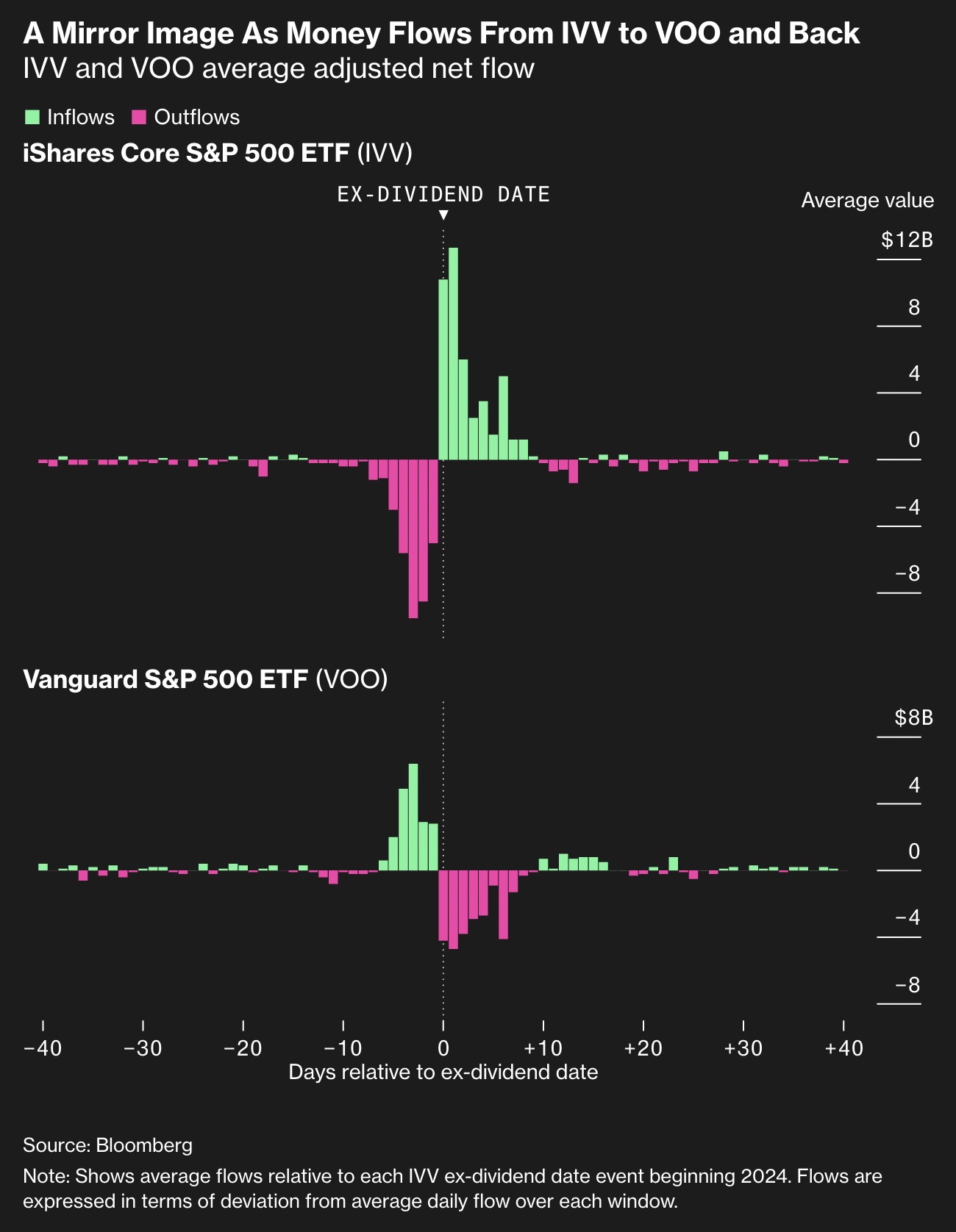
The strategy exploits a structural asymmetry between two near-identical products. Because IVV and VOO hold essentially the same stocks but distribute dividends on different dates, sophisticated foreign investors can sell out of whichever fund is approaching its ex-dividend date and park the proceeds in the other, ensuring they hold neither fund at the moment it confers the right to receive a dividend payment. Since the S&P 500's roughly 1% annual dividend yield flows through into price before the ex-dividend date, investors capture the economic value of the dividend as price appreciation rather than income. For foreign investors, that distinction is everything: price gains are not taxable in the United States, while dividends are subject to a 30% withholding tax.
Matt Bartolini, global head of research strategists at State Street Investment Management, says S&P 500 ETFs are used for "sophisticated trading," and that the flow patterns show large institutions "are utilizing the ETFs to gain continuous exposure without taking receipt of the dividend."
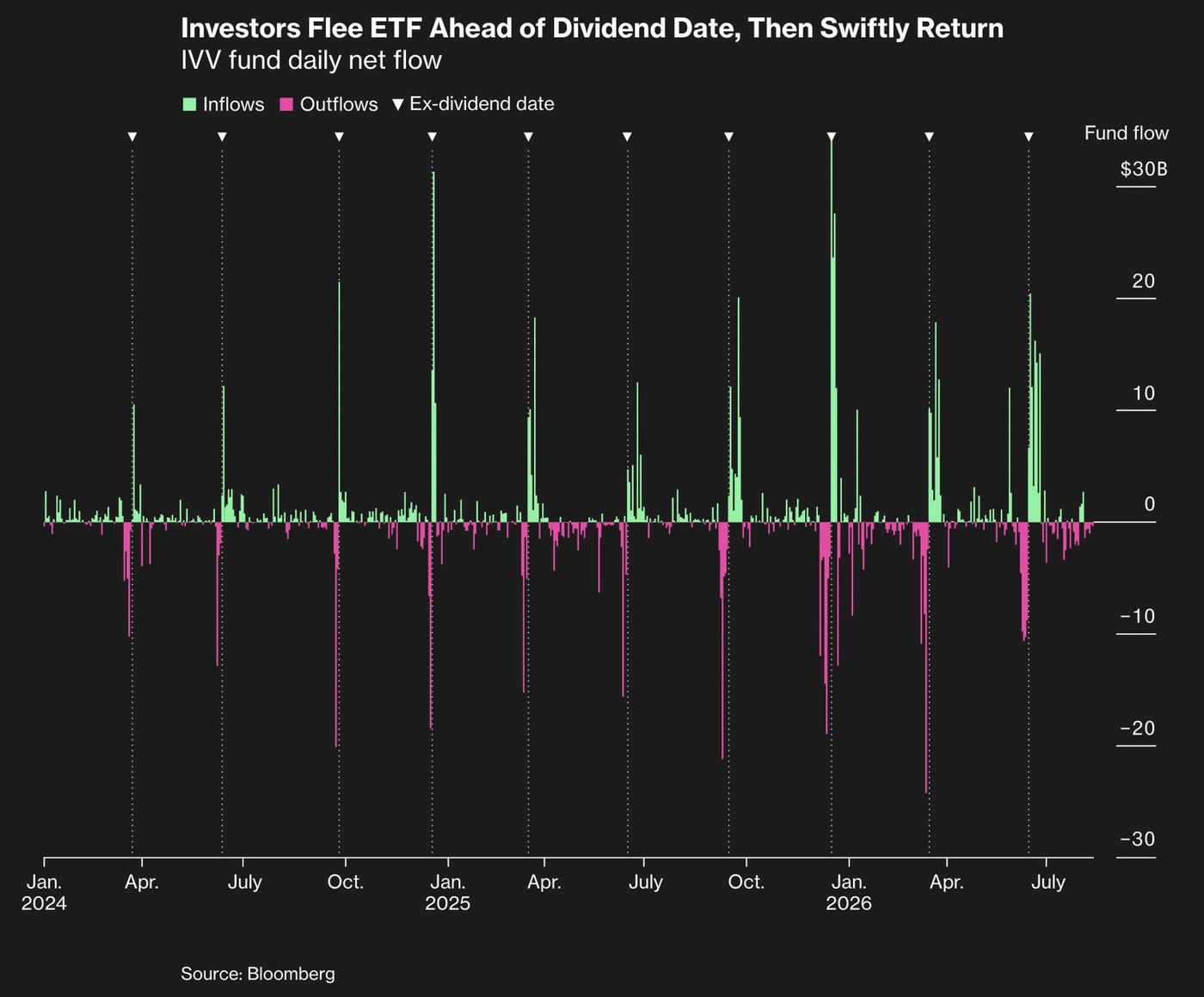
The pattern first became visible at scale in 2023. Based on the dollar volumes involved, Mider and Tsekova estimate the maneuver saved foreign investors approximately $147 million in U.S. taxes in 2025 alone. The phenomenon has since spread: State Street's SPDR Portfolio S&P 500 ETF (SPYM), which has grown to $168 billion in assets, displayed a similar pattern for the first time in June 2026. BlackRock's iShares 0-3 Month Treasury Bond ETF (SGOV) exhibits the same behaviour on a monthly basis, with flows of up to $1.3 billion pulling out just before its ex-dividend date and returning the following day.
Who Is Behind It
Pinpointing the participants precisely is difficult. ETF ownership is disclosed only quarterly through regulatory filings, and daily buying and selling is anonymous. That said, the reporting surfaces credible names. Vanguard executives believe Marshall Wace, the British hedge fund, may be a major participant. Marshall Wace was the third-largest holder of IVV as of June 30, 2026, with a $30 billion position. Spokespeople for both Vanguard and Marshall Wace declined to comment.
Royal Bank of Canada, the eighth-largest IVV holder at the same date, is identified as a major participant in the cash-and-carry trade, one of the primary strategies driving the switching behaviour. RBC also declined to comment.
The Actual Trade Underneath
The switching maneuver is rarely the entire transaction. Most participants are using ETFs as one leg of a more complex structure. The most common is the cash-and-carry trade, where an investor simultaneously sells S&P 500 futures while buying the index in the spot market via ETF, capturing the spread between the two. Mayank Mohan, CEO of Museum Mile Funds LLC and manager of more than $200 million, says the trade yields approximately 100 basis points above Treasuries, net of fees. The dividend withholding tax, he notes, "could eat up more than 30 basis points." Mohan says he has executed the switching trade on behalf of clients, and that "transaction costs are minuscule."
Natasha Sibley, a portfolio manager at Janus Henderson Investors, adds that cash-and-carry has grown popular due to a persistent gap between spot and futures prices, with sovereign wealth funds and pension funds among those pursuing it.
Regulatory Temperature
This is not the same as the ETF "heartbeat" transaction, which exploits a separate loophole to defer capital gains. The dividend-switching trade is simpler, depending only on the existence of multiple large, liquid, near-identical funds, and it has so far received a notably warmer reception from regulators.
At a July 2026 industry conference in New York, senior Treasury officials identified several ETF-related strategies as "potentially abusive," including pre-packaged fund structures designed to rotate between similar holdings to avoid dividends. When tax lawyer Jeffrey Hochberg of Sullivan & Cromwell asked whether those concerns extended to foreign investors rotating between near-identical funds directly, the official, Erika Nijenhuis, replied plainly: "That's not a focus."
Steven Rosenthal, former counsel to Congress's Joint Committee on Taxation, agreed the call was right. "It just seems like you're selling an S&P for another S&P," he said. "I would treat this as just fine from a tax perspective."
Five Key Takeaways for Advisors and Investors
1. Tax alpha is real, and it is systematic. The $147 million in estimated 2026 tax savings illustrates that sophisticated foreign institutions treat dividend withholding as a manageable cost, not a fixed one. Advisors serving non-resident clients should understand this strategy exists and is in active use by major institutional players.
2. ETF proliferation creates structural optionality. The switching trade only became practical once two large, low-fee, near-identical S&P 500 ETFs existed simultaneously. The growing depth of the ETF market is quietly creating new tax-management tools that did not exist a decade ago.
3. Cash-and-carry economics are tighter than they appear for taxable foreign investors. A 30-basis-point drag from dividend withholding on a 100-basis-point gross spread is material. Understanding the full tax cost of a strategy is as important as understanding the pre-tax return.
4. Regulatory clarity, for now, is favourable. Treasury's explicit statement that direct fund-switching by foreign investors is "not a focus" provides meaningful comfort, though advisors should monitor this posture as the scale of these flows grows and political attention to tax avoidance intensifies.
5. Fund-level dividend timing matters. BlackRock altered IVV's dividend timing in a way that made switching more convenient. State Street similarly adjusted SPYM's schedule. Advisors running international overlay or multi-product strategies should track ex-dividend calendars across major ETF providers as part of standard operational due diligence.
Footnote:
1 Mider, Zachary R., and Denitsa Tsekova. "A $40 Billion ETF Shuffle Helps Foreign Investors Dodge US Taxes." Bloomberg, 1 Sept. 2026, updated 2 Sept. 2026, https://www.bloomberg.com/graphics/2026-etf-foreign-investors-tax-dodge/.