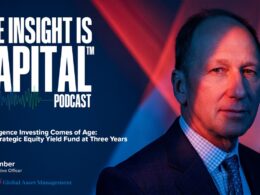





Sadiq Adatia, Chief Investment Officer at BMO Global Asset Management, breaks down the five-lens process driving portfolio decisions in the second half of 2026 — and explains why discipline, not prediction, is the real edge.
Every week, investors are inundated with headlines, most of which mean very little. The discipline to distinguish signal from noise is not a soft skill — it is, in Sadiq Adatia's view, the central competency of sound portfolio management. In a recent conversation on BMO ETFs' podcast Views from the Desk, Adatia — who authors the widely read weekly market commentary This Week with Sadiq — walked hosts Hilly Cutler and Zayla Saunders through the rigorous multi-lens framework that governs BMO GAM's investment positioning, the team's current views across asset classes, and what investors should be prepared for through the end of 2026.¹
Signal vs. Noise: The First Job
The conversation began with a question that sits at the heart of active asset management: how does a portfolio team stay oriented when markets are moving sharply and headlines are competing for attention?
Adatia's answer is structured. The team distinguishes between events that are likely to resolve within a few weeks or months — in which case they might generate a tactical trade but do not alter the strategic view — and events that represent a genuine, durable shift in fundamentals. His example is instructive: "If we thought that all of a sudden oil prices will now remain at about $100 a barrel, then that does change the outlook for the energy sector or anything that uses energy because the input cost now has dramatically changed. That would alter our longer-term view."
He is equally honest about the limits of this framework: "It's not always easy, to be honest with you. Sometimes noise does become a longer-term situation, and you don't know until maybe a month or two into it."
This epistemic honesty is characteristic of the approach. The team does not claim to identify every inflection point in real time. The goal is to avoid acting reflexively on what may be temporary dislocations while remaining alert to events that genuinely shift the investment case.
The Five Lenses: A Structured Process
The framework that anchors BMO GAM's asset allocation is what Adatia calls the five lenses. It draws on the views of more than eighteen people across the multi-asset solutions team, economists, technical and quantitative analysts, fundamental analysts, and chief strategists from both Canada and the U.S. Each contributor has a vote, but the votes are not equal-weighted — and the weights themselves shift dynamically based on track record.
"Someone's really good at getting the risk-on, risk-off part of that, they get a higher weight. Someone's better at the geographical part, they get a higher weight. So it really is taking advantage of everybody's expertise."
The five lenses run from macro risk appetite (Lens 1: risk-on vs. risk-off) through equity geography (Lens 2), fixed income (Lens 3), style and factor exposures (Lens 4), and finally implementation — currencies, commodities, sectors, and instruments (Lens 5). Each lens is scored from -3 to +3, where +1 represents a 1-2.5% overweight, +2 a 2.5-5% overweight, and +3 a conviction call requiring near-unanimous agreement across the team. A -3, Adatia notes, has never been reached — a reflection of a team that has, on balance, maintained a constructive stance through recent market cycles.
Current Positioning: Still Bullish, But Watching Carefully
The team's current scorecard is notable both for what it believes and what it is beginning to question.
On Lens 1, the team remains +1 on equities and -1 on fixed income. "Earnings are still fantastic, so we want to continue to play the fundamentals here," Adatia says. The primary watch item is whether that conviction holds: "We are looking at potentially reducing some of that allocation and just moving it around. So not taking the equity weight down, but just adjusting that."
On the equity geography side (Lens 2), the U.S. remains the core conviction. "We think the consumer is the strongest there. The best earnings are coming from those companies. We do still believe in the AI theme longer term." Emerging markets also rank positively, particularly Korea, Taiwan, India, and China, where valuations are lower and AI-linked earnings tailwinds are real. Canada has been moved to neutral after a prolonged underweight. International developed markets remain underweight: "We just don't see the fundamentals very good across the board."
Fixed income (Lens 3) is, in Adatia's words, being played as "the boring part." The team holds no material duration call and is not reaching for credit risk. His reasoning is pointed: "Fixed income is actually the one asset class that is actually getting the risk side of it right. So it's actually fairly priced." With central banks in wait-and-see mode — Adatia expects both the Fed and the Bank of Canada to hold rates through the balance of 2026, despite pressure in both directions — there is no compelling case to take a strong view on duration.
On style and factors (Lens 4), the team has rotated away from pure growth and momentum exposure and is tilting toward small-cap, managed actively rather than passively. "Each company is gonna be impacted by what goes on with the consumer, what goes on with interest rates. The small-cap companies have a harder time to get access to capital." Active selection matters most when the environment is uncertain, Adatia argues — passive makes more sense when conviction is high and tide-lifts-all-boats conditions prevail.
On the implementation lens (Lens 5), two calls stand out. The team has moved to a slight overweight on the Canadian dollar for the first time, seeing the loonie as undervalued and positioned to appreciate gradually as rate differentials and USMCA dynamics evolve. And the team remains bullish on gold — a position held since 2023 — even after taking profits on the way up. The thesis rests on renewed central bank buying, geopolitical hedge demand, and the view that the retail buyer's absence is temporary. "We think that earlier in the year, we saw a lot of people move away from gold. Central bankers who used to buy up gold decided to buy up more of energy names... We think now that's somewhat stabilized in that $80 range right now, we're starting to see that activity come back again on central bankers buying up more gold."
The Second Half: Volatility, Rotation, and Protection
Looking ahead, Adatia's message is consistent: stay constructive on earnings, but build in more protection and begin rotating toward better value.
"Count on volatility still being around," he says. Iran-U.S. tensions, a U.S. election cycle, the October renewal of U.S.-China tariff deferrals, and the ongoing uncertainty around USMCA negotiations all represent potential catalysts for short-term dislocations. The appropriate response is not to exit risk, but to be more deliberate about where it sits. "Not a bad time to rotate. You can always start to find better value out there. And that might be the theme that we might see in the second half — a bit of rotation, a bit of garnering profits, but still putting your foot on the pedal, but maybe with some protection and hedges around the way."
One data point he finds encouraging: value ETFs have not posted a single week of net outflows since January. "I think people have gotten a little smarter about investing. And that tells me that rotation is already happening."
Five Key Takeaways for Advisors and Investors
1 Distinguish between noise and a fundamental shift. Not every sharp market move requires a portfolio response. The team's discipline is to ask whether an event changes the long-term investment case — or whether it is simply a temporary dislocation to be managed or ridden through. Most things are noise. A few things are not.
2 Earnings remain the anchor. Despite elevated valuations and growing geopolitical risk, corporate earnings continue to justify a constructive stance on equities. U.S. corporate earnings are tracking approximately 25% higher year-over-year as of early reporting. Fundamentals still matter, and eventually they still drive stock prices.
3 Diversification is becoming more urgent, not less. The risk-reward calculus on technology and AI-linked names looks different today than it did two years ago. The team is actively rotating within equities — toward small-cap, toward select emerging markets, and away from the largest-cap hyperscalers — to improve the value proposition of the equity allocation without reducing overall risk appetite.
4 Fixed income deserves neutral respect. The boring call is the right call when neither the rate direction nor the credit environment offers a compelling edge. Holding neutral duration and avoiding credit risk is not a failure of conviction — it is an acknowledgment that fixed income is, unusually, fairly priced relative to the uncertainty embedded in the macro picture.
5 Gold and the Canadian dollar represent undervalued hedges. Both offer asymmetric upside in scenarios that markets appear to be underpricing: geopolitical escalation, a weaker U.S. dollar, and a gradual normalization of Canada's economic and currency position. Neither is a momentum trade — both are structured as portfolio hedges against tail risks that Adatia argues are not yet reflected in asset prices.
Source: Adatia, Sadiq, Hilly Cutler, and Zayla Saunders. "A CIO's Framework for Tuning Out the Noise." Views from the Desk, BMO Global Asset Management, 10 Aug. 2026, https://www.bmoetfs.ca/articles/podcast-a-cios-framework-for-tuning-out-the-noise-july-20-2026.