





The investment landscape is undergoing a structural realignment — one that rewards diversification for the first time in more than a decade. In a report published August 3, 20261, Goldman Sachs Global Investment Research's Peter Oppenheimer, Sharon Bell, Guillaume Jaisson, Elena Porfidia, and Jacinta Feng lay out the case that the narrow, concentrated market of the post-financial crisis era has given way to something broader, more nuanced, and for prepared investors, more rewarding.
The US Is No Longer the Only Game in Town
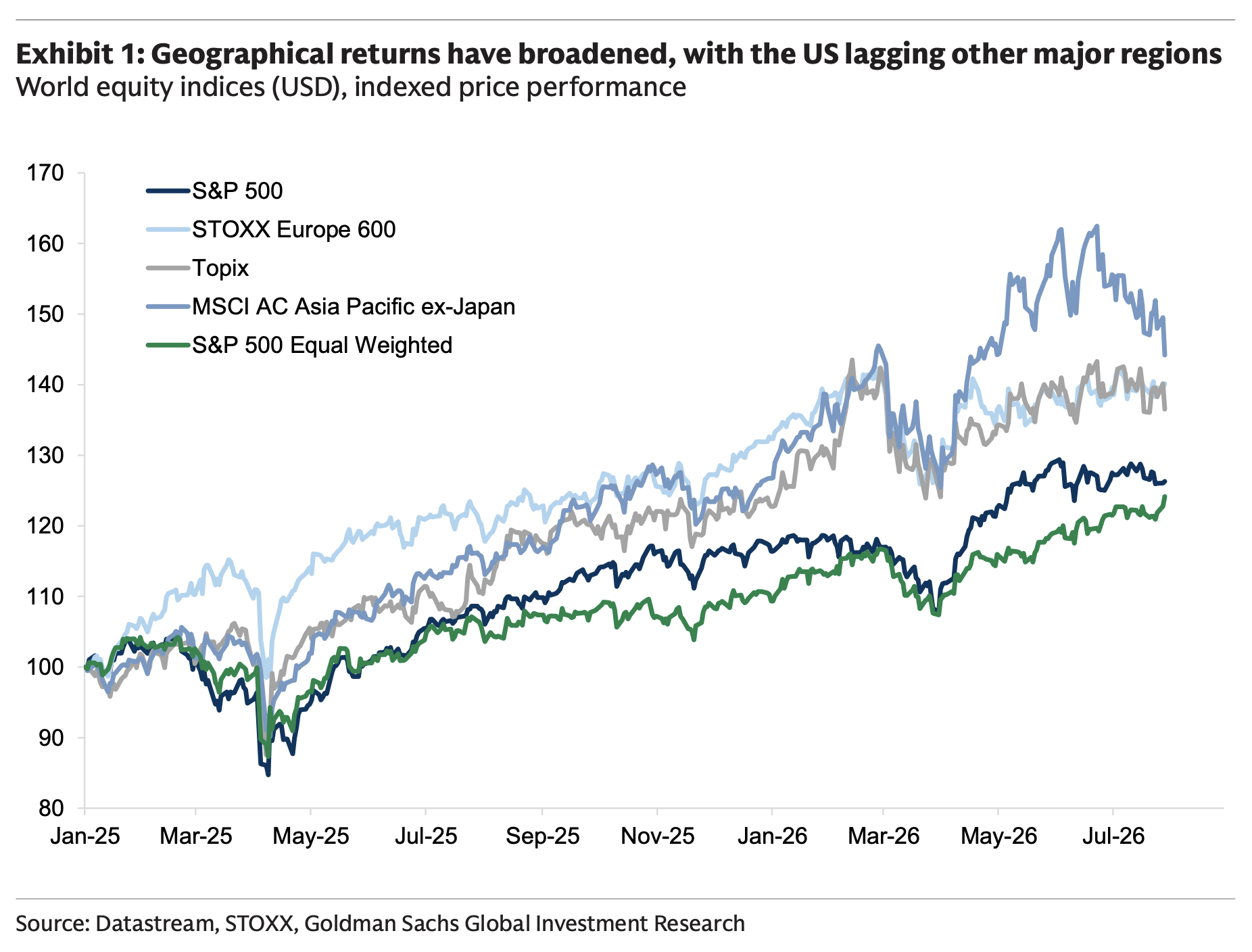
For fifteen years following the financial crisis, the pattern was predictable: US equities dominated regionally, Technology led sectorally, and Growth outpaced Value. That era has ended. "Since 2025, and again through this year," Oppenheimer writes, "the opportunity set has shifted. Equities have performed well, but the geographical spread has widened. The US has been the weakest of the major regions." The strongest returns, in local currency terms, have come from Japan, Asia Pacific, and Emerging Markets.
What makes this rotation durable rather than merely tactical is its foundation. Returns are no longer being driven by multiple expansion or the artificial support of near-zero interest rates. Instead, earnings growth is doing the heavy lifting. Asia, EM, and the US have all de-rated. Japan and Europe have seen modest valuation increases. "More government debt, increased issuance, and persistent inflation have all contributed to a higher cost of capital," the team observes, "leaving earnings as the key driver of returns." Earnings revisions, unusually, have continued to rise alongside strong reported results — a fundamental underpinning that the team views as sustainable.
Concentration Is Unwinding
The report identifies a meaningful structural shift in market breadth. For the first time since 2009, the equally weighted S&P 500 has outperformed the cap-weighted S&P 500 by more than 7.3%. The dominance of a handful of mega-cap names — which for years drove the bulk of index returns — is giving way to broader participation. Resilient economic conditions in the US and Europe, a pick-up in M&A activity attracting interest away from the largest-cap stocks, and a sharp momentum unwind have all accelerated this shift.
At the center of it all is a reckoning in Technology. The hyperscalers that once generated exceptional free cash flow while piggybacking on dot-com era infrastructure have pivoted aggressively into capital expenditure. "The US equity market, dominated by the hyperscalers, has experienced a sharp decline in FCF yield relative to more value-oriented markets, such as Europe," Oppenheimer notes, "helping to support the rotations of relative performance." The premium that the top five S&P 500 stocks commanded over the remaining 495 — consistent since 2017 — has all but evaporated. Software's valuation premium globally has collapsed from nearly 200% at the turn of the century to around 20% today.
Capex, Industrials, and the Super Cycle
The flip side of Technology's de-rating is the re-rating of sectors long neglected by growth-oriented capital. The scale-up in hyperscaler and chip company capex, combined with government borrowing directed at energy security, critical infrastructure, and defense, has ignited what the team calls a capex "super cycle." Industrials now carry the highest sector valuation globally — above their 20-year range. Consumer Staples, Discretionary, and Healthcare are all now more richly valued than IT or Communication Services on a price-to-earnings basis.
The risk embedded in Technology is not primarily a valuation bubble, the team argues, but potentially an earnings bubble. "Across Technology, there does not appear to be a valuation bubble, but there may be an earnings bubble." Implied future growth, while rising, remains well below dot-com era peaks — yet the 10-year EPS CAGR has already surpassed those peaks, raising legitimate questions about sustainability.
Alpha Is Back
With pairwise stock correlation falling across all major markets, idiosyncratic risk is re-emerging as a driver of returns. Stocks within the same sector are moving less in lockstep. Quality and Growth baskets have de-rated sharply. HALO stocks and more value-oriented positions have outperformed. "The opportunity to selectively find value in growth areas is rising," Oppenheimer writes. Energy has performed well on modest earnings; IT has delivered strong earnings growth and been rewarded with de-rating. The divergence between earnings and price is exactly where active managers find their edge.
5 Key Takeaways for Advisors and Investors
1 Diversify geographically. US underperformance is not an aberration. Japan, Europe, and Asia Pacific now offer competitive returns backed by earnings, not just cheap valuations.
2 Earnings quality matters more than ever. With the cost of capital structurally higher, valuation expansion cannot be counted on. Portfolios should be stress-tested for earnings durability, not just multiple resilience.
3 Revisit the equal-weight argument. The outperformance of equal-weighted versus cap-weighted exposure reflects a genuine broadening. Concentration risk in mega-cap names deserves a second look.
4 The Industrials re-rating is real. The capex super cycle has fundamental backing. Exposure to infrastructure, energy security, and defense-linked Industrials is no longer contrarian — but selectivity within the sector matters as valuations have stretched above historical ranges.
5 Active management has a tailwind. Falling pairwise correlations, sector rotations, and the divergence between earnings and price create exactly the conditions where skilled stock selection adds value. This is not a market to own passively and walk away from.
Footnote:
1 Oppenheimer, Peter, Sharon Bell, Guillaume Jaisson, Elena Porfidia, and Jacinta Feng. "Momentum, Rotation and the Value in Growth." Goldman Sachs Global Strategy Views, Goldman Sachs Global Investment Research, 3 Aug. 2026, https://www.gspublishing.com/content/research/en/reports/2026/08/03/9af2c021-fa54-4599-a433-648d8e78aac1.pdf.