




by Jeffrey Buchbinder, Jeffrey Roach & Adam Turnquist, LPL Research
AI's growing economic footprint: The AI boom is becoming increasingly intertwined with the broader U.S. economy, fueling a surge in imports of semiconductors and servers while making data-center construction an important source of business investment.
Trade deficit and political scrutiny: That spending has supported growth but also widened the trade deficit, while a changing political landscape could bring greater scrutiny to the power demands, permitting and costs associated with the buildout. None of that necessarily derails the AI investment cycle, but it could introduce more friction after a period of breakneck expansion.
Why fundamentals still matter: For investors, the shift is a reminder that enthusiasm over new technology ultimately runs into an old market reality: Capital spending can drive an investment boom, but productivity, profits, inflation and interest rates will determine whether it delivers lasting returns.Additional content provided by Jeffrey Buchbinder, CFA, Chief Equity Strategist and Adam Turnquist, CMT, Chief Cross Asset Strategist
Retain Your Focus on Economic Fundamentals When Markets Get Volatile
The AI boom is reshaping the U.S. economy in ways that are becoming increasingly difficult to separate from the broader macroeconomic outlook. The race to build AI infrastructure has fueled a surge in imports of semiconductors, servers, and other computing equipment, while datacenter construction has become an increasingly important source of business investment. Recent market volatility following the election results has understandably captured investors’ attention, but the underlying economic fundamentals remain an important anchor amid the political noise. In the third quarter, real GDP still grew at a 3.4% annualized rate, but a widening trade deficit subtracted roughly 3.3 percentage points from growth as imports soared.
Now the political backdrop surrounding that investment boom is changing and was a catalyst for the recent selloff. Democrats have won control of both chambers of Congress, while Democratic gains in several states could bring greater scrutiny of the enormous power requirements, permitting rules, incentives, and costs associated with datacenter construction. In Texas, for example, Democrat Gina Hinojosa defeated Republican Governor Greg Abbott after a campaign in which datacenter expansion became a political issue. That does not mean the AI buildout is about to stop. But the political shift could introduce more friction into what until now has been an extraordinarily rapid investment cycle.
For investors, that changing backdrop offers a useful reminder. Excitement surrounding AI has sometimes overshadowed a more familiar truth that over longer periods, markets remain tethered to economic growth, inflation, productivity, profits, and interest rates. The question is no longer simply how much capital companies are willing to commit to AI. Increasingly, it is whether those investments can generate the productivity gains and earnings needed to justify them.
Surging Imports Had Their Largest Impact Since 1947
One of the clearest signs of AI's economic footprint is showing up in international trade.
The trade deficit subtracted about 3.3 percentage points from third quarter GDP growth as imports surged, even as the economy expanded at a healthy 3.4% annualized pace. Excluding the unusual import swings surrounding the 2025 tariff announcements, the size of the drag stands out historically.
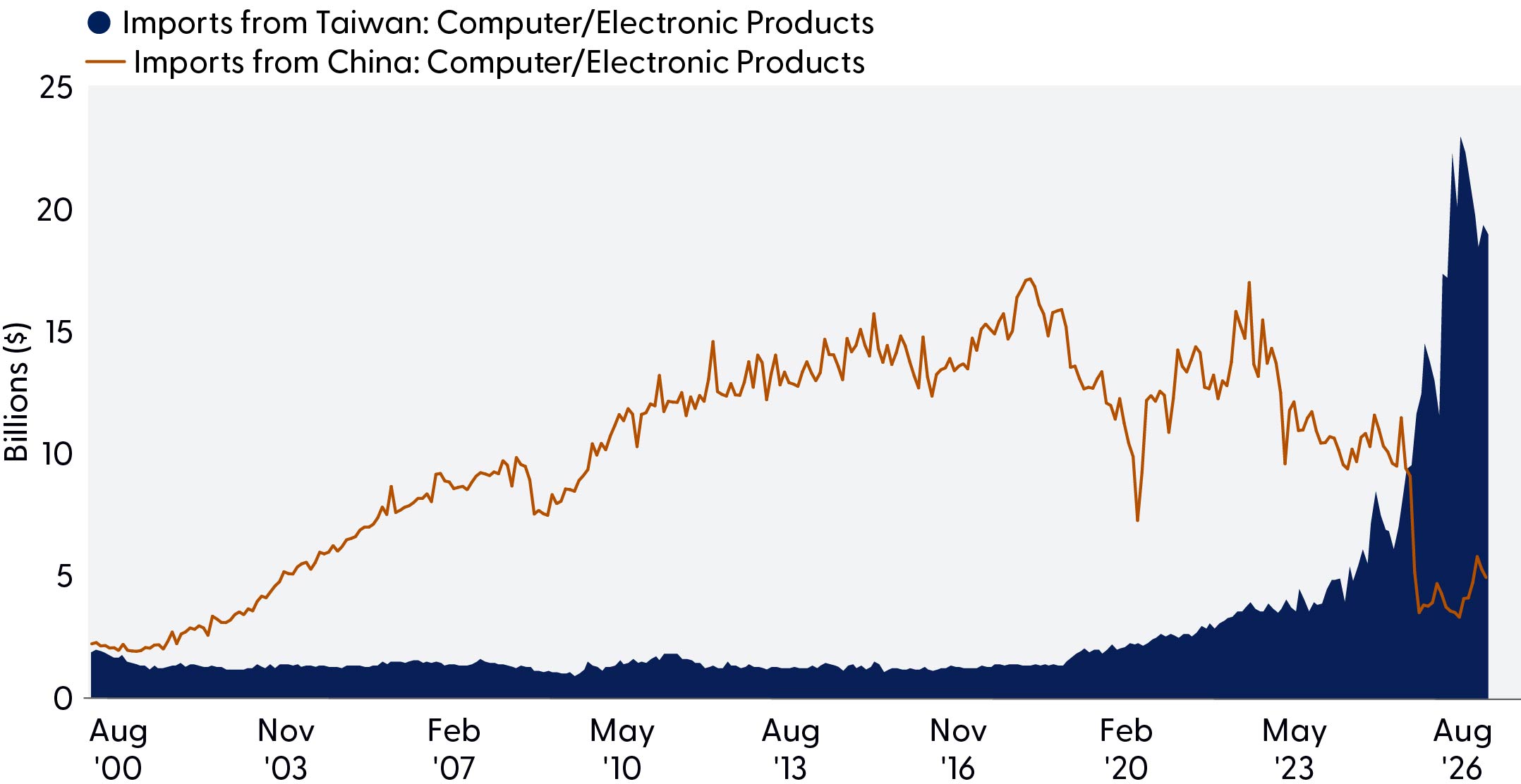
The AI Buildout Is Reshaping International Trade
Source: LPL Research, Census Bureau, 11/04/26
Past performance is no guarantee of future results. Economic forecasts may not develop as predicted.
The explanation is fairly straightforward. American technology companies are pouring capital into data centers and computing capacity, but much of the physical equipment needed to build that infrastructure is manufactured abroad. Servers, semiconductors, storage systems, networking equipment, and other advanced electronics are flowing into the U.S. at a rapid pace. The result is an unusual dynamic: an investment boom financed largely by American companies is generating significant demand for manufacturers outside the U.S.
AI has consequently become an important force in global trade, even as trade barriers have risen. Companies initially rushed to bring goods into the U.S. ahead of tariffs, but the continued strength in imports suggests something more fundamental is at work. Demand for computing capacity remains strong enough to offset some of the restraint created by higher trade barriers. Earlier this year, for example, semiconductor imports helped push capital-goods imports to record levels amid growing AI investment.
The AI boom is also changing where America buys its goods. China's share of U.S. imports has fallen sharply, while Taiwan, Mexico, Vietnam, and India have gained ground. The magnitude of the increase in technology imports from Taiwan and Mexico suggests this is about more than shifting existing trade away from China. AI is creating new demand while global supply chains are being reorganized.
Taiwan occupies a particularly important position because of its role in advanced semiconductors and computing equipment. Mexico's role is different but complementary. Its integration into North American manufacturing makes it an increasingly important conduit for the servers, electronics, and other equipment going into U.S. data centers.
The effects may even be reaching consumer prices. Strong data center demand for memory chips and other electronic components can create competition for inputs used elsewhere in the economy. That offers another indication of the scale of the investment cycle: AI infrastructure is increasingly competing for resources beyond the confines of the technology sector.
AI’s Next Boom May Be in the Jobs That Put It to Work
In a new unexpected twist, the corporate drive to increase AI adoption may be creating a new tech-consulting boom. October’s jobs report offered another sign that the labor market remains on solid footing, with payrolls rising 165,000, unemployment falling even as labor-force participation increased, and prior months revised higher. One particularly interesting pocket of strength is management and technical consulting, where demand may be offering an early glimpse of how AI is changing the composition of hiring. Companies are not simply spending on chips, servers, and data centers, they are also hiring specialized workers who can help integrate new technology into existing workflows and turn that investment into productivity gains. There is a useful precedent in the late 1990s, when management and technical consulting jobs posted sustained double-digit growth as businesses raced to adopt computers, software, and the internet. Today’s AI boom could be producing a similar dynamic. The infrastructure buildout may grab the headlines, but rising demand for technical consultants suggests the next phase may increasingly be about AI adoption and implementation across the broader economy.
Now to The Post-Election Setup
As of November 6, Democrats are projected to hold roughly 256 seats in the House and have secured at least 54 Senate seats, although several dozen House races and Senate contests in Alaska and Mississippi remain unresolved. The result creates a divided federal government, with a Democratic Congress facing a Republican White House.
Historically, the period surrounding midterm elections has often generated market volatility as investors weigh potential changes in taxes, spending, and regulation. This year's drawdown into Election Day was smaller than the average decline historically associated with midterm election years. Markets have also had to digest an economy that remains relatively strong alongside considerable policy uncertainty.
The relative resilience of broad equity indexes makes more sense when viewed through the economic backdrop. Growth has remained solid, corporate profits have been supportive, and investors had increasingly anticipated the possibility of a divided government. Gridlock limits the scope for sweeping fiscal legislation, while several Trump administration priorities, including deregulation and elements of trade and immigration policy, can still be pursued through executive and regulatory authority.
Where Policy Could Matter
Several areas deserve particular attention.
- AI and data centers. Data center construction may be one of the most consequential post-election investment issues. Congress matters, but many of the decisions governing data center construction are made by states, municipalities, and utility commissions. That makes gubernatorial races particularly important.
- Texas illustrates the point. Democrat Gina Hinojosa defeated three-term Republican Gov. Greg Abbott in a historic upset. Data centers were an explicit issue in the campaign: Abbott had announced a pause on new state permits, while Hinojosa questioned whether the restrictions went far enough and supported calls for a moratorium until additional protections could be established.
- LPL Research continues to expect the broader AI buildout to move forward. But greater political scrutiny, combined with local opposition to new facilities, could slow development or increase regulatory costs. That could affect portions of the AI infrastructure ecosystem, including semiconductors, electrical equipment, machinery, and power generation.
- Healthcare and consumer spending. A Democratic Congress could seek to soften previously enacted reductions to healthcare insurance and nutrition programs. Changes to Medicaid or Supplemental Nutrition Assistance Program funding could provide modest support to household spending while benefiting portions of the healthcare-services industry.
- Defense. Gridlock presents both opportunities and risks. A bipartisan budget agreement could pair Democratic domestic priorities with additional Republican-supported defense spending. Without such a compromise, however, repeated continuing resolutions could complicate planning and procurement for defense contractors.
- Banking deregulation. The election results are unlikely to halt the Trump administration's deregulatory agenda, much of which can proceed through federal agencies. A Democratic Congress could nevertheless slow parts of that process and increase political scrutiny. That could encourage some companies to accelerate mergers and acquisitions before the regulatory environment potentially becomes more restrictive.
- Treasury yields. A divided government also reduces the probability of another large fiscal expansion beyond what is already legislated. That could limit incremental Treasury issuance relative to a scenario involving another major reconciliation package and, at the margin, reduce one potential source of upward pressure on longer-term yields. A slower pace of data center construction could also put some incremental downward pressure on interest rates.
Seasonal Tailwinds: Can Risk Appetite Return?
Midterm elections have historically acted as something of a clearing event for markets.
In the weeks before Election Day, uncertainty about congressional control, taxes, regulation, and spending often encourages investors to hedge portfolios. Once the election passes, one source of uncertainty disappears. Investors can stop positioning around what might happen and begin adjusting to what actually happened.
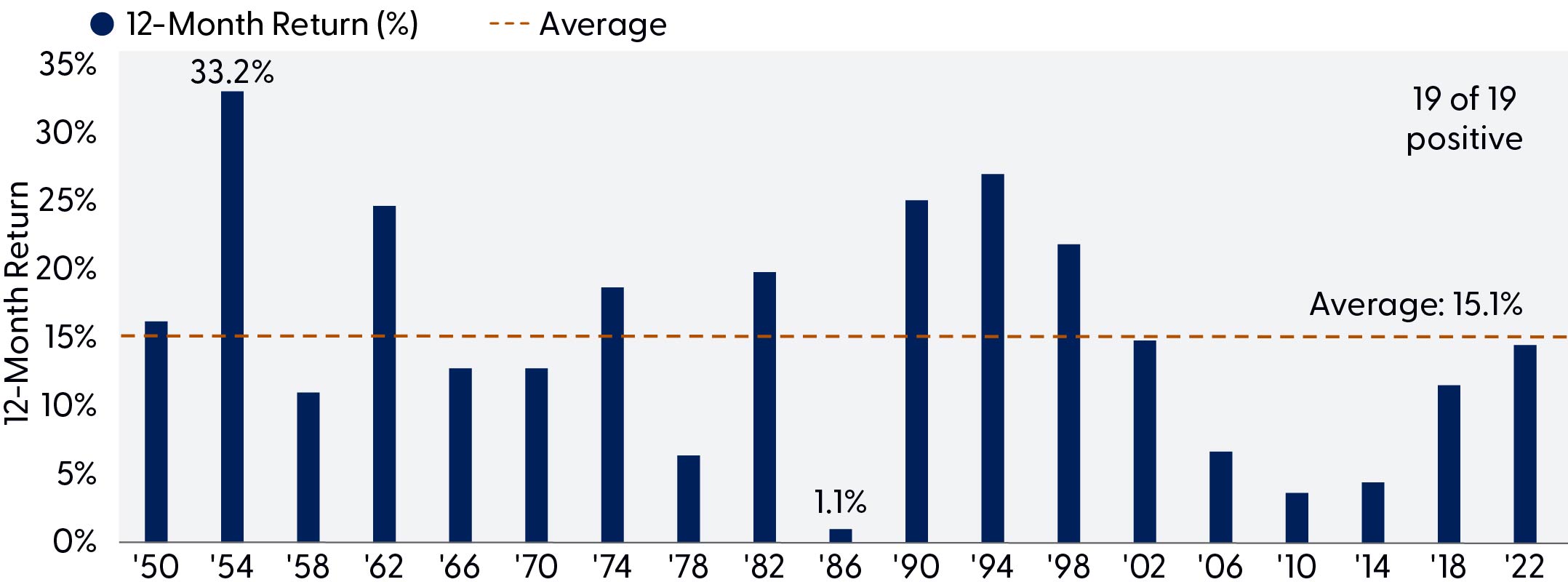
Historically, that transition has been favorable for equities. Since 1950, the S&P 500 has been higher 12 months after each of the last 19 midterm elections, producing an average gain of 15.1%. Even the weakest period finished higher: After the 1986 midterms, the index gained 1.1% over the subsequent 12 months despite the October 1987 crash occurring near the end of that window.
S&P 500 Post-12-Month Midterm Election Day Performance
Source: LPL Research, Bloomberg, 11/03/26
Disclosures: All indexes are unmanaged and cannot be invested in directly. Past performance is no guarantee of future results.
The modern design of the S&P 500 stock index was first launched in 1957. Performance back to 1950 incorporates the performance of the predecessor index, the S&P 90.
History is encouraging, but it shouldn't be mistaken for a forecast. Nineteen observations are a relatively small sample, and economic conditions, earnings, valuations, and monetary policy ultimately matter more than the calendar. And that brings us back to the more important point. Political opinions are best expressed at the polls, not in portfolios.
Conclusion
What happens in Washington matters. Elections can alter taxes, government spending, regulation, and the incentives facing businesses and households. But politics alone does not determine the direction of the economy or financial markets. More powerful forces usually do.
Corporate earnings, consumer spending, inflation, interest rates, credit conditions, and monetary policy remain crucial to the economic and market outlook. Increasingly, that list also includes the secular AI investment cycle, which has become an important contributor to capital spending, trade flows, corporate profits, and market performance.
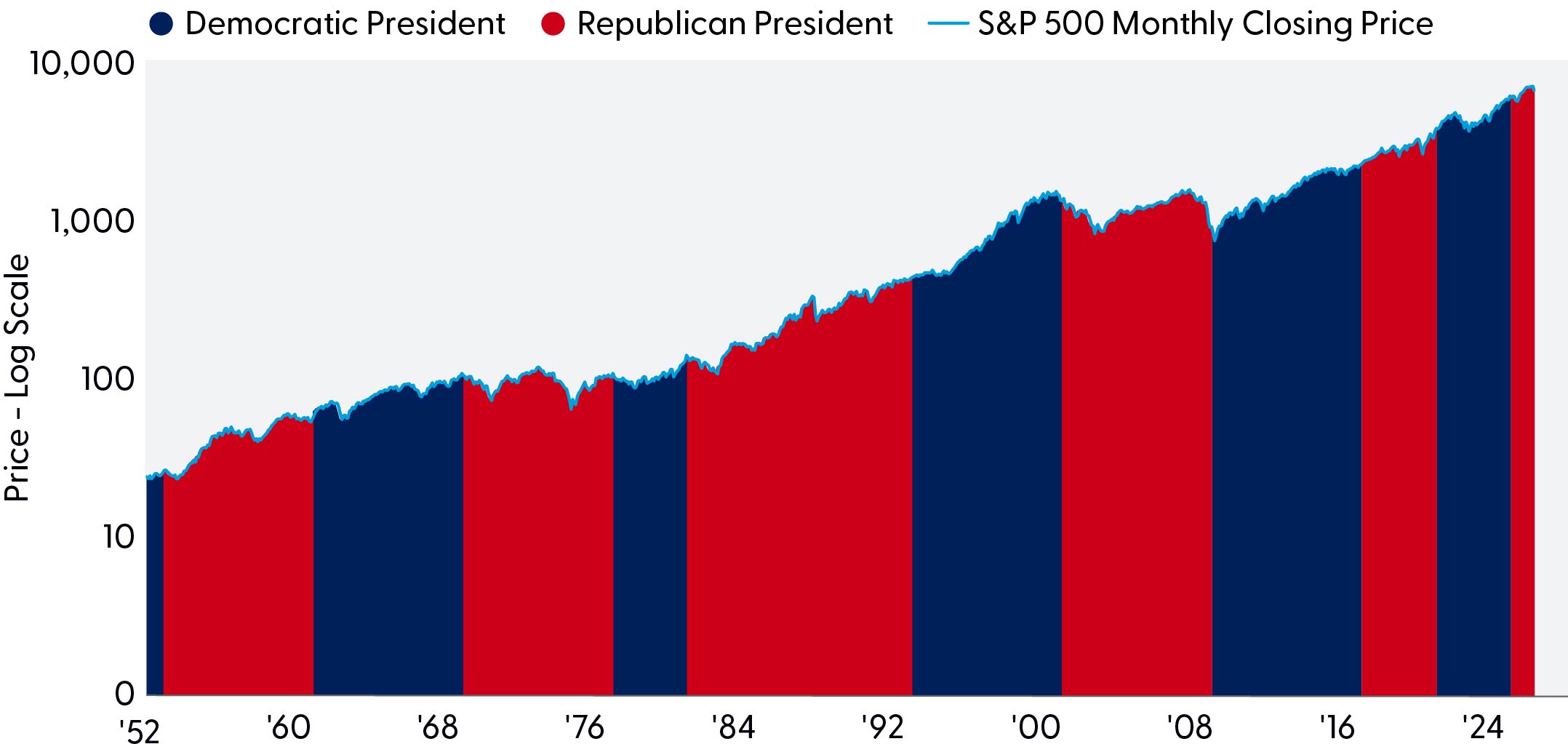
Stocks Have Historically Fared Well Under Various Political Combinations
Source: LPL Research, Bloomberg 11/05/26
Disclosures: All indexes are unmanaged and cannot be invested in directly. Past Performance is no guarantee of future results.
The modern design of the S&P 500 stock index was first launched in 1957. Performance back to 1950 incorporates the performance of the predecessor index, the S&P 90.
For long-term investors, we believe political opinions are best expressed at the polls, not in portfolios. The S&P 500 has historically advanced under a variety of political configurations because, over longer horizons, economic growth and corporate profitability have mattered more than party labels.
That principle may be especially useful now. The election could alter the path of the AI infrastructure boom, particularly in states where data center development is colliding with concerns about power availability, costs, and local opposition. But politics is only one part of the equation.
The more important question for markets is whether the massive amount of capital being deployed today translates into stronger productivity, earnings, and economic growth tomorrow.
For now, investors have several fundamental supports to consider: solid economic growth, resilient corporate profits, and the prospect that inflation pressures ease in the coming year. AI adoption could add another leg through productivity improvements, although investors will increasingly demand evidence that today's enormous capital expenditures can generate attractive returns.
Washington can change the rules of the game, but economic fundamentals still determine the score.
Asset Allocation Insights
LPL’s Strategic and Tactical Asset Allocation Committee (STAAC) maintains its recommendation for a tactical equity overweight and fixed income underweight. We believe AI-driven earnings strength, prospects for an improvement in the macro backdrop, post-midterms policy clarity, and positive seasonal trends provide a favorable risk-reward trade-off through 2026. The Committee favors the quality factor domestically to express the tactical equity overweight, backed by resilient U.S. economic growth, AI innovation, and relative insulation from possible additional energy shocks.
The Committee holds a slight preference for the value style over its growth counterpart given cyclical tailwinds, relatively more attractive valuations, and our positive view of the energy sector. The Committee believes the technology sector valuations are attractive and that skepticism around the AI buildout has become overly pessimistic post-midterms.
The STAAC recommends neutral duration positioning in fixed income allocations relative to benchmarks on the competing narrative of the AI story and any potential slowdown. But keeping some duration in portfolios is worth considering, given that starting yields for 10- and two-years provide a cushion. However, the long end should be kept on a shorter leash, in our view. Fiscal deficits and price-insensitive corporate supply will keep the term premium elevated, even in a slowdown. We would not chase 30-year Treasuries until AI issuance shows signs of cresting.
In credit, hyperscalers should be treated as a supply trade, not a credit trade, and we would be more cautious on long-dated hyperscaler paper ahead of what we expect to be even heavier supply in 2027. Lastly, neocloud borrowers, BBB issuers with heavy data center lease commitments, and project vehicles that depend on a single tenant carry the real AI credit risk. Their spreads are the proverbial canary in the coal mine. Be cautious.
Jeffrey Buchbinder, CFA, Chief Equity Strategist, LPL Financial
Jeffrey Roach, PhD, Chief Economist, LPL Financial
Adam Turnquist, CMT, Chief Cross-Asset Strategist, LPL Financial
Copyright © LPL Research