




by Jane Bleeg & Vinay Thapar, AllianceBernstein
Compelling growth drivers and relentless innovation make a strong case for healthcare stocks today.
From earlier detection and more precise treatments to smarter medical technology, the healthcare sector continues to reinvent products that improve and save lives. Yet healthcare stocks have struggled to reflect that progress, overshadowed in recent years by investor enthusiasm for AI beneficiaries. We believe the sector’s strong fundamentals, durable business models and attractive valuations offer recovery potential and diversification benefits for long-term equity investors.
The structural forces supporting healthcare growth remain intact: aging populations need more and increasingly complex care, people are more engaged with their health, and innovation persists across medical devices, life sciences and diagnostics. So why have healthcare stocks underperformed?
What’s Been Weighing on Healthcare?
We believe two factors explain the weakness: market concentration around AI beneficiaries and policy uncertainty.
Since the launch of ChatGPT in late 2022, equity returns have become increasingly concentrated in a narrow group of AI-related companies, and investor flows followed suit. Technology funds attracted about $306 billion from January 2023 through September 2026, while healthcare funds saw outflows of roughly $31 billion, according to EPFR. During the same period, healthcare stocks advanced by a cumulative 27%, far behind the MSCI World Index’s 99% and technology’s 225%.
To a lesser degree, US policy uncertainty has also pressured healthcare stocks. Concerns about potential tariffs on pharmaceuticals and medical devices, initiatives to align US drug prices with those in other countries, and margin pressures in managed care weighed on investor sentiment. We believe that many, if not all, of these concerns have now been put in the rearview mirror, having little to no impact on the underlying healthcare profit pool.
These challenges have shaped market perception despite healthcare’s robust fundamentals. The healthcare sector is projected to deliver double-digit earnings growth in the coming years, according to consensus estimates. Its share of the US economy is expected to grow from 18.7% in 2026 to 20.6% in 2034, based on data from Centers for Medicare & Medicaid Services.
Demographics Support Sustainable Growth
Many healthcare companies enjoy a consistent source of demand from a rapidly aging population worldwide. Through 2030, the number of people aged 65 and older is projected to grow by about 2.7% a year, roughly four times faster than the world population overall and six times faster than people younger than 65, based on UN data. Older people account for more than double the healthcare spending of any other age group.
More people living longer create a structural tailwind for higher spending on healthcare goods and services, from drugs to technology to long-term care. Based on historical experience, we believe these trends are likely to continue even when economic growth slows, as people still need medicines, diagnostic tests and medical procedures.
Innovation Spans Healthcare Segments
Blockbuster medicines, such as GLP-1 weight-loss drugs, often command the innovation spotlight. Innovative breakthroughs can also be found across pharmaceutical segments from oncology to immunology. Beyond pharma, advances in medical devices, diagnostics, healthcare services and life sciences continue to reshape how diseases are treated and managed.
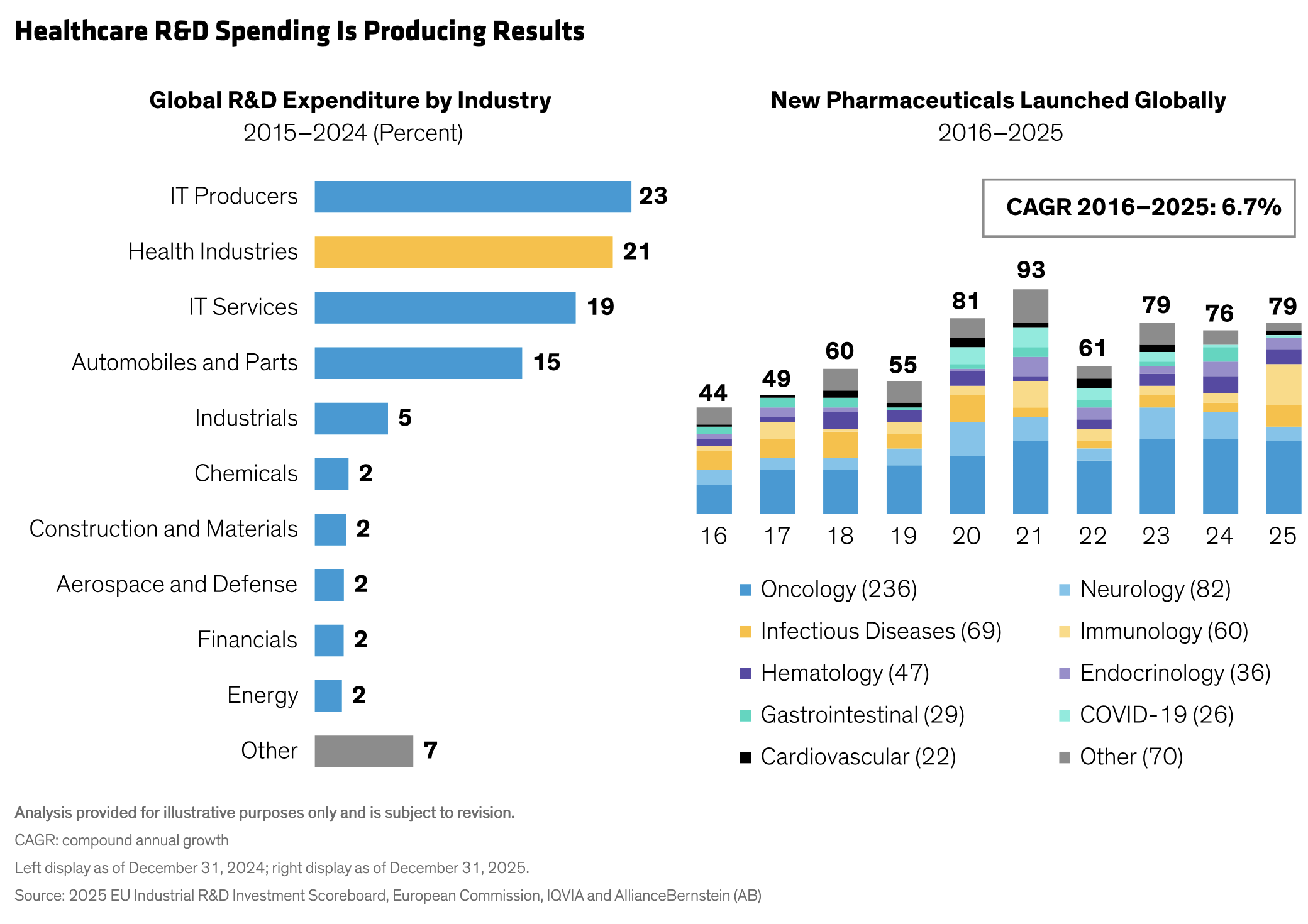
As a result, healthcare is one of the most research-intensive sectors, accounting for 21% of all global R&D spending (Display). These investments have translated into a steady increase in new treatments.
Personalized medicine is an illustrative case. In August 2026, Moderna and Merck reported positive trial results for an experimental cancer vaccine tailored to the mutations in individual patients’ melanoma tumors. Eventually, personalized vaccines may be able to fight a range of cancers, transforming oncology. In our view, creative approaches, new treatment options and upgraded tools often inspire further innovations, creating sustainable long-term value for healthcare companies and shareholders.
Unlocking Value with AI
Healthcare doesn’t need AI to grow. Without AI, the sector has consistently delivered low-double-digit annual earnings growth.
That said, AI adoption could make that growth even faster, in our view. The healthcare sector is labor-intensive, with employee costs representing about 51% of output, compared to an average of 30% for all industries, according to the Bureau of Economic Analysis. This suggests meaningful scope for AI-driven productivity gains in healthcare.
AI applications could also help healthcare companies discover new drugs and bring them to market faster, improve diagnostic speed and accuracy, and reduce administrative burdens related to data collection and sharing. We see AI as a driver of differentiation for healthcare companies, leading early, strategic adopters to improve their earnings growth and equity return potential in the coming years.
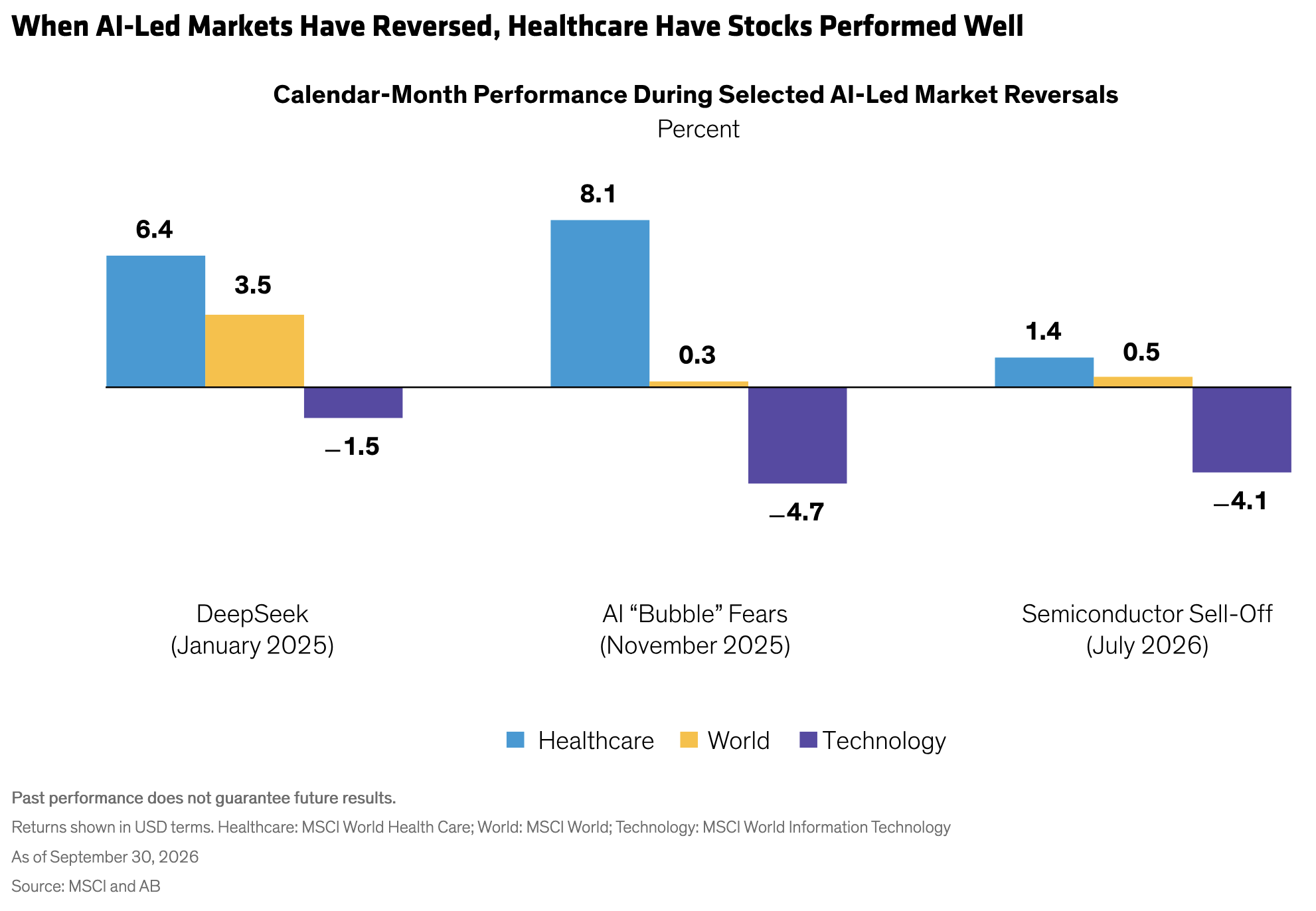
Yet for the vast majority of healthcare companies, this upside isn’t reflected in valuations today. As a result, we believe healthcare offers diversification from the AI trade while still providing investors with access to attractive earnings growth potential. In fact, during three recent AI-related sell-offs, healthcare fared better than both technology stocks and the broader market (Display). In our view, the sector’s low correlation with AI performance makes healthcare an attractive diversifier in a market closely tied to investor expectations surrounding a limited group of companies.
Seeking Quality at Reasonable Valuations
But translating healthcare’s growth drivers and diversification benefits into investment returns requires a selective approach. We believe investors should look for quality companies capable of generating durable long-term returns above their cost of capital, especially in the current environment. Over time, shares of companies with resilient business models and more predictable earnings patterns tend to perform well across different market environments—if they can be had at the right price.
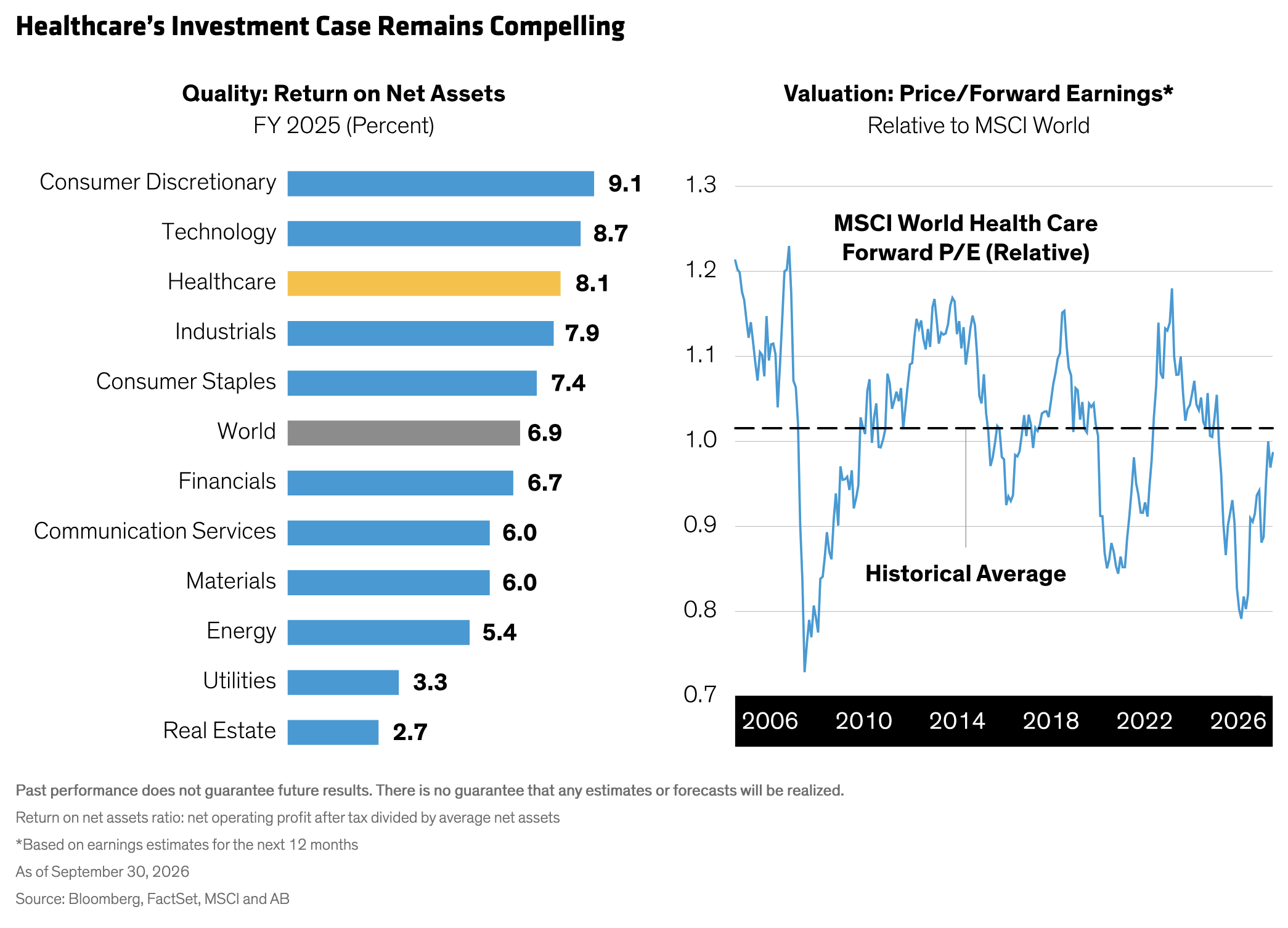
With healthcare stocks offering high return on assets at a discount to the broader market (Display), we believe opportunities abound within the sector. Current valuations reflect strong pent-up return potential that could be unlocked if investor sentiment improves and the market begins to reward healthcare businesses for their quality.
History provides useful context. From 2000 through 2025, the MSCI World Health Care Index captured about 70% of the market’s gains in rising markets but only 54% of its losses in falling ones, resulting in annualized outperformance of 1.2 percentage points versus the MSCI World Index (Display).
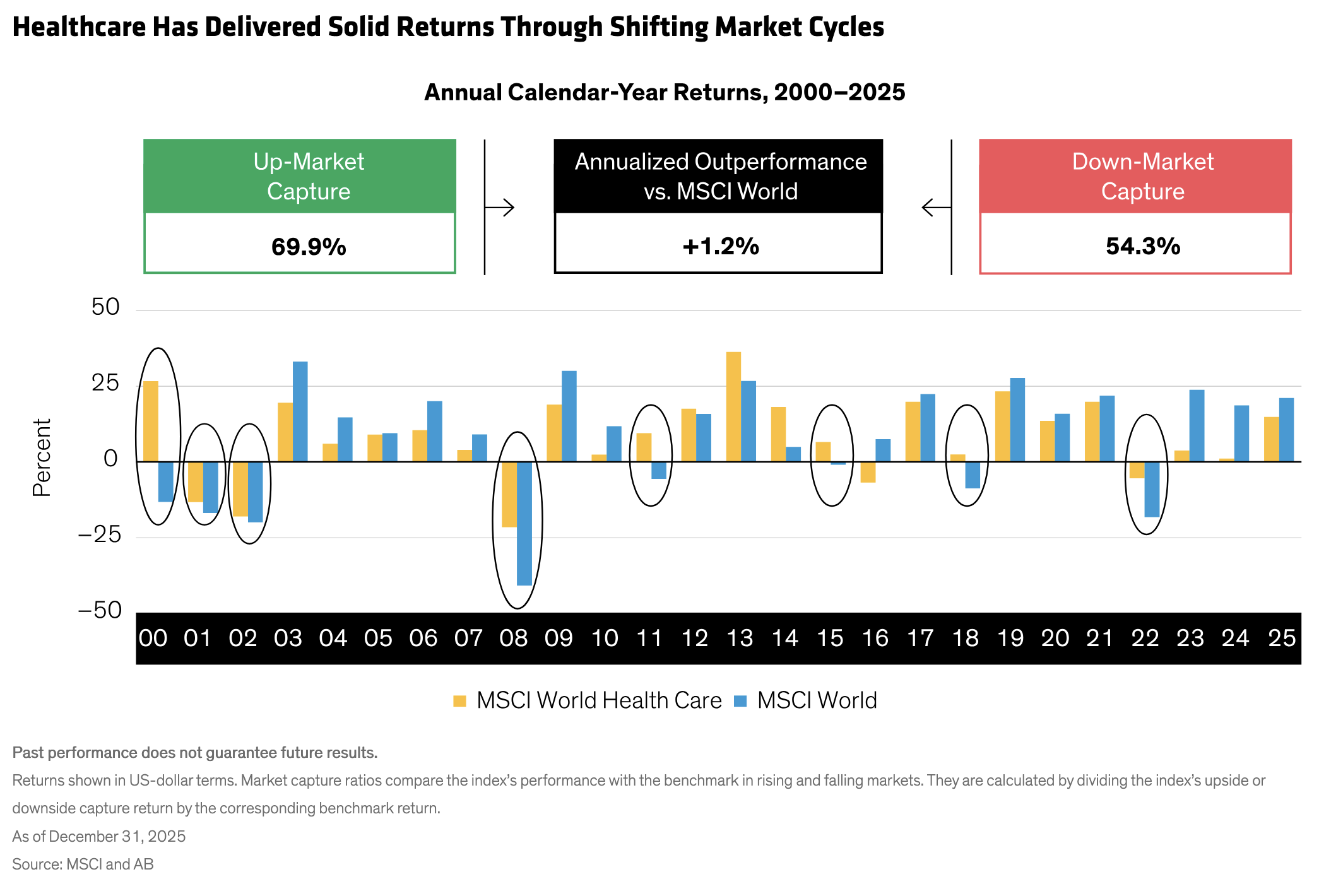
Healthcare investors have endured a challenging period in which strong fundamentals haven’t been fully reflected in share prices. But we believe staying the course can be rewarding for portfolios that look beyond recent share-price movements to capture business models that offer long-term growth potential. With durable demand, broadening innovation and reasonable valuations, healthcare’s underlying strengths make a compelling case for a second opinion.
Copyright © AllianceBernstein
***
About the Authors

Jane Bleeg is a Senior Vice President and Co-Chief Investment Officer—Global Healthcare Strategy. Prior to this, she was a portfolio manager for European Value Equities—a role she assumed in 2022. Before that, Bleeg was a senior research analyst responsible for European healthcare and US large-cap pharmaceutical companies for the Value Equities Group. Before joining the firm in 2016, she was an engagement manager in the life sciences practice of L.E.K. Consulting, an analyst for Great Point Partners, a healthcare hedge fund, and an investment banking analyst in the healthcare investment banking group at Piper Jaffray & Co. Bleeg holds a BBA (magna cum laude) in finance from the University of Notre Dame and an MBA (with distinction) from Saïd Business School at the University of Oxford. Location: London

Vinay Thapar is a Senior Vice President and Co-Chief Investment Officer for US Growth Equities and a Portfolio Manager for the Global Healthcare Strategy. He is also a Senior Research Analyst, responsible for covering global healthcare. Before joining the firm in 2011, Thapar spent three years at American Century Investments as a senior investment analyst responsible for healthcare. Prior to that, he worked for eight years at Bear Stearns in the Biotech Equity Research Group, most recently as an associate director. Thapar holds a BA in biology from New York University and is a CFA charterholder. Location: New York