




When the most profitable companies in the world suddenly line up to sell stock, it pays to ask why. That is the question at the heart of a new report from Verdad Advisers’ Amos Lawrence1, which examines whether aggregate equity issuance, the sum of all corporate decisions to issue or repurchase shares, works as a timing signal for sectors and the market as a whole.
Lawrence opens with two events that frame the entire analysis. "In June, SpaceX went public and raised nearly $75 billion dollars of equity, the largest IPO in history," he writes. But the offering that deserves closer attention came a week earlier: "On June 2nd, Google's parent company Alphabet issued around $85 billion, citing AI capex spend to build out AI infrastructure." The significance is hard to overstate. "Google is one of the most profitable companies in the world and hasn't issued equity since 2006, making the move worthy of more attention than it got at the time."
What History Says About Issuance Waves
To test the signal, Lawrence aggregates US net equity issuance, including stock-based compensation, for companies above $100 million in market cap from 1990 to 2026. The pattern is unmistakable. "Aggregate US issuance peaked at $1.5 trillion in 2000, right at the top of the dot-com bubble." Buybacks dominated after the financial crisis, "until a big wave of issuance hit in 2020 and 2021 alongside the liquidity-induced market euphoria."
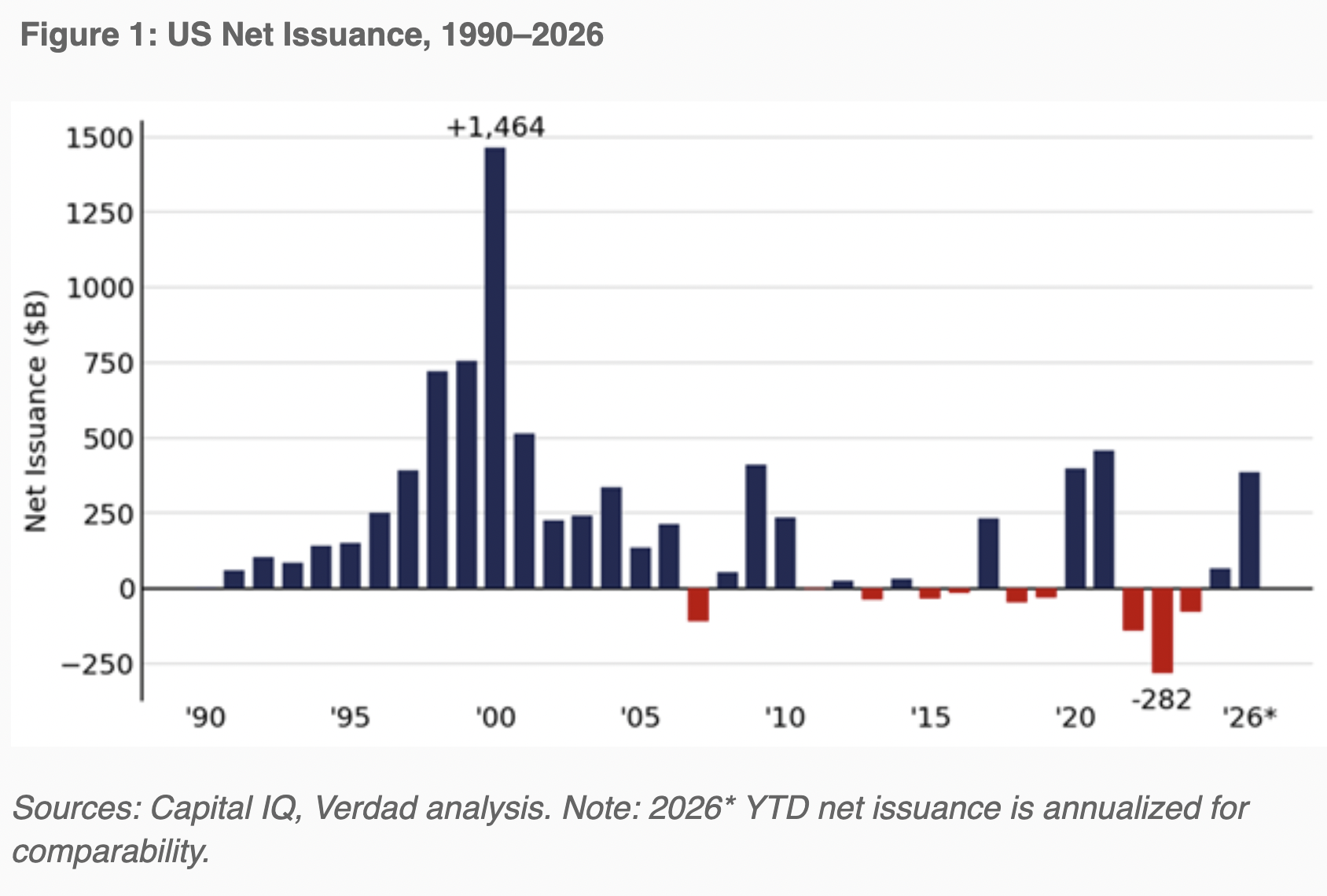 The consequences of those two manias were not subtle. "The two unambiguous issuance manias in this sample, 2000 and 2021, were each followed by double-digit negative returns (−12% and −18% respectively for the S&P 500 Total Return Index)." Nor is this a new discovery. Lawrence points to Baker and Wurgler's 2000 study, which showed that "the equity share of new issues was among the strongest negative predictors of next-year returns, stronger than dividend yield or book-to-market."
The Signal Is Noisy, So Decompose It
To be fair, Lawrence is careful not to overclaim. "There are many non-arbitrage reasons to issue or repurchase equity, and net issuance is a noisy signal." Companies with "lucrative, capex-intensive investment opportunities, like AI data centers, can rightfully demand large cash injections quickly," and some sectors, like REITs with dividend mandates, issue for structural reasons that have nothing to do with valuation.
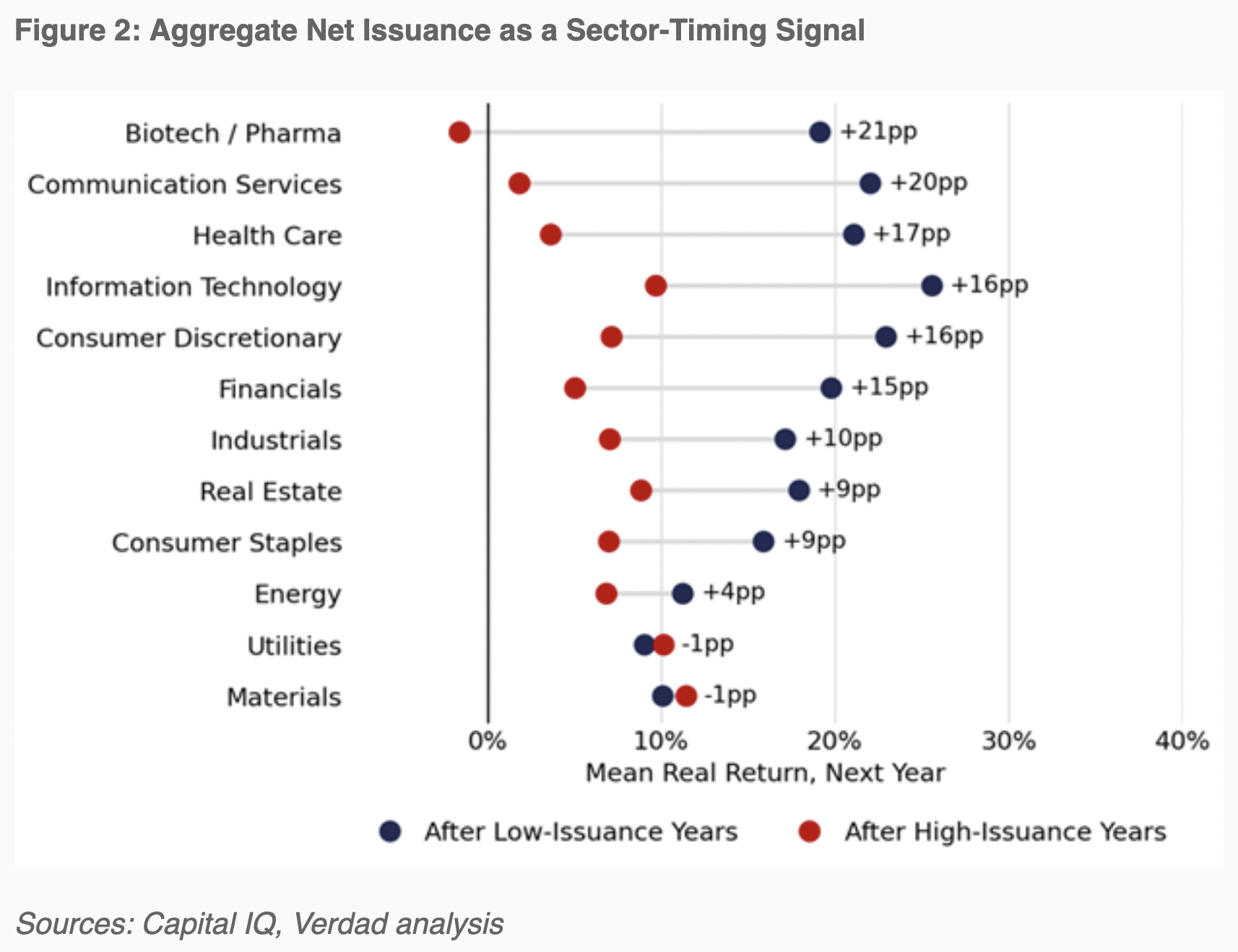
That is why he decomposes issuance by sector, sorting each sector's yearly aggregate issuance into terciles and comparing subsequent one-year returns. The results, shown in Figure 2, reveal "a consistent and compelling pattern." The interpretation is straightforward corporate logic: "When management teams choose to issue equity, they think the return they will earn on their projects is higher than the cost of that equity. Conversely, when they choose to repurchase equity, it is because they believe their equity offers the most attractive return of any of their investment opportunities."
Where the Signal Points Today
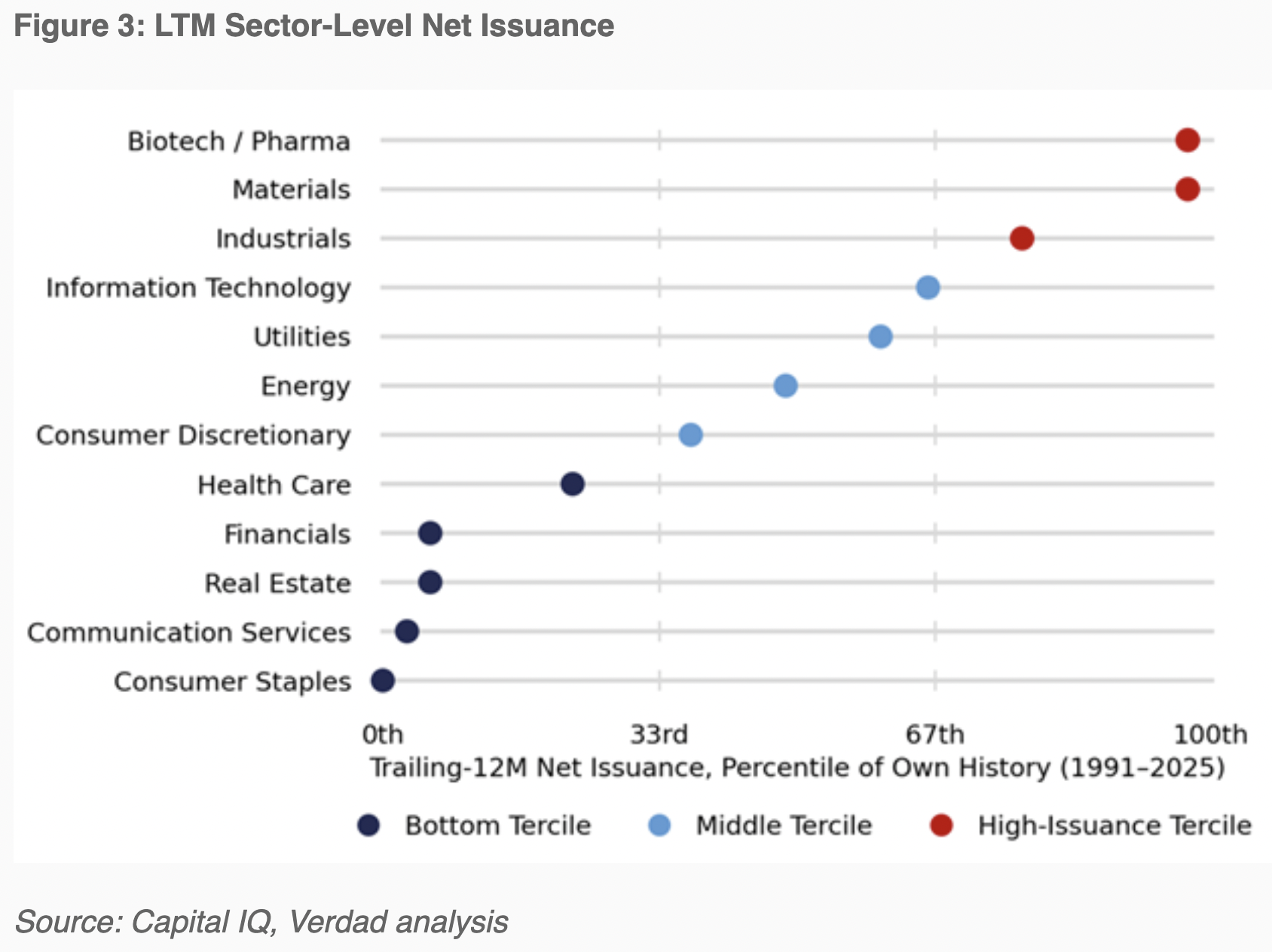
Applied to the trailing twelve months, the sector map is pointed. "Biotech/Pharma, Materials, and Industrials are all in the third tercile." Materials gets a pass, since "issuance historically hasn't been very informative for Materials, but the historical precedent bodes poorly for Biotech and Industrials." On the other side of the ledger, "Communication Services and Consumer Staples are both in the lowest tercile, and historically that has meant significantly higher returns, especially for Communication Services."
Lawrence's closing frame is the memorable one. By aggregating insider behaviour across whole sectors, "we can construct something like a 'wisdom of crowds' metric that may prove useful as a market timing signal." Management, after all, knows its own business best. When thousands of managements act in the same direction at once, the market should listen.
Five Key Takeaways for Advisors and Investors
- Issuance manias precede drawdowns. The 2000 and 2021 issuance peaks were each followed by double-digit negative S&P 500 total returns.
- Alphabet's first equity raise since 2006 is a signal, not a footnote. An $85 billion issuance from one of the world's most profitable firms deserves scrutiny, whatever the AI capex rationale.
- The signal works best at the sector level. Heavy-issuing sectors have historically underperformed; heavy-repurchasing sectors have outperformed.
- Today's caution zones are Biotech/Pharma and Industrials, both in the highest issuance tercile with poor historical precedent.
- Today's opportunity zones are Communication Services and Consumer Staples, where net repurchases have historically preceded significantly higher returns.
Footnote:
1 Lawrence, Amos. "The Smartest Money: Share Issuance as a Market- and Sector-Level Timing Signal." Verdad Advisers, 2026, https://mailchi.mp/verdadcap/the-smartest-money?e=3ab0a2b45c.