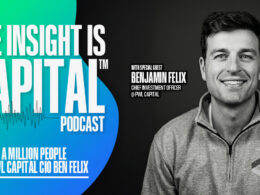





by The Editorial Team, AdvisorAnalyst
A conversation between BMO GAM's Bipan Rai and Dan Stanley, Head of Institutional Sales, reveals a structural shift in how the world's most sophisticated investors are deploying exchange-traded funds1 — not as a passive alternative, but as a precision instrument.
The macro backdrop on the day BMO GAM's Open Outcry podcast sat down to discuss institutional ETF adoption was, to put it plainly, complicated. US 30-year yields had just breached 5% for the first time in two decades. Markets were re-pricing Fed rate cut expectations into hike expectations by end-2026. Forward earnings growth was running close to 20% — the strongest in years — holding equities steady even as duration sold off hard. And in Canada, a Bank of Canada rate hike, in Rai's view, remaines "probably misplaced given the degree of slack in the real economy."
This is the environment in which Dan Stanley, BMO GAM's Head of Institutional Sales, makes his rounds with pension plans, insurers, endowments, hedge funds, and the model portfolio providers who are quietly becoming among the most prolific ETF users in the market. The conversation that follows is a practitioner's guide to how institutional thinking about ETFs has fundamentally changed — and where the next frontier of adoption lies.
From Tactical Tool to Capital Markets Infrastructure
The common mental model of ETFs — cheap beta, passive exposure, retail-friendly — misses what's actually happening at the institutional level. Stanley is direct about this.
"I could sit here and tell you that institutions are using them for insight, they're using them for hedging, they're using them for securities lending to access inventory. They're easier to short. And those are all true," he says. "I think probably the most important two key reasons how this has evolved... really come down to liquidity and thinking about them really as a capital markets tool."
The liquidity point deserves particular attention. Stanley described a client who approached BMO GAM holding approximately $25 million in a very difficult-to-trade corporate bond. The solution wasn't a secondary market transaction. Instead, BMO GAM executed a custom creation: they bought the illiquid bond position off the client and delivered ZAG — BMO's broad bond universe ETF — in return. The client then had full optionality: sell ZAG on-exchange, hold it, have a market maker disaggregate it back into bonds, or redeem for cash.
"In effect what they've done is they've turned a very hard to trade group of a bond into a very highly liquid and tradable securities," Stanley says.
This is not passive investing. This is liquidity engineering.
The second shift — the psychological one — may be more durable. "Think of an ETF as a tool that can be used as an alternative to cash securities and to derivatives like futures, options and swaps," Stanley says. "The power... is really, really, really effective because of the complexity of frankly the investment world that is faced by all investors, including institutional investors."
Fixed Income: Where the Structural Case Is Clearest
BMO GAM leads in fixed income ETFs, and Stanley made the case that bond markets represent the most compelling use case for institutional adoption. The problem is not always visible in benign conditions. "Oftentimes institutional investors will come back to me and say, well, I don't face those challenges oftentimes," Stanley acknowledges. "And in certain sectors of the bond market, they may not face the challenges today, but there may be a day like March of 2020, when you do face those challenges."
Bond ETFs solve for three things that individual bond portfolios structurally cannot: instant diversification, continuous pricing, and tradability under stress. "Tradability is something that the individual bonds and traditional portfolios do struggle to deliver, especially when the markets are stressed," he says.
Who's Leading the Adoption Curve
Not all institutional segments are moving at the same pace. Stanley identified model portfolio providers — the large asset allocators — as the fastest-growing segment of institutional ETF usage, followed by pensions and hedge funds. Insurers remain early-stage, constrained by legacy order management systems designed for cash bonds and unique regulatory capital treatment. The irony, Stanley notes, is that recent accounting changes actually make the case for insurers to use ETFs more, given the flexibility needed to match assets and liabilities.
"Asset allocators naturally start with macro views of the market," he says. "And ETFs are just a very cost efficient way to get exposure to those macro views." He cites ZCOM, BMO's Broad Commodity ETF, as a recent example: a client seeking commodities exposure with no storage capacity and limited appetite for futures complexity found an ETF to be "a perfect solution."
Portable Alpha: The New Portfolio Architecture
The coexistence thesis — ETFs alongside active managers rather than replacing them — is becoming operational through the concept of portable alpha. Institutions are pairing best-in-class active managers for alpha generation with ETF-delivered beta, often through the same asset management relationship.
"Often what we see is institutions will go to an asset manager. They want to find that best active manager to generate certain alpha. And then often that same asset manager can turn around and say, hey, we'll provide you with your beta oftentimes via an ETF," Stanley says. "That portable alpha strategy is one that we're hearing a lot about and in effect it is about combining alpha plus beta, which in plain English is asset manager, with an ETF or index structure."
Stanley is emphatic that the commercial approach at BMO GAM is not replacement — it's augmentation. "We're not here to say you should be using ETFs as 100% of your solution set. We recognize that there are amazing active managers out there... There is tremendous value in the best active managers and the best active strategies out there."
Active ETFs: Early, Niche, But Watch the Family Office Space
On the active versus passive question, Stanley drew a clear distinction. Traditional institutional allocators — endowments, pensions, hedge funds — remain predominantly passive and factor-oriented. Factor strategies occupy "the middle of that spectrum where you've got plain vanilla beta on one end... pure active on the other." Active ETFs, by contrast, are gaining traction with ultra-high-net-worth family offices, where the cost efficiency of the ETF wrapper makes active management economically accessible for investors who lack the scale to negotiate institutional fee arrangements directly.
"We're trying to get the benefit of the low cost and efficient ETF with active management," Stanley says. "The reality is a lot of the bigger institutions who have scale, they can get efficient active management at low cost already."
Three Key Takeaways for Advisors and Investors
1 ETFs are infrastructure, not just allocation. The institutional use case has moved well beyond "cheap beta." Custom creation processes, portable alpha structures, and capital markets applications mean ETFs now function as liquidity infrastructure — solving problems that active mandates and cash securities cannot. Advisors should think about ETFs the same way: as optionality, not just exposure.
2 The stress-test argument is decisive for fixed income. The case for bond ETFs in client portfolios is not just about cost — it is about what happens when liquidity disappears. March 2020 is the benchmark. Continuous pricing and on-exchange tradability in stressed markets are features that individual bond ladders structurally cannot replicate.
3 Active and passive are not rivals — they're a system. The most sophisticated institutional portfolios are being designed as alpha-plus-beta constructs, with active managers sourcing alpha and ETFs delivering the beta efficiently. This architecture is increasingly accessible to advisors building model portfolios. The question is not which to choose — it is how to pair them correctly for the client objective.
Footnote:
1 "The Open Outcry Podcast: Why ETFs Are Winning Institutional Attention…." BMO ETF Dashboard, 27 May 2026.