



by Carl R. Tannenbaum, Chief Economist, Northern Trust
I am periodically called in to consult on economic plans for Chicago, home of our corporate headquarters. Last week, I landed an idea that could fuel growth across the Great Lakes region for many years to come.
The U.S. economy is all in on artificial intelligence (AI). But there are some natural limitations to progress which will have to be carefully managed. The massive demand for power to fuel AI data centers will require substantial investment in new capacity. The stress that this will place on fuel supplies and key commodities around the world has been well-documented.
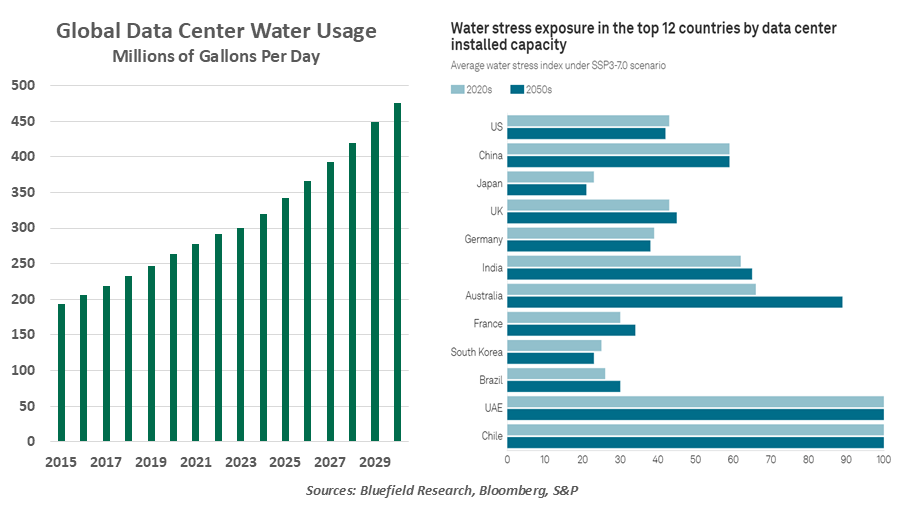
But there is another commodity that is critical to the AI ecosystem: water. Data centers often rely on water cooling techniques that consume water to dissipate heat; a large facility uses as much water annually for this purpose as 50,000 homes. In aggregate, researchers have estimated that water demand from data centers has tripled in the last decade. Further, the electricity currently used by these facilities requires an estimated 800 billion liters of water every year. These needs are projected to increase substantially in the years ahead.
Data centers have been positioned proximately to power and personnel, with water access often an afterthought. In the United States, a study performed by Bloomberg last summer found that about two-thirds of new data centers started and completed in the last four years are positioned in places that have high levels of water stress.
Data centers are thirsty places.
This challenge is even worse in China, where access to water in many parts of the country is poor. Almost 90% of data centers constructed there since 1997 are in areas with high water stress. 70% of India’s data center capacity is in areas which are prone to water shortages.
New AI installations compete with residents, manufacturers and agriculture for water. As we described in a 2024 article, a number of populations around the world are struggling for water access; deploying scarce supplies to support technology has created some local backlash and generated restrictions on new developments.
The lack of reliable water supplies may also compromise the resilience of data centers, which could diminish performance levels for AI platforms.
Disputes over water rights are increasing within the United States, at its borders, and elsewhere in the world. Reduced flows through the Colorado River have created challenges for the six states that rely on that source. States within India are also pressing for shares of a diminished water supply. Increased data center construction is bringing increased intensity to these situations.
Lastly, the infrastructure for water production, treatment and transportation in many parts of the world are in need of reinforcement. As is the case for the power demands of AI, investment in generation and transmission need to be commensurate with demand.
Creating new water supplies is challenging, so remedies focus on better management of existing sources. Greater water reclamation and the use of closed-loop cooling systems will help, as will greater use of power that does not require water for generation. As well, refinements in AI models to make them more efficient will reduce the need for both power and water.
All of this was in the back of my mind when I arrived in Texas for a series of client visits. It was unseasonably warm for February, which was taking a toll on the multitude of data centers operating in the state. They will certainly be at the center of efforts to reconcile technological advance with the limitations of natural resources.
As I was slaking the thirst created by the 80 degree temperatures, it occurred to me that two things that Chicago and adjacent areas have in abundance are cold weather and water. If we can figure out how to export these increasingly valuable commodities, our economic future could be assured.
Copyright © Northern Trust