



North American equities are no longer moving in lockstep. AI remains influential, but performance within technology has diverged. Cyclicals are improving. Policy shifts are beginning to influence capital allocation in industrials and resources.
On Fidelity Connects, the discussion centers on whether this environment represents a durable shift or another phase of rotation.
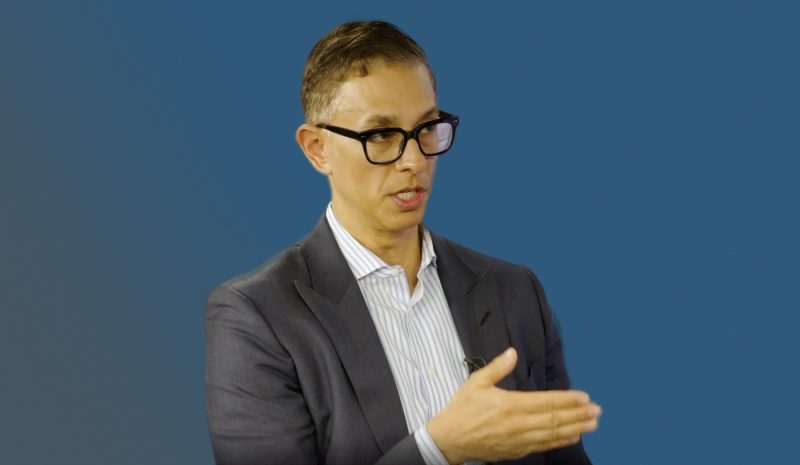
For Darren Lekkerkerker, the defining feature is dispersion. Some companies are benefiting from structural tailwinds. Others are adjusting to competitive pressure. Broad exposure alone may not capture those differences.
In that context, portfolio construction becomes more selective.
A Concentrated Mandate
The Fidelity American Equity Fund is expected to hold roughly 45 stocks, with a significant portion of capital allocated to the top ten positions .
This reflects an established approach. His North American strategy has produced “mid-20% CAGR” over three years and “approximately 17% compounded annual growth per year on a gross basis” over five and ten years .
The underlying philosophy is straightforward:
“You have to make sure you own your best ideas… And then secondly, you got to be right in order to get the performance.”
The American mandate, which he now runs as of January, narrows the geographic focus, but the investment framework remains the same: concentrated exposure to companies viewed as durable, competitively positioned, and appropriately valued.
In a market marked by wider performance gaps between sectors and individual stocks, that structure is intentional rather than expansive.
AI’s Second Act: From Momentum to Dispersion
The AI trade has not died. It has fractured.
In Lekkerkerker’s words, “I think that there’s more dispersion than normal”. Software has lagged. Internet names are mixed. Hardware and semiconductors have led.
This is not the era of blind indexing, he argues:
“I think it’s something where our skill, which is stock picking, and our investment process can become more valuable because there’s more dispersion and a better opportunity to outperform the benchmark.”
The shockwave came from generative AI itself. When Anthropic released an enhanced Claude model, markets reacted viscerally. The narrative flipped from “software eats the world” to “AI eats software.” As Lekkerkerker puts it:
“I think all of our viewers get that the nervousness in the market is that AI eats software, whereas the tagline used to be software eats the world.”
The market began questioning pricing models, seat-based revenues, and the durability of moats. Legal information services were hit particularly hard. Entire sub-industries gapped lower.
Yet Lekkerkerker urges discrimination, not capitulation. After meeting with one of the leading LLM firms, he relays their view:
“Software will be used more in the new world. There will be some disruption. Not all of it will be disrupted.”
The dividing line?
“Software that is high use or critically important and/or inexpensive is probably fine… But the opposite of that is at risk.”
The takeaway is subtle: AI is not a uniform destroyer. It is a filter. The high-friction, proprietary, workflow-embedded systems survive. The replaceable do not.
Rotation: Early Cyclicals and the Policy Tailwind
Beyond tech, a rotation is unmistakable.
“It’s definitely been a rotation in the market,” he says . Early cyclicals have gained traction as recession fears faded and growth stabilized.
The drivers are macro—but used tactically, not doctrinally. Short rates are lower. Fiscal stimulus looms. The Atlanta Fed’s GDPNow is running near 4%, up from last year’s 2–3% range .
Yet even here, Lekkerkerker insists on discipline. He is “macro-aware” but bottom-up by design:
“What that means… is I try to focus on owning the best companies as opposed to trying to predict or forecast economic variables or different markets.”
Still, the backdrop matters:
“The economy is stable and accelerating… Earnings growth has accelerated in the fourth quarter so far. 13% year over year… So it seems like a pretty nice backdrop for stock picking.”
The conclusion is not that the market will rise in a straight line. It is that stock pickers have room again.
Industrials: AI’s Physical Footprint
If hyperscalers are becoming owners of hard assets, industrials are the quiet beneficiaries.
Lekkerkerker is overweight the sector.
“I’m bullish on industrials,” he states , particularly machinery. Demand is strengthening across end markets, but data centers are a key driver. The AI buildout is no longer just silicon and code; it is steel, power, cooling, and fabrication.
This is where his background as a former mining analyst intersects with the present moment. He is comfortable navigating both bits and atoms.
Banks: The Quiet Re-Rate
Financials—especially in Canada—are another axis of conviction.
After meeting with the six largest Canadian bank CEOs in a single day—“That’s a good day” —he emerged constructive.
Credit costs are elevated but “expected to normalize or come down” . Mortgage resets have been managed. Capital markets and wealth businesses are contributing. Expense discipline is generating operating leverage.
Regulatory sentiment has improved as well:
“It seems like the government also… had to prioritize economic growth much more… and so the sentiment appears much, much better.”
In the U.S., deregulation could mean higher capital returns. In Canada, resolution of trade tensions could catalyze a re-rating across industrials, banks, and consumer names.
Metals Over Energy: A Hard-Asset Bias
Lekkerkerker’s commodity preferences are clear—and consistent.
He reiterates his prior bullishness on gold, copper, and uranium, but today tilts more strongly toward copper.
On gold:
“The demand drivers of US dollar diversification, elevated geopolitical risks… monetary stimulus, and larger budget deficits… probably set to continue.”
On copper:
“The supply side is very bullish. There’s been 4 large mines that are not producing due to political reasons or mine operations issues.”
He acknowledges that prices are above his view of fundamentals but sees structural support from U.S. stockpiling and direct investment—an echo of China’s earlier playbook.
Energy, by contrast, appears oversupplied. He holds some exposure, but it is “more modest versus metals and mining” .
The throughline is clear: in a world tilting toward strategic resource security, metals have structural backing.
The Consumer: Repairing the Bottom of the “K”
The U.S. consumer remains bifurcated. Lekkerkerker agrees that the K-shape persists, though less dramatically in Canada.
Lower rates and fiscal stimulus could “lift the bottom part of the K” . Tax refunds in March may boost sentiment and spending.
He sees opportunity where last year delivered damage:
“These stocks were bombed out last year… so they have cheaper valuations.”
Retail, autos (manufacturers more than parts), and hotels are areas of interest—tactical expressions of cyclical recovery.
Portfolio Positioning: Selective Growth, Measured Cyclicality
In closing, Lekkerkerker distills his positioning:
“I do continue to like tech and communications. I’m trying to be very selective… there’s higher dispersion… I like the early cyclicals. I tend to have increased my exposure in consumer, industrial, and financials, and then I own mining and metals.”
It is neither a barbell nor a binary bet. It is a layered portfolio:
- Selective AI beneficiaries
- Early-cycle industrial and consumer exposure
- Financials poised for operating leverage
- Structural hard-asset plays in copper and gold
And perhaps most tellingly, alignment.
When asked which fund he is the largest shareholder in, his answer is immediate:
“North American Equity Fund.”
Skin in the game. Concentration by design. Dispersion as opportunity.
In a year when the narrative swings between AI exuberance and hard-asset resurgence, Lekkerkerker is not choosing sides. He is choosing businesses—carefully, deliberately, and with conviction that stock picking, once again, matters.
Footnote:
1 FidelityConnects. "North American equities: What’s driving markets now." 12 Feb. 2026