



Listen on The Move
When equity markets grow concentrated and expensive, the real risk isn’t volatility — it’s failing to diversify before the cycle turns.
For years, global real estate has sat in what Pierre Daillie calls “the penalty box” — weighed down by rising rates, skepticism, and falling valuations. Yet beneath the headlines, fundamentals never broke.
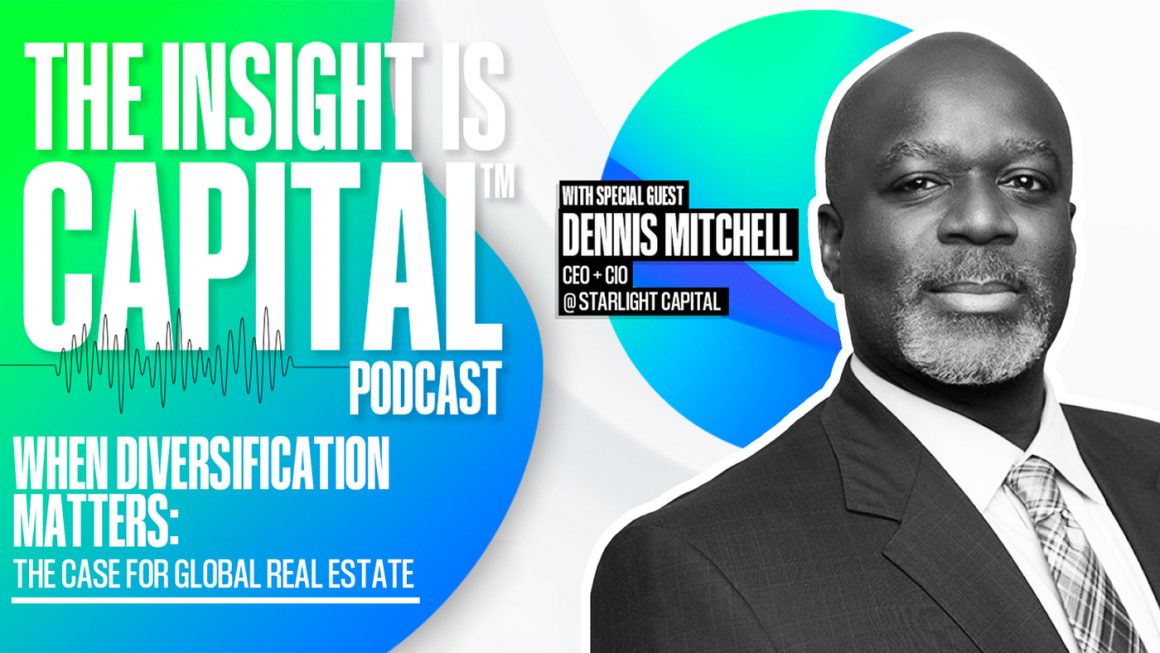
In this episode of Insight Is Capital, Pierre sits down with Dennis Mitchell, CEO and CIO of Starlight Capital, to unpack why global real estate may be one of the most misunderstood — and potentially asymmetric — opportunities in today’s market.
Mitchell argues that the most important change in global real estate “has nothing to do with global real estate.” Instead, it’s about opportunity cost. With the S&P 500 trading north of 24x earnings and the “Mag 7” representing more than 30% of the index, investors face rising concentration risk — amplified by passive flows.
Meanwhile, publicly traded REITs in North America have traded at discounts of up to 30% to net asset value, even as supply-demand fundamentals strengthen across key sectors like seniors housing, data centers, industrial, and cell towers.
Mitchell breaks down real estate returns into three drivers — yield, growth, and multiple expansion — and explains why today’s combination of 4–6% yields, 3–7% internal growth, and potential mean reversion creates a compelling setup.
From demographic tailwinds in seniors housing to AI-driven infrastructure demand for data centers and towers, this conversation reframes real estate not as a rate-sensitive trade — but as a disciplined, supply-demand story hiding in plain sight.
🎯 3 Key Takeaways
1️⃣ The Real Estate Story Isn’t About Rates — It’s About Opportunity Cost
With equity multiples elevated and passive concentration at historic highs, the opportunity cost of not diversifying into real estate has increased materially.
Concentration + passive flows + stretched multiples = asymmetric portfolio risk.
2️⃣ Fundamentals Are Strong Where Supply Is Constrained
Across sectors like seniors housing, industrial, data centers, and towers, resilient demand meets limited supply.
In Canada alone, for example, vis-à-vis seniors housing:
- The 70+ population is set to double by 2035
- ~200,000 additional seniors housing units will be needed
- No decade has delivered more than 73,000 units
That gap matters.
3️⃣ Real Estate Offers a Three-Engine Return Profile
Mitchell outlines three sources of return:
- Yield: 4–6% tax-efficient income
- Growth: 3–7% internal growth
- Multiple Expansion: Potential double-digit upside from valuation normalization
Add it together, and real estate may offer predictable double-digit total return potential — with diversification benefits.
⏱️ Timestamped Chapters
00:00 – Why global real estate’s biggest shift has nothing to do with real estate
02:30 – Volatility, geopolitics, and the reality of today’s markets
03:38 – S&P 500 concentration risk & passive investing concerns
07:58 – Interest rates vs. supply and demand fundamentals
10:05 – Why seniors housing may have the strongest fundamentals globally
13:17 – Public vs. private markets: pricing inefficiencies and diligence
14:55 – REIT privatizations & valuation gaps
18:34 – The three drivers of real estate returns: yield, growth, multiples
20:52 – AI “picks and shovels”: data centers & cell towers
22:40 – What Dennis is watching in 2026: fund flows & M&A
If markets have rewarded concentration for the past decade, this episode asks the harder question:
What happens when the cycle shifts — and diversification starts to matter again?
More...
Dennis Mitchell on Linkedin
Starlight Capital
#GlobalRealEstate #REITInvesting #Diversification #IncomeInvesting #PortfolioStrategy #PassiveInvestingRisk #SeniorsHousing #DataCenterREIT #AITechnologyInfrastructure #MarketConcentration #StarlightCapital #InvestmentPodcast
Copyright © AdvisorAnalyst.com