





by Chris Buchbinder, Mark Casey, Martin Romo, Christopher Thomsen, Capital Group
Has the AI boom reached bubble territory? Have markets overcome the risks of policy uncertainty? Can markets outside the U.S. continue to show strength, or will the global rally fade as it has many times in the past?
These questions sit front and centre for investors heading into 2026. Certainly, risks are ever-present: Valuations for many types of stocks are sky-high, government debt is skyrocketing, and inflation remains sticky. That said, a more stable economic backdrop bodes well for equities in 2026. And markets are broadening, as compelling opportunities expand beyond the Magnificent Seven (Alphabet, Amazon, Apple, Meta, Microsoft, NVIDIA and Tesla) across geographies, industries and market capitalizations.
“We are moving from a binary market environment in which U.S. tech stocks dominated returns to a more balanced one with a broadening opportunity set,” explains Martin Romo, chair and chief investment officer of Capital Group and a portfolio manager for Capital Group U.S. Equity FundTM (Canada). “This environment requires balance. That means investing in U.S. and non-U.S. stocks, growth and value, cyclical and secular trends. I believe the importance of active stock selection, supported by deep research, has never been clearer,” Romo adds.
Here are three key investment strategies that we believe will generate compelling opportunities in the year ahead.
1. Tap into dynamic growth potential
Tech giants have invested in AI infrastructure at a mind-boggling pace in a race for supremacy. Along the way, their share prices — and investor enthusiasm — have soared. The AI boom has also triggered a growing number of news reports questioning whether it has reached bubble territory. Some have even drawn comparisons to the dot-com bubble of the late 1990s.
But such concerns may be overblown or at least premature, according to Chris Buchbinder portfolio manager for Capital Group U.S. Equity FundTM (Canada)., “In my view, it’s too early to let the risk of a bubble overcome the compelling opportunities presented by this formidable technology,” Buchbinder says. “It’s possible we will see an AI bubble at some point down the road, but I don’t think we’re there yet.”
There are some clear differences between today’s AI leaders and the dot-com pioneers of a generation ago. For starters, stock prices for AI leaders are generally supported by solid earnings growth. What’s more, the companies making aggressive AI-related investments — including the Magnificent Seven listed above — generate strong free cash flow that can support aggressive capital spending for some time to come.
Artificial intelligence: Boom or bubble?
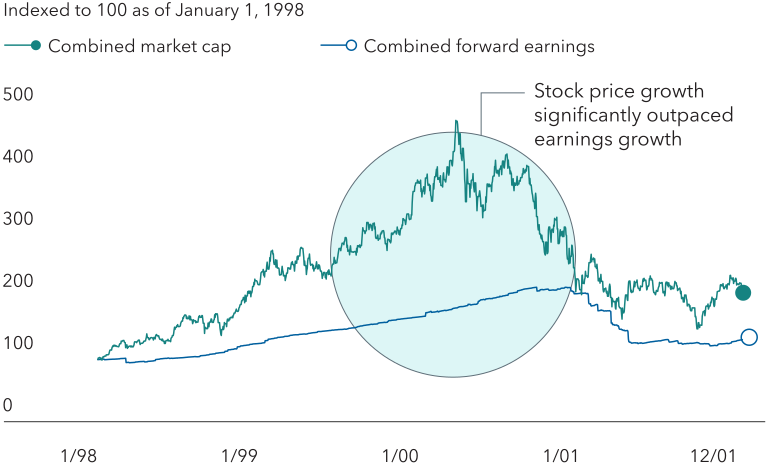
Sources: Capital Group, Bloomberg. Data aggregates forward 12-month net income ("forward earnings") and market capitalization ("market cap") for the “Four Horsemen” of the dot-com era: Microsoft, Cisco, Intel, and Dell, four of the largest and best performing companies of that period. Indexed to 100 on January 1, 1998. Based in USD.
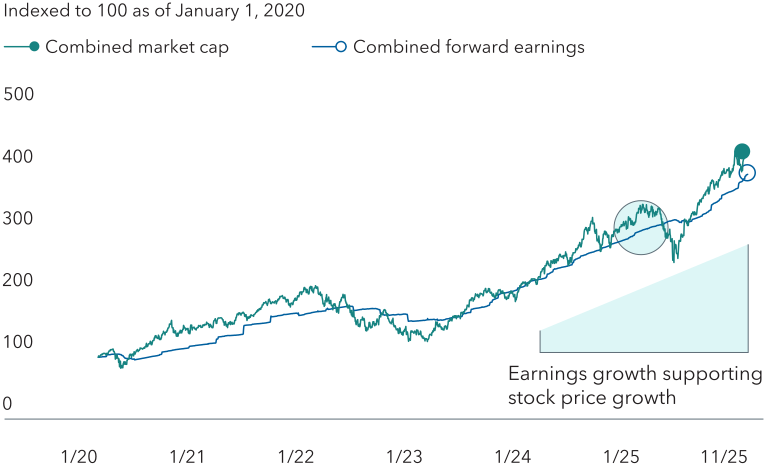
Sources: Capital Group, Bloomberg. Data aggregates forward 12-month net income ("forward earnings") and market capitalization ("market cap") for NVIDIA, Microsoft, Apple, Amazon, Meta, Broadcom, Alphabet, seven of the largest AI-exposed companies. Data indexed to 100 on January 1, 2020. As of November 30, 2025. Based in USD.
“We are still in the very early stages of the development and deployment of AI,” says equity portfolio manager Mark Casey. “Over the next decade, I expect AI to become pervasive in most software and hardware — and there will be many types of robots.”
Already, the list of companies adopting AI in pursuit of boosting productivity has expanded from health care to media to financials. For example, JPMorgan Chase reported in May that it has saved US$2 billion using AI to generate operational efficiencies.
With its potential to transform the economy, the AI boom is also generating growth opportunities for power generation and capital equipment companies that can help build out AI infrastructure.
2. Diversify portfolios with international investments
New catalysts for growth across Asia and Europe are showing that the strength of the U.S. economy and stock market doesn’t mean exclusivity, as other nations also are pursuing productivity gains.
In Europe, Germany has introduced a bold infrastructure stimulus — roughly 12% of the country’s GDP — aimed at boosting growth, spurring competitiveness and strengthening regional security. These initiatives provide opportunities for a range of industrial companies, such as Schneider Electric, which makes energy management systems, as well as industrial software developers like Siemens.
In Japan and other Asian countries, improving corporate governance is providing a tailwind for companies as they adopt structural reforms and shareholder friendly initiatives like accelerating share buybacks and paying higher dividends. For example, in Japan, electronics and semiconductor maker Tokyo Electron and industrial conglomerate Mitsubishi Heavy Industries have taken steps such as appointing majority independent boards and setting an ambitious return on investment targets. In Korea, companies like SK hynix and Hyundai Heavy Industries are pursuing similar initiatives.
"These recent actions to boost competitiveness and shareholder returns, as well as attractive relative valuation to U.S. peers, have gotten me excited about investing in non-U.S. companies," says equity portfolio manager Chris Thomsen.
Initiatives in Europe and Asia could further fuel ongoing stock market rallies in these regions. Since April 2025, when the U.S. announced new tariffs on most trading partners, major non-U.S. markets have outpaced both the Magnificent Seven group of U.S. tech giants and the S&P 500 Index.
Non-U.S. stocks have outpaced the Magnificent Seven
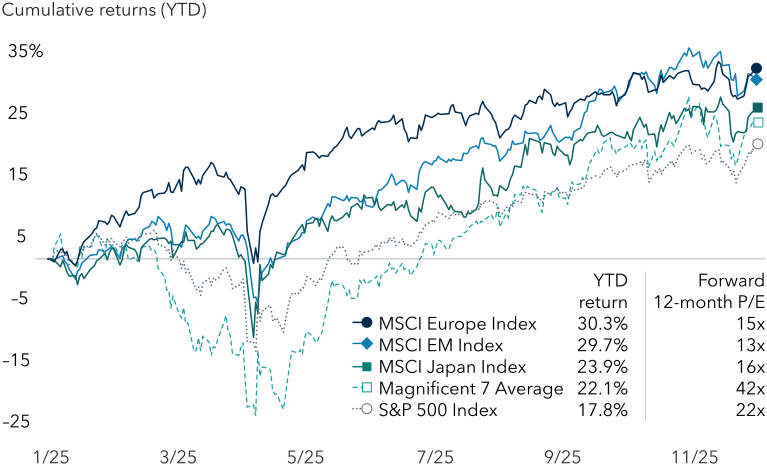
Sources: Capital Group, FactSet, MSCI, Standard & Poor’s. Fwd 12M P/E = forward 12-month price-to-earnings ratio. Returns reflect total returns in USD. PE ratio for the Magnificent Seven Average is the market cap weighted average as of November 30, 2025. Data shown is from January 1, 2025, through November 30, 2025.
3. Defend against volatility with dividends
Investors concerned about the volatility that can be associated with highly valued technology stocks would do well to remember the important role dividend-paying stocks can play in a diversified portfolio. They have historically been resilient during market declines but have generated positive returns when markets have advanced.
For example, over the 20 years ended November 30, 2025, in periods that the S&P 500 Index declined, the S&P 500 Dividend Aristocrats Index outpaced the broader market by an average 67 basis points, or 0.67 percentage points.
Dividend payers outpaced the S&P 500 during declines
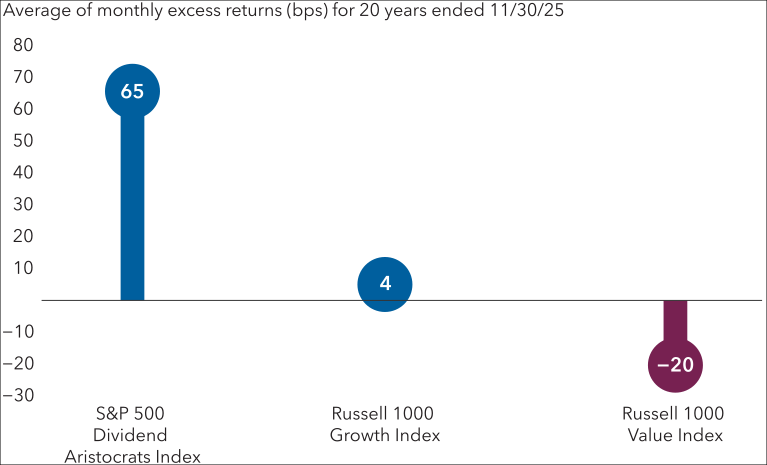
Sources: Capital Group, FTSE Russell, Morningstar, Standard & Poor's. Figures reflect the average difference in monthly total returns between the index specified and the S&P 500 Index, across all months in which the S&P 500 Index had a negative return. As of November 30, 2025. Based in USD.
“In my portfolios, I am seeking to participate in AI trends as they continue to unfold among dynamic, growth-oriented companies,” Buchbinder says. “But I am also seeking balance by investing in companies with compelling valuations that could hold up when markets are volatile.” Today’s universe of dividend payers includes a diversity of companies, including companies in out-of-favour sectors, like energy companies Halliburton and Diamondback Resources, as well as property and casualty insurance companies like AIG and cruise lines like Royal Caribbean. But it also includes technology leaders connected to the AI boom, such as Alphabet and Broadcom, as well as Taiwan Semiconductor Manufacturing Company, the world’s largest semiconductor foundry.
Take a balanced, well-diversified approach
Investors come into every new year confronted with a mix of opportunities and challenges. And each new year comes with surprises. We continue to see strong potential in the AI boom, a transformational driver of growth that presents opportunities across numerous industries. But there are more companies and industries driving returns beyond the AI phenomenon. It’s no longer a matter of choosing between U.S. and international or growth and value — it is important to embrace both, but selectively. The market volatility in April 2025 after the U.S. announced widespread tariffs serves as a fresh reminder of the importance of maintaining balanced, well-diversified portfolios.
Chris Buchbinder is an equity portfolio manager with 29 years of investment industry experience (as of 12/31/2024). He holds a bachelor’s degree in economics and international relations from Brown University.
Mark Casey is an equity portfolio manager with 25 years of investment industry experience (as of 12/31/2024). He holds an MBA from Harvard and a bachelor’s degree from Yale.
Martin Romo is chair and chief investment officer of Capital Group. He is also an equity portfolio manager with 32 years of investment industry experience (as of 12/31/2024). He holds an MBA from Stanford and a bachelor's degree in architecture from the University of California, Berkeley.
Christopher Thomsen is an equity portfolio manager with 31 years of investment industry experience (as of 12/31/2024). He holds an MBA from Columbia and a bachelor’s degree in international economics from Georgetown University.
Copyright © Capital Group