



by Carl Tannnenbaum, Chief Economist, Northern Trust
A few years ago, lightning struck an electrical substation near our home. As a result, we were without power for almost three days. We were cooking over fire, using candles and socializing without electronic distractions. It was as if we had retreated 150 years in time.
It is easy to overlook how important access to cheap power is for societies. It is essential for both commerce and the quality of life. But as economies embrace artificial intelligence (AI), the price and availability of power is becoming a concern.
AI has taken businesses and the markets by storm. Its promise of additional productivity could boost profits and raise standards of living. For AI adherents, the sky is limit.
But those lofty ambitions may be grounded by earthy limitations. It is going to take a lot of electrons to deliver AI solutions: data centers are expected to account for 20% of the increase in global electricity usage through 2030. These facilities will compete with residences and factories for power; both will likely pay more for energy in the years ahead.
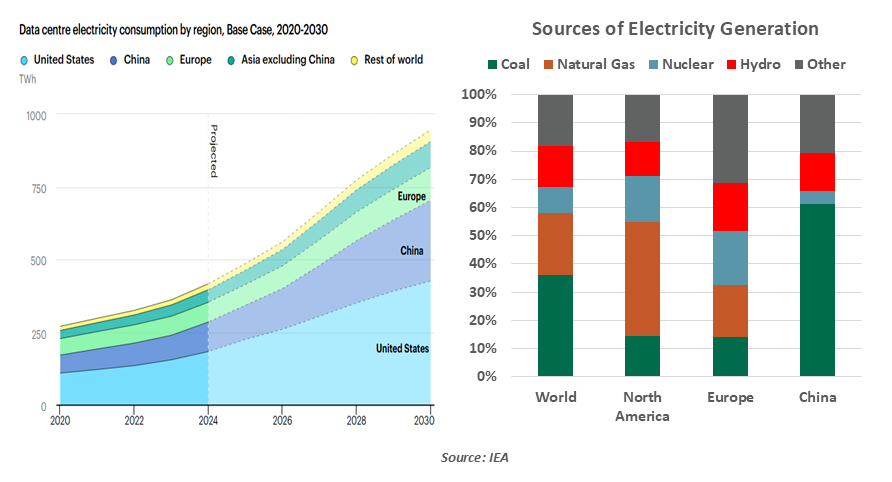
Producing more electricity will require more fuel. Extraction of coal and natural gas will have to increase; transport channels for those commodities will have to be widened. Construction of new plants, windmills, solar farms and dams will require capital, and could raise environmental concerns. Pipelines will have to be extended, and capacity for shipping liquified natural gas will need to be enhanced.
The equipment needed to turn fuel into electricity is in short supply. Turbines used in gas-fired power plants are on back order: lead times have stretched from a norm of two years to almost five. Competition for those components has intensified as “hyperscalers” seeking to create dedicated power plants for their data centers vie wit h traditional utilities. This sets up a conflict between public and private generators that could attract regulation.
Servers generate a lot of heat. Managing their temperatures requires water-based cooling systems. Water is scarce in some areas where data center construction has been most active, setting up potential conflict with farmers and residents.
Transmission will also be a significant challenge. Power cables are typically made of copper; prices have hit a series of all-time highs this year. Bloomberg anticipates a global shortage of 6 million tons of that metal over the next 10 years. Much of the infrastructure supporting electricity systems around the world is aged, and may not be able to safely handle increased loads without significant modernization.
Further, bringing new power plants online can sometimes create shocks to systems that result in unstable supply. Integrating electricity from different sources presents another set of challenges for the power grid, which engineers are working on feverishly.
AI’s lofty ambitions may be grounded by earthy limitations.
Delivery of electricity in many parts of the world relies on a patchwork of networks that haven’t been optimized, aren’t especially resilient and are vulnerable to physical and technological attacks. As more and more essential functions come to be steered by AI, the greater the opportunity for bad actors to create disruption.
AI proponents correctly assert that the technology can save substantial amounts of electricity through process engineering. AI-created conservation routines are already assisting factories and offices; analysts are very optimistic that AI will find further economies in generation of power and the operation of the power grid. New generations of AI chips and algorithms may require fewer computations to arrive at conclusions, reducing the need for electricity.
But as we get excited about the possibilities of AI, we also need to avoid taking the availability of power for granted. There are a lot problems to solve, and tradeoffs to reconcile.
After the most recent blackout, several of my neighbors invested in backup generators. That gave me the bright idea of purchasing a fleet of them and selling the electricity to local server farms. It would be the best-performing investment in my portfolio.
Copyright © Northern Trust