




Market Insights (November 29, 2012)
Gold: Solution to the Banking Crisis
by Eric Sprott and David Baker, Sprott Asset Management
The Basel Committee on Banking Supervision is an exclusive and somewhat mysterious entity that issues banking guidelines for the world’s largest financial institutions. It is part of the Bank of International Settlements (BIS) and is often referred to as the Central Banks’ central bank. Ever since the financial meltdown four years ago, the Basel Committee has been hard at work devising new international regulatory rules designed to minimize the potential for another large-scale financial meltdown. The Committee’s latest ‘framework’, as they call it, is referred to as “Basel III”, and involves tougher capital rules that will force all banks to more than triple the amount of core capital they hold from 2% to 7% in order to avoid future taxpayer bailouts. It doesn’t sound like much of an increase, and according to the Basel group’s own survey, the 100 largest global banks will only require approximately €370 billion in additional reserves to comply with the new regulations by 2019.1 Given that the Spanish banks alone are believed to need well over €100 billion today simply to keep their capital ratios in check, it is hard to believe €370 billion will be enough protect the world’s “too-big-to-fail” banks from future crises, but it is indeed a step in the right direction.2
Initial implementation of Basel III’s capital rules was expected to come into effect on January 1, 2013, but US banking regulators issued a press release on November 9th stating that they wouldn’t meet the deadline, citing a large volume of letters (ie. complaints) received from bank participants and a “wide range of views expressed during the comment period”.3 It has also been revealed that smaller US regional banks are loath to adopt the new rules, which they view as overly complicated and potentially devastating to their bottom lines. The Independent Community Bankers of America has even requested a Basel III exemption for all banks with less than $50 billion in assets,“in order to avoid large-scale industry concentration that would curtail credit for consumers and business borrowers, especially in small communities.”4 The long-term implementation period for all Basel III measures actually extends to 2019, so the delays are not necessarily meaningful news, but they do illustrate the growing rift between the US banking cartel and its European counterpart regarding the Basel III framework. JP Morgan’s CEO Jamie Dimon is on record having referred to Basel III regulations as “un-American” for their favourable treatment of European covered bonds over US mortgage-backed securities.5 Readers may also remember when Dimon was caught yelling at Mark Carney, Canada’s (soon to be former) Central Bank Governor and head of the Financial Stability Board, during a meeting in Washington to discuss the same topic.6 More recently, Deutsche Bank’s co-chief executive Juergen Fitschen suggested that the US regulators’ delay was “hurting trans-Atlantic relations” and creating distrust... stating, “when the whole thing is called un-American, I can only say in disbelief, who can still believe in this day and age that there can be purely European or American rules.”7 Suffice it to say that Basel III implementation has not gone as smoothly as planned.
One of the more relevant aspects of Basel III for our portfolios is its treatment of gold as an asset class. Documents posted by the Bank of International Settlements (which houses the Basel Committee) and the United States FDIC have both referenced gold as a “zero percent risk-weighted item” in their proposed frameworks, which has launched spirited rumours within the gold community that Basel III may define gold as a “Tier 1” asset, along with cash and AAA-government securities.8,9 We have discovered in delving further that gold’s treatment in Basel III is far more complicated than the rumours suggest, and is still, for all intents and purposes, very much undecided. Without burdening our readers with the turgid details, it turns out that the reference to gold as a “zero-percent risk-weighted item” only relates to its treatment in specific Basel III regulation related to the liquidity of bank assets vs. its liabilities. (For a more comprehensive explanation of Basel III’s treatment of gold, please see the Appendix). But what the Basel III proposals do confirm is the regulators’ desire for banks to improve their liquidity position by holding a larger amount of “high-quality”, liquid assets in order to improve their overall solvency in the event of another crisis.
Herein lies the problem, however: the Basel III regulators have stubbornly held to the view that AAA-government securities constitute the bulk of those high quality assets, even as the rest of the financial world increasingly realizes they are anything but that. As banks move forward in their Basel III compliance efforts, they will be forced to buy ever-increasing amounts of AAA-rated government bonds to meet post Basel III-compliant liquidity and capital ratios. As we discussed in our August newsletter entitled, “NIRP: The Financial System’s Death Knell”, the problem with all this regulation-induced buying is that it ultimately pushes government bond yields into negative territory - as banks buy more and more of them not because they want to but because they have to in order to meet the new regulations. Although we have no doubt in the ability of governments’ issue more and more debt to satiate that demand, the captive purchases by the world’s largest banks may turn out to be surprisingly high. Add to this the additional demand for bonds from governments themselves through various Quantitative Easing programs… AND the new Dodd Frank rules, which will require more government bonds to be held on top of what’s required under Basel III, and we may soon have a situation where government bond yields are so low that they simply make no sense to hold at all.10,11 This is where gold comes into play.
If the Basel Committee decides to grant gold a favourable liquidity profile under its proposed Basel III framework, it will open the door for gold to compete with cash and government bonds on bank balance sheets – and provide banks with an asset that actually has the chance to appreciate. Given that US Treasury bonds pay little to no yield today, if offered the choice between the “liquidity trifecta” of cash, government bonds or gold to meet Basel III liquidity requirements, why wouldn’t a bank choose gold? From a purely ‘opportunity cost’ perspective, it makes much more sense for a bank to improve its balance sheet liquidity profile through the addition of gold than it does by holding more cash or government bonds – if the banks are given the freedom to choose.
The world’s non-Western central banks have already embraced this concept with their foreign exchange reserves, which are vulnerable to erosion from ‘Central Planning’ printing programs. This is why non-Western central banks are on track to buy at least 500 tonnes of net new physical gold this year, adding to the 440 tonnes they collectively purchased in 2011.12 In the un-regulated world of central banking, gold has already been accepted as the de-facto forex diversifier of choice, so why shouldn’t the regulated commercial banks be taking note and following suit with their balance sheets? Gold is, after all, one of the only assets they can all own simultaneously that will actually benefit from their respective participation through pure price appreciation. If banks all bought gold as the non-Western central banks have, it is likely that they would all profit while simultaneously improving their liquidity ratios. If they all acted in concert, gold could become the salvation of the banking system. (Highly unlikely… but just a thought).
So far there have only been two banking jurisdictions that have openly incorporated gold into their capital structures. The first, which may surprise you, is Turkey. In an unconventional effort to increase the country’s savings rate and propel loan growth, Turkish Central Bank Governor Erdem Basci has enacted new policies to promote gold within the Turkish banking system. He recently raised the proportion of reserves Turkish banks can keep in gold from 25 percent to 30 percent in an effort to attract more bullion into Turkish bank accounts. Turkiye Garanti Bankasi AS, Turkey’s largest lender, now offers gold-backed loans, where “customers can bring jewelry or coins to the bank and take out loans against their value.” The same bank will also soon “enable customers to withdraw their savings in gold, instead of Turkish lira or foreign exchange.”13 Basci’s policies have produced dramatic results for the Turkish banks, which have attracted US$8.3 billion in new deposits through gold programs over the past 12 months - which they can now extend for credit.14 Governor Basci has even stated he may make adjusting the banks’ gold ratio his main monetary policy tool.15
The other banking jurisdiction is of course that of China, which has long encouraged its citizens to own physical gold. Recent reports indicate that the Shanghai Gold Exchange is planning to launch an interbank gold market in early December that will “pilot with Chinese banks and eventually be open to all.”16 Xie Duo, general director of the financial market department of the People’s Bank of China has stated that, “[China] should actively create conditions for the gold market to become integrated with the international gold market,” which suggests that the Chinese authorities have plans to capitalize on their growing gold stockpile.17 It is also interesting to note that China, of all countries, has been adamant that its 16 largest banks will meet the Basel III deadline on January 1, 2013.18 We can’t help but wonder if there is any connection between that effort and China’s recent increase in physical gold imports. Could China be positioning itself for the day Western banks finally realize they’d prefer gold over Treasuries? Possibly – and by the time banks figure it out, China may have already cornered most of the world’s physical gold supply.
If global banks’ are realistically going to improve their balance sheet diversification and liquidity profiles, gold will have to be part of that process. It is ludicrous to expect the global banking system to regain a sure footing through the increased ownership of government securities. If anything, we are now at a time when banks should do their utmost to diversify away from them, before the biggest “crowded trade” of all time begins to unravel itself. Basel III liquidity rules may be the start of gold’s re-emergence into mainstream commercial banking, although it is still not guaranteed that the US banking cartel will adopt all of the Basel III measures, and they still have years to hammer out the details. If regulators hold firm in applying stricter liquidity rules, however, gold is the only financial asset that can satisfy those liquidity requirements while freeing banks from the constraints of negative-yielding government bonds. And while it strikes us as somewhat ironic that the banking system may be forced to turn to gold out of sheer regulatory necessity, that’s where we see the potential in Basel III. After all – if the banks are ultimately interested in restoring stability and confidence, they could do worse than holding an asset that has gone up by an average of 17% per year for the last 12 years and represented ‘sound money’ throughout history.
Appendix: Gold’s treatment in Basel III
Basel III is a much more complex “framework” than Basel I or II, although we do not claim to be experts on either. It should also be mentioned that Basel II only came into effect in early 2008, and wasn’t even adopted by the US banks on its launch. Post-meltdown, Basel III is the Basel Committee’s attempt to get it right once and for all, and is designed to provide an all-encompassing, international set of banking regulations designed to avoid future bailouts of the “too-big to fail” banks in the event of another financial crisis.
Without going into cumbersome details, under the older Basel framework (Basel I), the lower the “risk weighting” regulators applied to an asset class, the less capital the banks had to set aside in order to hold it. CNBC’s John Carney writes, “The earlier round of capital regulations… government-rated bonds rated BBB were given 50 percent riskweightings. A-rated bonds were given 20 percent risk weightings. Double A and Triple A were given zero risk weightings — meaning banks did not have to set aside any capital at all for the government bonds they held.”19 Critics of Basel I argued that the risk-weighting system compelled banks to overweight their exposure to assets that had the lowest riskweightings, which created a herd-like move into same assets. This was most evident in their gradual overexposure to European sovereign debt and mortgage-backed securities, which the regulators had erroneously defined as “low-risk” before the meltdown proved them to be otherwise. The banks and governments learned that lesson the hard way.
Basel III (and Basel II) takes the same idea and complicates it further by dividing bank assets into two risk categories (credit and market risk) and risk-weighting them depending on their attributes. Just like Basel I, the higher the “riskweight” applied to an asset class, the more capital the bank is required to hold to offset them.
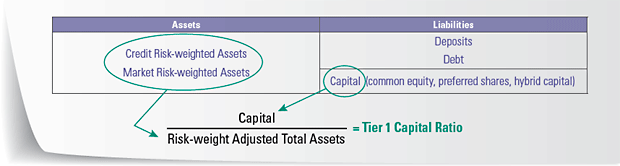
It is our understanding that gold’s reference as a “zero percent risk-weighted asset” in the FDIC and BIS literature only applies to gold’s “credit risk” - which makes perfect sense given that gold isn’t anyone’s counterparty and cannot default in any way. Gold still has “market-risk” however, which stems from its price fluctuations, and this results in the bank having to set aside capital in order to hold it. So for banks who hold physical gold on their balance sheet (and we don’t know of any who do, other than the bullion dealers), the gold would not be treated the same as cash or AAA-bonds for the purposes of calculating their Tier 1 ratio. This is where the gold community’s conjecture on gold as a “Tier 1” asset has been misleading. There really isn’t such a thing as a “Tier 1” asset under Basel III. Instead, “Tier 1” is merely the ratio that reflects the capital supporting a bank’s risk-weighted assets.
HOWEVER, Basel III will also be adding an entirely new layer of regulation concerning the relative liquidity of the bank’s assets and liabilities. This will be reflected in two new ratios banks must calculate starting in 2015: the Liquidity Coverage Ratio (LCR) and Net Stable Funding Ratio (NSFR).
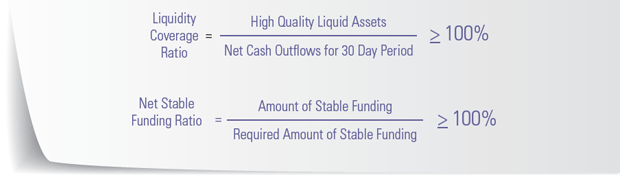
Just as Basel III requires risk-weights for the asset side of a bank’s balance sheet (based on credit risk and market risk), Basel III will also soon require the application of risk-weights to be applied to the LIQUIDITY profile of both the assets and liabilities held by the bank. The idea here is to address the liquidity constraints that arose during the 2008 meltdown, when banks suffered widespread deposit withdrawals just as their access to wholesale funding dried up.
This is where gold’s Basel III treatment becomes more interesting. Under the proposed LIQUIDITY component of Basel III, gold is currently labeled with a 50% liquidity “haircut”, which is the same haircut that is applied to equities and bonds. This implicitly assumes that gold cannot be easily converted into cash in a stressed period, which is exactly the opposite of what we observed during the crisis. It also requires the bank to maintain a much more stable source of funding in order to hold gold as an asset on its balance sheet. Fortunately, there is a strong chance that this liquidity definition for gold may be changed. The World Gold Council has in fact been lobbying the Basel Committee, the Federal Reserve and the FDIC on this issue as far back as 2009, and published a paper arguing that gold should enjoy the same liquidity profile as cash or AAA-government securities when calculating Basel III’s LCR and NSFR ratios.20 And as it turns out, the liquidity definitions that will guide banks’ LCR and NSFR calculations have not yet been finalized by the Basel Committee. The Basel III comment period that ended on October 22nd resulted in the deadline being pushed back to January 1, 2013, and given the recent delays with the US bank regulators, will likely be postponed even further next year. Of specific interest to us is how the Basel Committee will treat gold from a liquidity-risk perspective, and whether they decide to lower gold’s liquidity “haircut” from 50% to something more reasonable, given gold’s obvious liquidity superiority over that of equities and bonds.
The only hint we’ve heard thus far has come from the World Gold Council itself, which suggested in an April 2012 research paper, and re-iterated on a recent conference call, that gold will be given a 15% liquidity “haircut”, but we have not been able to confirm this with either the Basel Committee or the FDIC.21 In fact, all inquiries regarding gold’s treatment made to those groups by ourselves, and by other parties that we have spoken with, have been met with silence. We get the sense that the regulators have no interest in stirring the pot by mentioning anything related to gold out of turn. Given our discussion above, we can understand why they may be hesitant to address the issue, and only time will tell if gold gets the proper liquidity treatment it deserves.
Footnotes:
1 Moshinsky, Ben (September 27, 2012) “Big EU Banks Faced $256 Billion Basel III Capital-Gap Last Year”. Bloomberg. Retrieved on November 20, 2012 from: http://www.bloomberg.com/news/2012-09-27/big-eu-banks-faced-256-billion-basel-iii-capital-gap-last-year.html
2 Campbell, Dakin (October 1, 2012) “Spanish Banks Need More Capital Than Tests Find, Moody’s Says”. Bloomberg. Retrieved on November 20, 2012 from: http://www.bloomberg.com/news/2012-10-01/spanish-banks-need-more-capital-than-tests-find-moody-s-says.html
3 Federal Reserve, FDIC and OCC Joint Release (November 9, 2012) “Agencies Provide Guidance on Regulatory Capital Rulemakings”. Office of the Comptroller of the Currency. Retrieved on November 15, 2012 from: http://occ.gov/news-issuances/news-releases/2012/nr-ia-2012-160.html
4 Hamilton, Jesse and Hopkins, Cheyenne (November 14, 2012) “Regulators Grilled Over Community Banks’ Basel Burden”. Bloomberg. Retrieved on November 20, 2012 from: http://www.bloomberg.com/news/2012-11-14/community-banks-basel-iii-burden-to-be-hearing-s-focus.html
5 La Roche, Julia (September 12, 2011) “Jamie Dimon Lashes Out, Calls Global Capital Rules “Anti-American”. Business Insider. Retrieved on November 20, 2012 from: http://www.businessinsider.com/jamie-dimon-calls-bank-rules-are-anti-us-and-us-should-withdrawl-from-basel-2011-9
6 Tencer, Daniel (October 5, 2011) “Jamie Dimon, JPMorgan Chief, Takes Criticism From Prominent Canadian Bankers After Mark Carney Spat.” Huffington Post. Retrieved on November 21, 2012 from: http://www.huffingtonpost.ca/2011/10/05/jamie-dimon-mark-carney-eric-sprott_n_996061.html
7 Reuters (November 15, 2012) “U.S. Basel III delays create distrust – Deutsche co-CEO”. Reuters. Retrieved on November 20, 2012 from: http://www.reuters.com/article/2012/11/15/deutschebank-france-basel-idUSL5E8MFL0020121115
8 http://www.bis.org/publ/bcbs128b.pdf (See footnote 32)
9 http://www.fdic.gov/news/board/2012/2012-06-12_notice_dis-d.pdf (See page 193)
10 Under Dodd-Frank rules, US bank derivative transactions will soon be made on Central Clearing Parties (CCPs) which will require additional US Treasury bonds to be posted as collateral in addition to what is required under Basel III.
11 McCormick, Liz Capo (November 14, 2012) “U.S. Rate Swap Spreads May Widen as Demand for Treasuries Rises”. Bloomberg. Retrieved on November 20, 2012 from: http://www.bloomberg.com/news/2012-11-15/u-s-rate-swap-spreads-may-widen-as-demand-for-treasuries-rises.html
12 Bullion Street (November 22, 2012) “Central banks Gold purchase to hit 500 tons in 2012”. BullionStreet. Retrieved on November 23, 2012 from: http://www.bullionstreet.com/news/central-banks-gold-purchase-to-hit-500-tons-in-2012/3419
13 Akbay, Sibel (October 29, 2012) “Turkish Banks Go for Gold to Lure $302 Billion Hoard”. Bloomberg. Retrieved on November 20, 2012 from: http://www.bloomberg.com/news/2012-10-29/turkish-banks-go-for-gold-to-lure-302-billion-hoard.html
14 O’Byrne, David (November 21, 2012) “Banking: Gold deposits could meet credit demand”. Financial Times. Retrieved on November 22, 2012 from: http://www.ft.com/intl/cms/s/0/f7e81ece-17af-11e2-8cbe-00144feabdc0.html
15 Akbay, Sibel (October 29, 2012) “Turkish Banks Go for Gold to Lure $302 Billion Hoard”. Bloomberg. Retrieved on November 20, 2012 from: http://www.bloomberg.com/news/2012-10-29/turkish-banks-go-for-gold-to-lure-302-billion-hoard.html
16 Reuters (November 12, 2012) “Shanghai plans ETFs as China seeks to open gold market further”. Financial Post. Retrieved on November 12, 2012 from: http://business.financialpost.com/2012/11/12/shanghai-plans-etfs-as-china-seeks-to-open-gold-market-further/
17 Ibid
18 Xiaocen, Hu (November 14, 2012) “No delay for China’s banks on Basel III”. People’s Daily. Retrieved on November 20, 2012 from: http://english.peopledaily.com.cn/90778/8018050.html
19 Carney, John (January 13, 2012) “Jamie Dimon Confirms Worst Fears About Basel III”. CNBC. Retrieved on November 15, 2012 from: http://www.cnbc.com/id/45988683/Jamie_Dimon_Confirms_Worst_Fears_About_Basel_III
20 World Gold Council (April 2010) “Response to Basel Committee on banking supervision’s consultative document: “International framework for liquidity risk measurement, standards and monitoring, December 2009”. World Gold Council. Retrieved on November 15, 2012 from: http://www.gold.org/government_affairs/regulation/
21 World Gold Council (April 4, 2012) “Case study: Enhancing commercial bank liquidity buffers with gold”. World Gold Council. Retrieved on November 15, 2012 from: http://www.gold.org/government_affairs/research/