

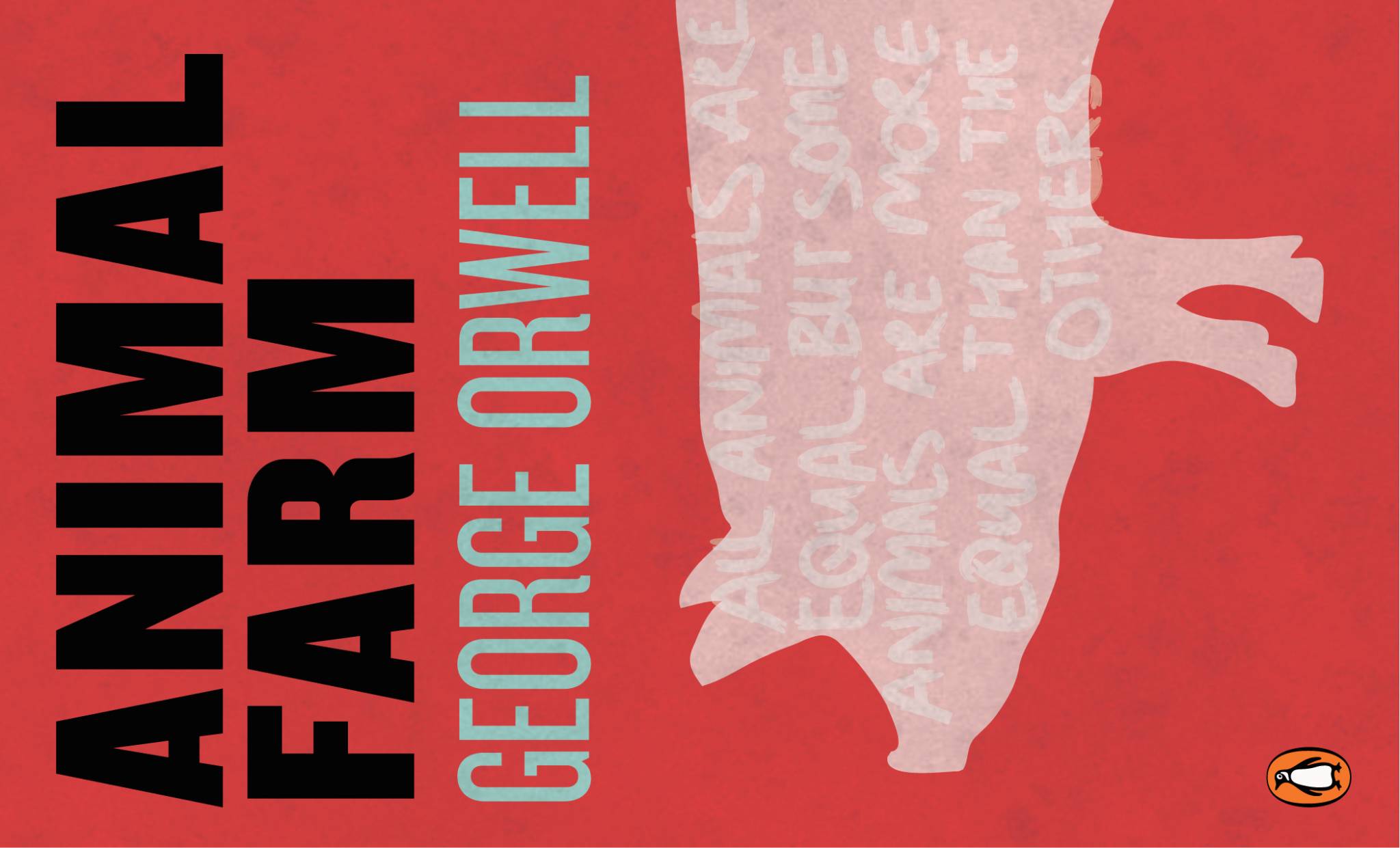

Animal Farm
by Guy Haselmann, Director, Capital Markets Strategy, Scotiabank GBM
· Karl Marx died in March 1883, yet there has been a rebirth of the ideas he detailed on the inherent flaws of capitalism. Recently, Paul Tudor Jones gave a ‘Ted Talk’ about capitalism needing re-definition. My paper entitled ‘2014 and Beyond’ began with the sentence, “Modern day capitalism appears to need a different moniker”. It is quite possible that future developments in capitalism will have profound and on-going influence on markets and valuations.
· Let me first go on record and say that in the 135 years since Marx’ death, capitalism has been the single greatest engine for human advancement. It has certainly been an outstanding way to organize the production and distribution of goods and services. Its free-market structure encouraged innovation, leading to new methods and products whose technological advancements allowed for globalization and the general shrinking of the world. Entrepreneurship aided improvements to health and education, and was the cornerstone to economic progress. No other social construct in history has done more to advance the human condition, or lift more people out of poverty, than capitalism.
· A capitalist structure’s main quest is to ensure the real appreciation of capital. Corporate leaders are incentivized to maximize shareholder value at almost any cost: the best means is to increase output per hour worked (productivity). Can this be sustained forever?
· The causes and responses of the 2008 crisis are the culmination of decades of intervention by lawmakers, central banks, and regulators trying to create a perception of prosperity. Unfortunately, many of the actions by policy officials have been designed whereby current day benefits were trade-off against future economic prospects. It is unfortunate that policy-makers’ well-intentioned attempts to build a stronger economic system may have added to future challenges and complexities.
· Marx exposed the inherent contradictions where he believed that weak aggregate demand leads to workers not being hired in an endless loop causing capitalism to ultimately self-destruct. Is it possible that capitalism’s underlying focus on profits, and the necessity for endless purchases of goods and services, has a practical limit?
· The necessity for growth has led to over-capacity, which has been a root cause of deflation, and one driver of the Fed’s futility. QE and ZIRP (i.e., Zero Interest Rate Policy) have only served to turbo-charge this loop. Going forward, markets will have to contend with servicing the large amounts of debt created under ZIRP. High levels of indebtedness require a minimum degree of economic growth just to ensure debt-servicing is possible.
· Markets and the economy will also have to contend with troubling demographics. On the horizon in upcoming years is a steep acceleration of retirements. New retires will draw on retirement and medical benefits, but more importantly, they will withdraw their labor services from the economy. Capital will have less labor to work with which will result in less business activity. Moreover, older people are simply less innovative (maybe this is why productivity levels have fallen in the last few decades).
· There are currently profound and complicated relationships between, capitalism and inequality, between labor and capital, and between governments and its citizenry. Social tensions are swelling between: business owners and workers, voters and politicians, rich and poor, old and young, and amongst countries. Tensions are spurring general resentment, nationalism, and religious vehemence.
· The question becomes how will these tensions be resolved? Feelings of inequality and injustice are constraints on economic growth that ultimately affect everyone negatively with the potential for calamitous consequences. Easy solutions do not exist. Eradication of US inequality, for instance, will require more than redistribution and wealth transfer policies, especially since the US system is already progressive and steep in subsidies. At an extreme, they risk making everyone worse off.
· Furthermore, the conversation surrounding the issue has been counter-productive as some politicians infer that when the rich benefit it is at the expense of the poor. Measurement errors distort the discussion; such as when reportable taxable income is used to measure income gaps but does not include subsidies. Regardless, the divide is real and growing, but it is not a zero sum game where one’s benefit is at the expense the other. Each side feels victimized.
· The great challenges outlined in this note are of critical importance and should not be dismissed quickly. As Paul Tudor Jones said during his ‘Ted Talk’, these conditions typically lead to “war, revolution, or higher taxes”. Maybe the early warning signs before those occur are organized protests, police backlash, racial tensions, currency wars, protectionism, voter backlash, rise of fringe political parties, Sunni/Shia tensions, and ‘Arab Spring’ (etc.)
· It might be useful to think about these high level concepts while applying them more granularly to markets. In this respect, maybe bonds are not in bubble territory as so many believe.
o Maybe there is a deeper reason why central banks are hoarding such vast quantities of sovereign debt.
o Maybe central banks simply cannot afford to have market interest rates rise too high due to the cost of debt servicing extreme levels or global indebtedness; and due to terrible demographics in developed world economies.
o Maybe corporate revenue growth will be challenged for decades to come.
o Maybe the mindset of maximizing profits at all costs has a practical limit.
o Maybe for capitalism to survive peacefully, the perceived divide - between wages and profits and labor and capital - needs to shrink and unite (hurting profit margins).
· Since major central banks are at or near the lower bound (and many have ballooned balance sheets), and since most major governments (and corporations) have historically high levels of debt, effective future stimulus may not be available. Central bank’s powering risk assets higher may no longer be possible. Higher prices may only be achievable through elusive economic growth. Maybe bonds just aren’t as bubble-like as pundits claim. Maybe it is equities (and forward earnings estimates) that have greater bubble-like characteristics.
“If you drive a car, I’ll tax the street / If you try to sit, I’ll tax your seat / If you get too cold, I’ll tax the heat / If you take a walk, I’ll tax your feet” – The Beatles
Regards, Guy
Guy Haselmann | Director, Capital Markets Strategy
▬▬▬▬▬▬▬▬▬▬▬▬▬▬▬▬▬▬▬▬▬▬▬▬▬▬▬
Scotiabank | Global Banking and Markets
250 Vesey Street | New York, NY 10281
T-212.225.6686 | C-917-325-5816
guy.haselmann[at]scotiabank.com
Scotiabank is a business name used by The Bank of Nova Scotia
Read/Download the complete report below: