





For most of the past decade, corporate America was the most dependable buyer of its own stock. That is no longer the case. In "The Smart Money Is Selling Equity,"1 Acadian Asset Management's Owen Lamont, Senior Vice President and Portfolio Manager, Research, argues that U.S. firms have switched from net repurchasers to net issuers. He thinks the shift matters because companies have a long record of timing their own shares well. His verdict is plain: "the era of repurchases has ended and an era of issuance has begun."
The Third Horseman Rides In
Lamont describes equity issuance as the third horseman of a bubble apocalypse, a warning sign he has tracked for years. He measures it broadly. Any corporate action that changes split-adjusted shares outstanding counts. IPOs, secondary offerings, stock-based pay and stock-financed acquisitions add supply. Buybacks and going-private deals take it away. His formula isolates the part of the change in market capitalization that price movement cannot explain.
The latest reading stands out. Trailing 12-month net issuance reaches 3.1% of total U.S. market cap as of November 12, 2026 (Figure 1). That is still below the peaks of 1999 and 2000 and of 2021. The figure leaves out the scheduled Anthropic IPO, and Lamont expects the line to pass its 2021 peak if that deal goes ahead.
SpaceX Changes the Size, Not the Direction
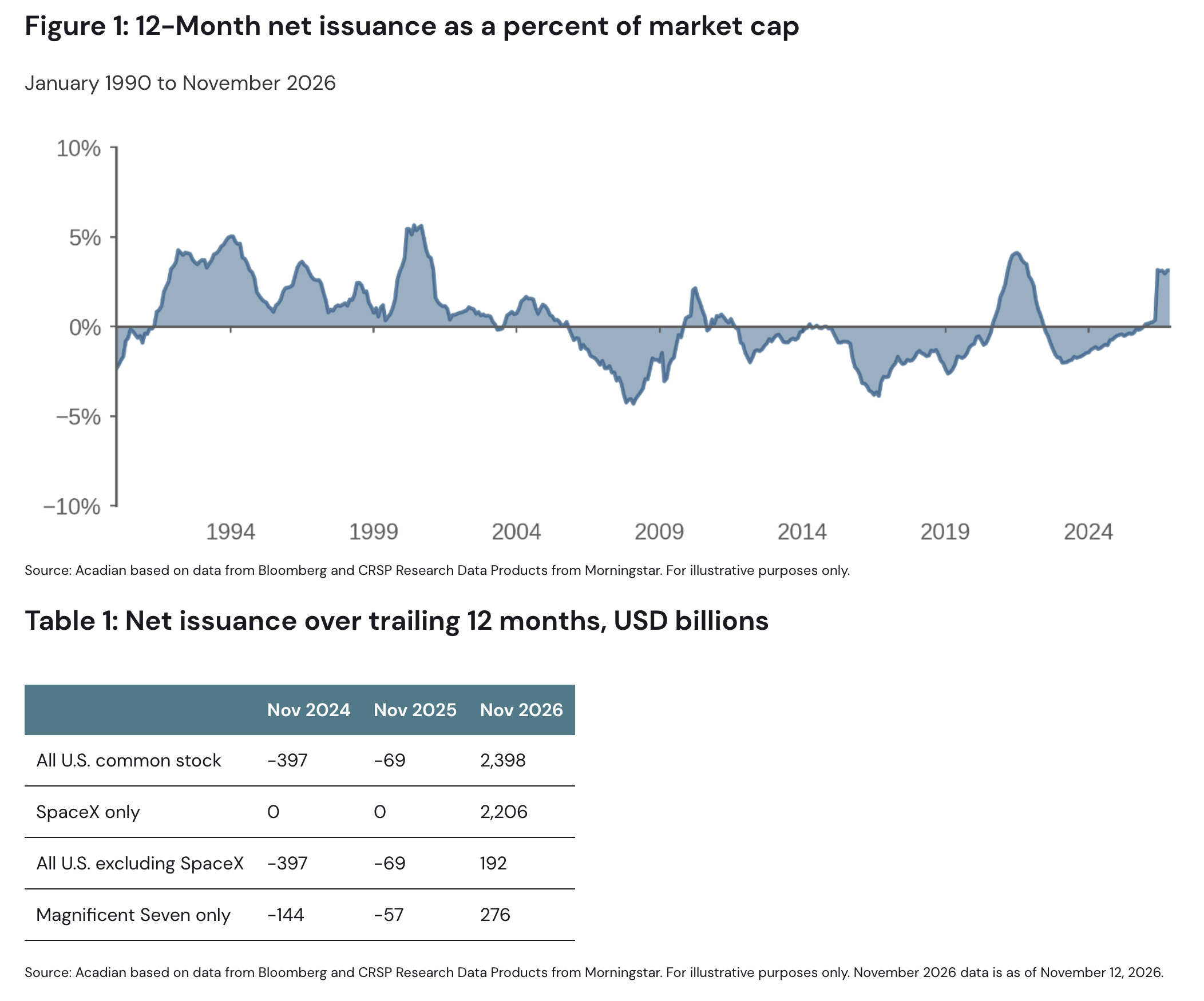 Table 1 shows about $2.4 trillion of net issuance over the past year. Roughly $2.2 trillion of that comes from the June 2026 SpaceX IPO. Even without SpaceX, issuance totals about $192 billion. The comparison is net buybacks of $397 billion in the year to November 2024 and $69 billion in the year to November 2025. The Magnificent Seven tell the same story. They moved from $144 billion of net repurchases in 2024 to $276 billion of net issuance, with Alphabet, Meta and Tesla leading. A float-adjusted measure based on the Morningstar US Total Market Index shows a smaller swing because it counts SpaceX at its initial float (Figure 2). Lamont expects the gap to narrow as float unlocks, and both measures are now clearly positive.
Meta's Costly Pivot
Meta shows the turn most clearly. After the 2021 rebrand, the metaverse spending was widely criticized and is now often seen as a blunder, yet Meta kept buying back stock throughout. By mid-2026 it had become a net issuer, and in October it announced plans to raise up to $98 billion in new equity to fund AI capital spending. Lamont offers two readings. Either Zuckerberg now believes the shares are overvalued, or Meta has used up its internal cash and borrowing capacity. Neither reading is comforting.
Debt First, Then Equity
The Baker-Wurgler equity share divides gross equity issuance by the sum of gross equity and corporate bond issuance. It peaked near 18% during the 2021 COVID bubble, just before the market fell, and Lamont treats that as out-of-sample support for the measure. The share has risen sharply again but remains below that peak. The order of events also repeats (Figure 3). Debt issuance rose in 2020 and equity followed in 2021. Debt rose again in 2024, and equity followed in 2026. Behind all of this is the finding of Baker and Wurgler (2000) that firms tend to issue when their shares are rich and buy back when they are cheap, and that on average they get the timing right.
Smart Money, Dumb Money, or Something In Between
Lamont sets out two explanations and does not pick one. If the market is overpriced, the smart money is selling and today's buyers risk ending up as the dumb money. If firms simply need capital for the AI buildout, buying now need not be a mistake. The truth may sit between the two. He is also candid about his own record. Since March 2024 he has argued at least eight times that the market was not in a bubble because firms were not issuing equity, including in his January 2026 piece "We are not in an AI bubble." The facts have changed, and he says he would no longer write that article.
The One Certainty
Whatever the motive, the same companies that once bought back their shares as undervalued are now selling them. Lamont says that switch is the one thing he is sure of. (Owen A. Lamont, Acadian Asset Management, November 2026)
Five Key Takeaways for Advisors and Investors
- Track net issuance, not just buybacks. Trailing net issuance is 3.1% of U.S. market cap, and passing the 2021 peak is a clear threshold to watch.
- Look past the SpaceX headline. Even without it, issuance of $192 billion replaces $397 billion of buybacks from two years earlier.
- Check where mega-cap money comes from. The Magnificent Seven's move to $276 billion of net issuance affects index-heavy portfolios directly.
- Watch the sequence. Debt issuance in 2024 followed by equity in 2026 repeats the 2020 to 2021 pattern that came before the last drawdown.
- Treat a changed view as discipline. Lamont's reversal is a reason to re-test your own bubble assumptions against the data.
Footnote:
1 Lamont, Owen A. "The Smart Money Is Selling Equity." Owenomics, Acadian Asset Management, Nov. 2026, https://www.acadian-asset.com/investment-insights/owenomics/the-smart-money-is-selling-equity. Accessed 24 Nov. 2026.