





by Richard Bernstein, Bernstein Advisors, Janus Henderson
When investors start treating the stock market like prediction markets, things have gone awry.
Yet, 2026 has in some ways been a record-breaking year for risk-taking. Data and surveys show investors using record amounts of investment leverage, having record-low cash allocations and record portfolio concentration, and incorporating historically aggressive equity positioning.
A recent Northwestern Mutual Life study found that 40% of Americans were replacing traditional savings with participating in the prediction and cryptocurrency markets. Investors increasingly seem to view the financial markets and the prediction markets as interchangeable. And that is potentially dangerous.
The financial markets are vital to the global economy. They are the main conduit for capital formation. Companies issue debt and equity to fund plant builds, equipment purchases, and jobs creation. That capital investment can generate a sizable multiplier effect across the economy, and investors benefit through rising share prices and compounding dividends.
On the other hand, prediction markets may present themselves as otherwise, but they function largely as gambling sites that add little-to-no economic value to the broader economy. Sure, they correctly called the outcome of the recent U.S. mid-term election. But will that forecast stimulate the economy or expand economic resources?
Unfortunately, that gambling mentality seems to have entrenched itself in the equity market, making it an opportune time to remind investors that such extreme risk-taking is a regular feature of financial bubbles.
Five hallmarks of a financial bubble
Our analysis of financial bubbles points to five hallmark characteristics. Today’s AI boom checks all five boxes.
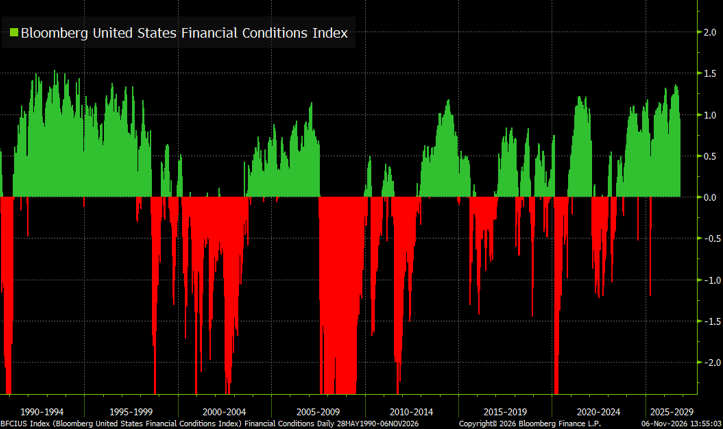
1. Available liquidity: Liquidity remains abundant. Access to capital remains remarkably easy, aided by the Federal Reserve’s hesitancy thus far to raise interest rates. Increased stock and bond volatility has led to some tightening, but financial conditions remain accommodative relative to history.
Exhibit 1: Bloomberg US Financial Conditions Index (May 28, 1990 – November 6, 2026)
Source: Bloomberg Finance L.P. RBA/JHI.
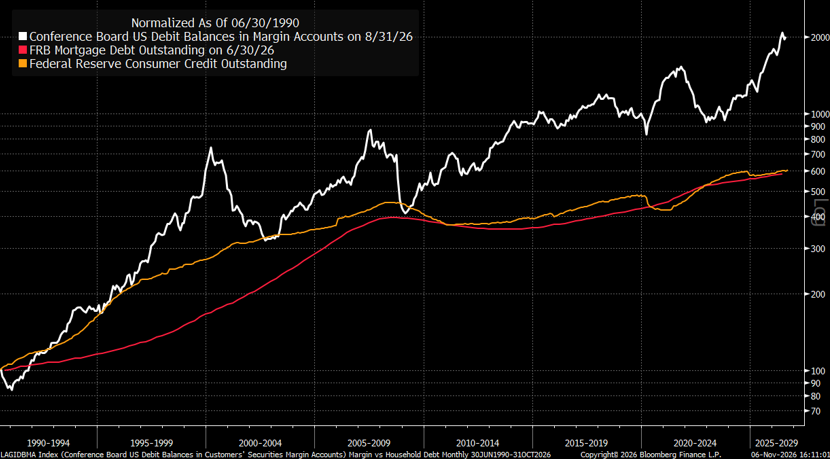
2. Increased use of leverage: Leverage has become the norm rather than the exception. Margin debt is growing faster than both credit card and mortgage debt, and options volume has reached record highs.
Exhibit 2: Margin debt growth vs. mortgage and credit card debt (June 1990 – October 2026)
Source: Bloomberg Finance L.P. RBA/JHI.
3. Increased trading volumes: Turnover is also at extremes. NASDAQ trading volume has never been higher than it was during the recent bull run.
Exhibit 3: NASDAQ Monthly Total Volume (August 1996– November 2026)

Source: Bloomberg Finance L.P. RBA/JHI.
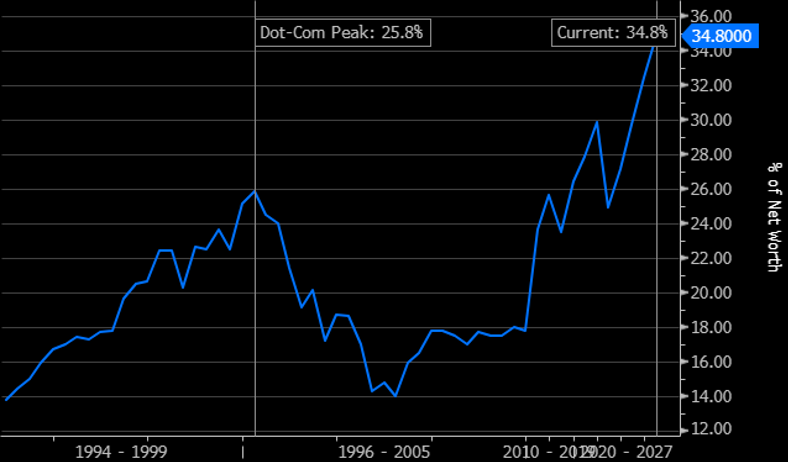
4. Democratization of the market: Broader participation in markets is palpable. Individual investors are playing a larger role in the markets, and equities as a percent of household net worth is at an all-time high.
Exhibit 4: Equities as a Percentage of Household Net Worth (December 1994 – November 2026)
Source: Bloomberg Finance L.P. RBA/JHI
It isn’t simply that households own more stocks, however. BofA Securities shows that individual investors’ equity exposure is concentrated in risky, high-beta stocks. Not only do households have record equity allocations, but they are using leverage to buy higher-beta stocks. Risk taking is amplified, with this approach more akin to gambling than a prudent long-term savings strategy.
5. Record new issues: AI mania has historic levels of new stock offerings and large-scale bond issuance siphoning money from the broader global economy. Issuers once measured a bond sale by the premium over government bonds they had to pay investors. Today, the headline for tech company new issues is how much capital was raised, while the cost of borrowing barely registers. With AI-related capital expenditures heading for $1 trillion in 2027, there is no sign of a slowdown.
Where have all the growth investors gone?
Compelling narratives and price momentum now carry more weight than disciplined analysis of company fundamentals. In a market this speculative, genuine fundamental growth investors appear to be a dying breed. And a growing body of evidence suggests investor focus has shifted in favor of quick gains over long-term growth.
Consider, for instance, how many global equities qualify as “super growth” companies, which we define as companies with projected 3- to 5-year earnings growth of 25% or more. Our analysis identified over 230 companies across a wide range of industries that meet that threshold today. Only two Magnificent 7 companies passed the screen. And nearly 75% are companies based outside of the U.S.
Those non-U.S. growth stocks are also cheaper. The MSCI ACWI ex US Growth Index currently trades at a P/E ratio of about 20 versus 29 for the MSCI US Growth Index, a discount of roughly 30%.
Faster growth at lower valuations should attract fundamental growth investors to non-U.S. stocks, but there is evidence to the contrary. While non-U.S. stocks make up roughly 35% of both the global growth and overall global equity universes, the 10 largest U.S.-based actively managed global growth mutual funds currently hold an average non-U.S. equity allocation of just 28%, according to Bloomberg. Individual investors look similarly underweight: Our analysis of data from the Fed and the ICI suggests their non-U.S. allocations are between 15%-25%.
Bearish? Hardly.
Our comments linking artificial intelligence and technology shares to gambling and bubbles might lead some to conclude that we are bearish. We are not. On the contrary, we believe equity investors’ narrow focus on momentum, coupled with their disregard for the broad range of longer-term fundamental growth opportunities available globally, present a robust investment opportunity.
Perhaps 2027 will turn the tides from gambling and momentum back to a focus on fundamentals. Either way, we prefer to look for higher returns on investment where capital is scarce, and we are energized by today’s very broad opportunity set.
IMPORTANT INFORMATION
Artificial intelligence (“AI”) focused companies, including those that develop or utilize AI technologies, may face rapid product obsolescence, intense competition, and increased regulatory scrutiny. These companies often rely heavily on intellectual property, invest significantly in research and development, and depend on maintaining and growing consumer demand. Their securities may be more volatile than those of companies offering more established technologies and may be affected by risks tied to the use of AI in business operations, including legal liability or reputational harm.
Equity securities are subject to risks including market risk. Returns will fluctuate in response to issuer, political and economic developments.
Copyright © Janus Henderson