





by Patrick O'Connell, Sara Rosner, Katrina Butt, AllianceBernstein
Weather shocks can reshape economic conditions and markets, with implications for asset classes.
El Niño is a climate phenomenon, but its effects transcend the weather map. Driving wide shifts in rainfall and temperature, it can disrupt everything from agriculture to monetary policy, ultimately affecting companies, sovereign issuers and asset prices. For investors, physical exposure is the starting point. But analyzing financial materiality also matters as weather shocks hit economies and industries and fundamentals amplify or absorb their impact.
We think the broader perspective is especially important with the Super El Niño underway, fueled by historically elevated global temperatures and likely to be felt well into 2027. But rather than viewing the prolonged event as a roadmap to market winners and losers, we think investors should approach it as a cross-asset stress test.
A Familiar Phenomenon in Unfamiliar Conditions
El Niño is a global climate pattern occurring every two to seven years, marked by unusually warm surface waters in the eastern tropical Pacific. Typically lasting nine to 12 months, it triggers significant shifts in temperature and precipitation worldwide. Effects vary widely by geography. Some regions face drought, others heavier rainfall and still others see little change or even improved conditions.
Research conducted in partnership with the Columbia Climate School suggests this El Niño is further complicated by historically elevated global temperatures, creating a Super El Niño with limited precedent and potentially exceptional strength. A weather map may show where shifts in temperature and rainfall could emerge, but for investors, the more consequential questions are how and when they travel through the financial system. In fact, our research shows that investment impacts can last for 12 to 18 months or longer.
Commodities: Following Shocks Through Supply Chains
Agriculture provides a clear transmission channel. Rainfall shifts can affect crop yields, supply and prices, as well as logistics to move products to market, but sensitivity varies by crop and region. Indonesia and parts of southern Africa may face agricultural stress, for example, while the historical El Niño signal for the US Corn Belt is much weaker.
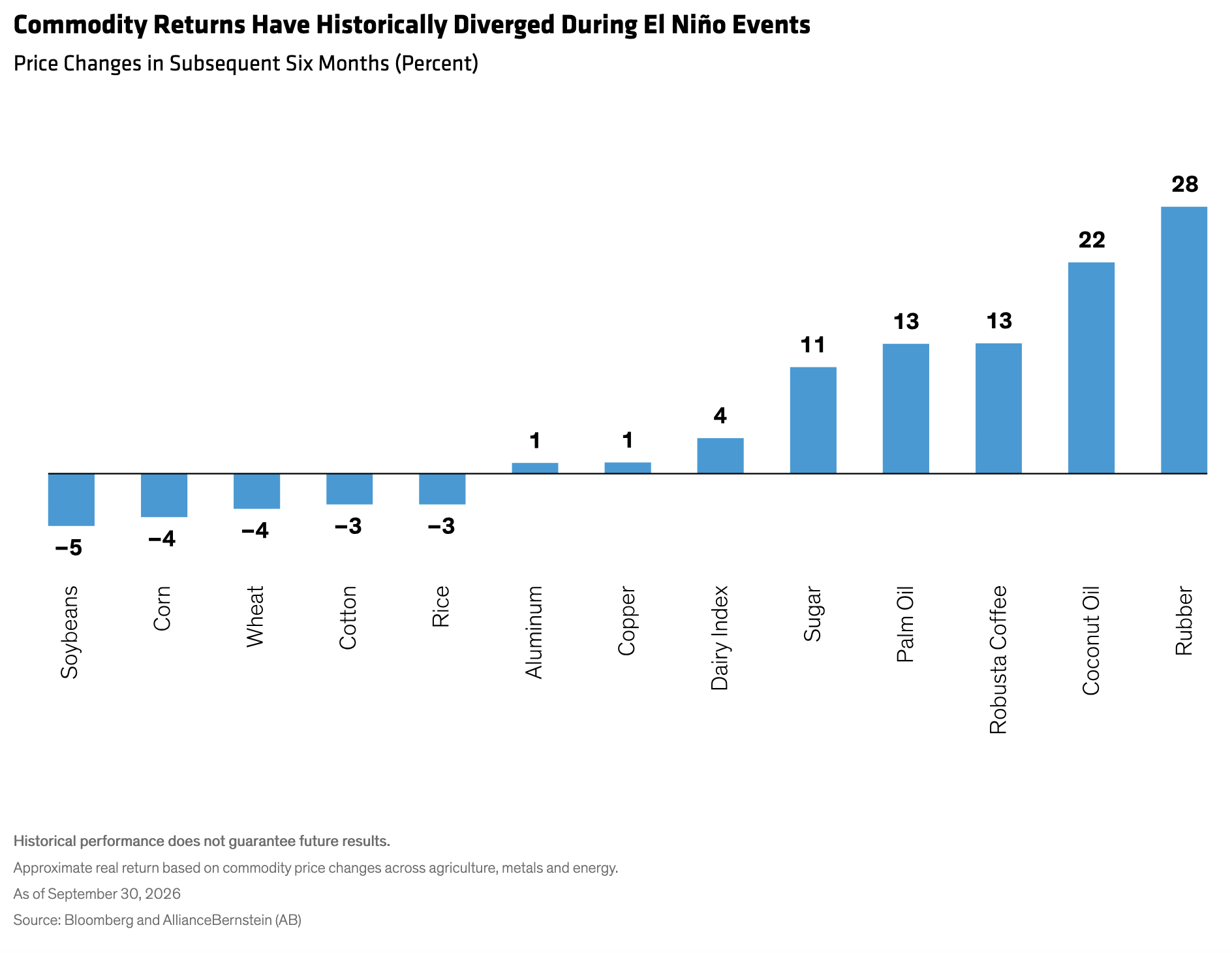
Commodity responses have varied, too (Display), with prices for rubber, coconut oil and robusta coffee rising relatively sharply during strong episodes, while wheat, corn and soybeans have proved less responsive.
Rather than seeking an “El Niño trade,” our analysis suggests investors may benefit from identifying supply chains most vulnerable to disruption because of climate exposure, geographic concentration and limited resilience. For example, reduced rainfall can constrain hydropower generation, shifting demand toward alternative energy sources. El Niño can also intersect with existing energy, geopolitical and supply chain pressures, potentially magnifying the economic impact.
Fixed Income: When Weather Becomes an Inflation Story
El Niño’s transmission to fixed-income markets is less direct but potentially just as significant. Historically, strong El Niño episodes haven’t shown a clear relationship between weather intensity and aggregate emerging-market credit risk, as sovereign spreads reflect broader economic, fiscal and political forces. The more revealing path may run through inflation and monetary policy.
Disruptions to crops or hydropower can raise food and electricity prices, adding inflationary pressure and potentially altering central bank policy. The initial effects may appear in local rates and currencies, while sovereign-credit implications depend on whether the shock weakens a country’s fiscal position.
Transmission also varies by country. Colombia combines hydropower exposure with food-price sensitivity; Ecuador faces both flooding and drought agricultural and infrastructure risks; and Zambia’s hydropower exposure intersects with copper mining and maize production. Similar weather shocks can therefore create very different vulnerabilities across sovereign issuers.
The starting point matters, too. Prior strong El Niño episodes occurred in more disinflationary environments, making today’s higher-inflation backdrop and its potential influence on monetary policy especially important to watch.
Equities and Corporate Credit: Fundamentals Can Change the Forecast
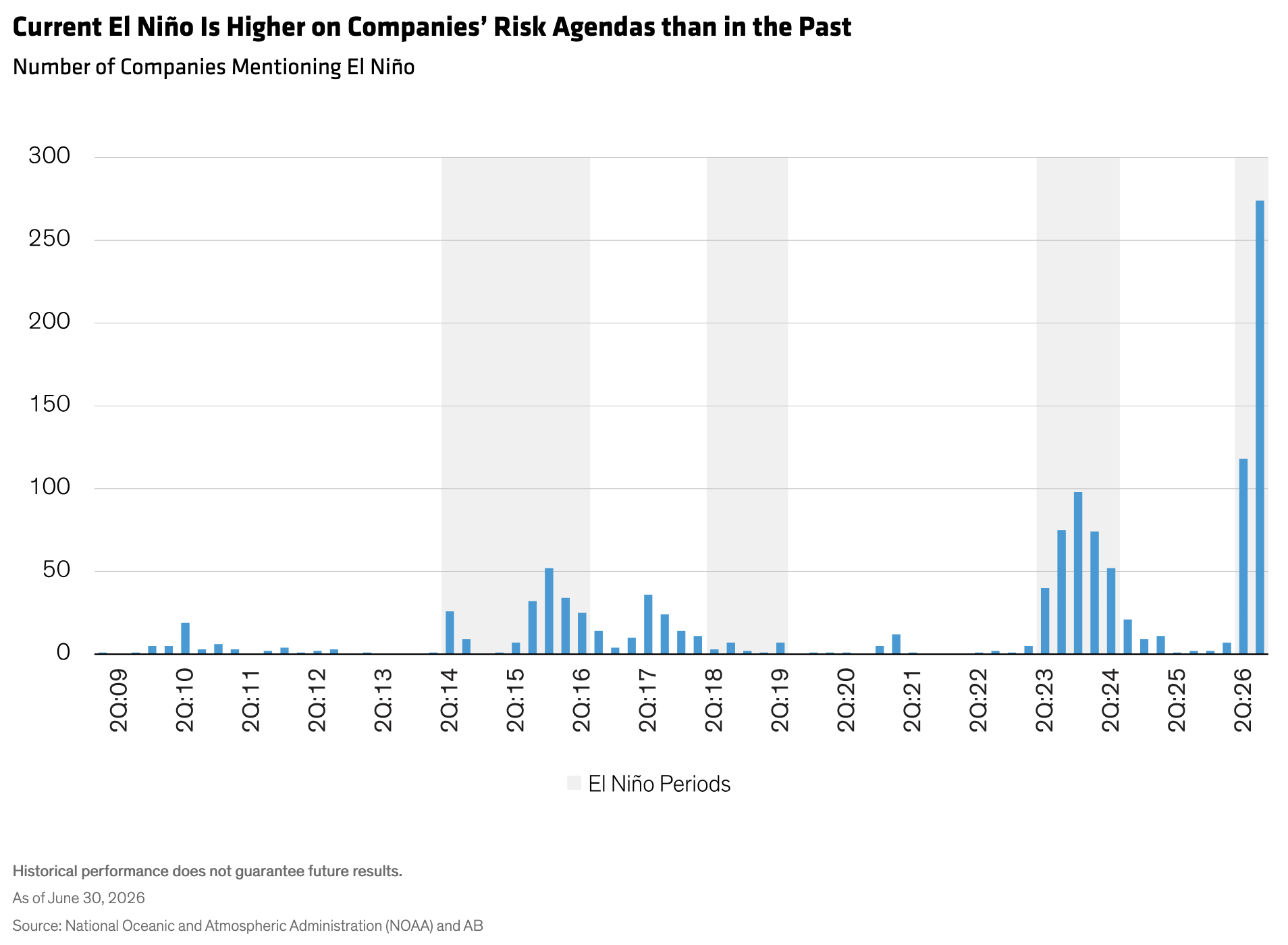
At the corporate level, El Niño exposure is drawing more attention. About 275 companies mentioned it in statements and earnings calls in the second quarter of 2026 alone, nearly triple the number at the height of the strong 2023 to 2024 event (Display).
But exposure alone says relatively little about investment risk or opportunity. In our engagement* with a state-owned South American hydroelectric utility in a drought-prone region, we found that preventative storage measures had kept its reservoirs well supplied, averaging 82.2% capacity versus 79.0% nationally. That capacity is supporting both the utility’s own generation and the public system.
Similarly, our engagement with a Japanese instant-noodle maker revealed a consistent inverse relationship between wheat prices and earnings during El Niño events. In fact, the company’s earnings per share rose in every El Niño cycle when improved growing conditions boosted wheat yields, lowering prices and therefore the company’s input costs.
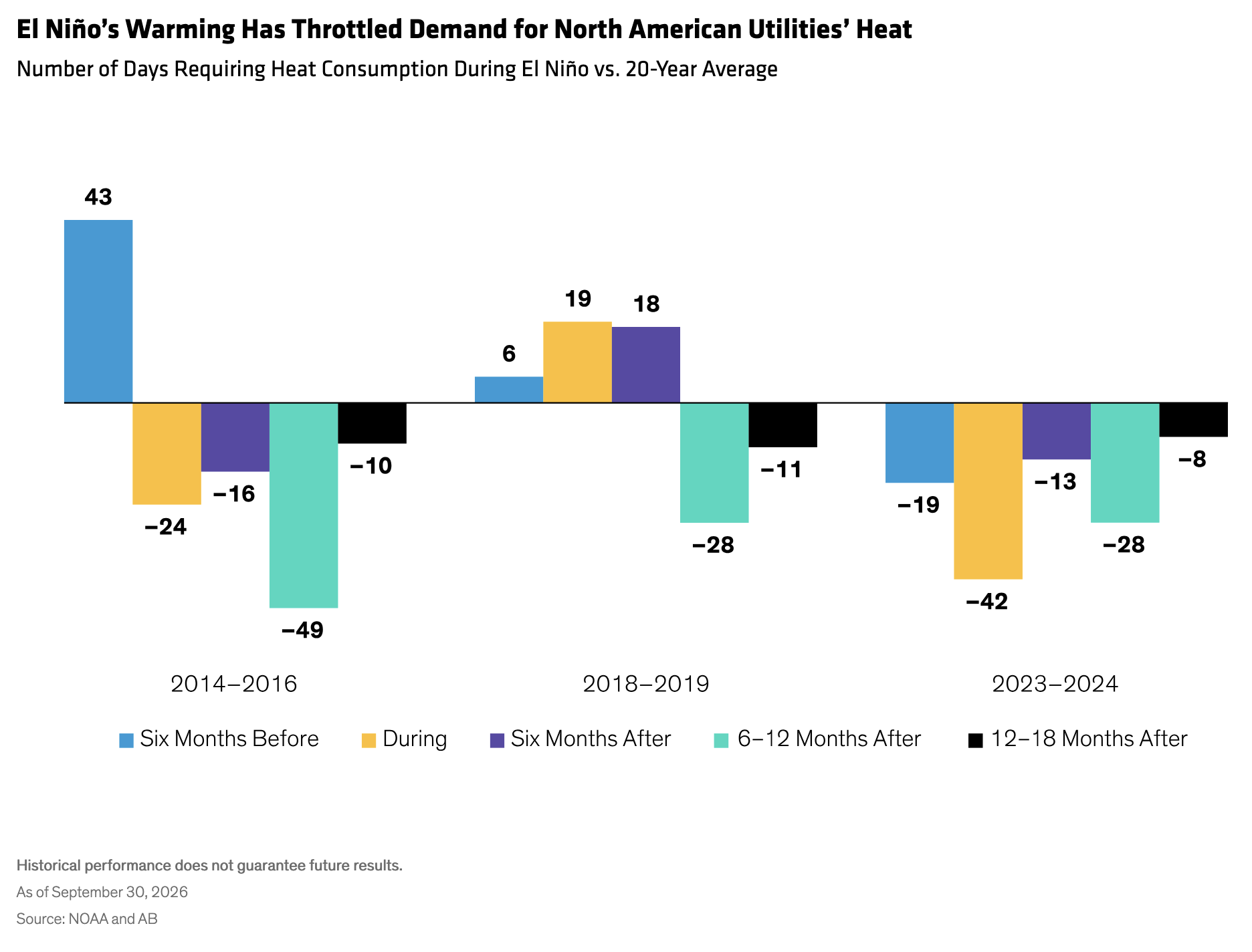
Sector effects can vary, too. North American utility earnings have historically faced pressure during El Niño as warmer winters reduce household heating demand (Display). Elsewhere, reduced rainfall and reservoir levels can pressure hydro-heavy generators, potentially increasing demand for alternative-power providers.
Fundamentals also matter at the company level. For food producers and utilities alike, hedging, broad sourcing, pricing power, generation mix, contractual protections, vertical integration and diversification can determine how much of the physical shock reaches earnings.
Focus on Transmission Channels, Not Predictions
We think transmission rather than projection may be the more useful way to frame Super El Niño: less a directional market call and more as a stress test of underlying vulnerabilities. Timing matters, too, because physical effects may emerge before their financial consequences, which could occur much later.
We believe investors should start with physical exposure, then trace potential effects through supply chains, commodity prices, inflation and policy. From there, they can better assess the factors that may amplify or absorb El Niño’s shock, from diversification and pricing power to contractual protections and balance-sheet strength. Ultimately, what matters is where and when disruption becomes financially material.
The authors would like to thank Cole Moore, Investment Stewardship Analyst and Engagement Lead—Responsible Investing at AB, for his significant contributions to the research behind this blog.
About the Authors
Patrick O'Connell, CFA
Patrick O’Connell is a Senior Vice President and Director of Responsible Investing Portfolio Solutions and Research. In this role, he develops strategies and tools that help integrate ESG considerations into the teams’ research, engagement and investment processes across AB’s investment teams. From 2021 to 2024, O’Connell served as director of Fixed Income Responsible Investing Research. Earlier in his career, he served as a corporate credit research analyst, focusing on emerging-market corporates in Latin American and African countries. O’Connell joined the Emerging Markets research team in 2013 after working as a credit analyst covering US high-yield energy credits at AB. Prior to joining the firm in 2012, he was a desk analyst at UBS Investment Bank, where he helped allocate capital on the trading desk. O’Connell holds a BS in accounting and finance (magna cum laude) from Villanova University and is a CFA charterholder. Location: New York
Sara Rosner
Sara Rosner is a Senior Vice President and AB’s Director of Responsible Investing Research. She leads the Responsibility team’s work with AB’s investment teams and clients on identifying, researching and engaging with material environmental and social issues that arise in the investment process. Rosner also leads AB’s collaboration with the Columbia Climate School, which focuses on enhancing investors’ ability to integrate climate change considerations into their decision-making and investment processes. She has developed and is implementing AB’s approach to managing material risks and opportunities stemming from the global transition to a lower carbon economy and has managed firmwide initiatives on climate scenario analysis, carbon offsets, and ESG education and training. Prior to joining the firm in 2018, Rosner performed research for the Columbia Center on Sustainable Investment, where she worked on projects related to the United Nations Sustainable Development Goals and renewable energy alternatives in the extractive industry. She spent most of her early career as a journalist covering energy and infrastructure finance in the Americas for Euromoney Institutional Investor. Rosner holds a BS (magna cum laude) in international studies from Pepperdine University and an MS in sustainability management from Columbia University. She is a global member of 100 Women in Finance and a member of Women Investing in a Sustainable Economy (WISE). Rosner was named one of Crain’s New York Business Notable Leaders in Sustainability 2023. Location: New York
Katrina Butt
Katrina Butt is a Vice President and Portfolio Manager for Emerging Markets Debt, where she is responsible for the management of hard-currency emerging-market sovereign portfolios. Previously, she was a senior Latin America economist in the Global Economic Research group for Fixed Income, focusing on macroeconomic analysis and fixed-income strategy in Latin America and the Caribbean. Earlier in her career, Butt was an economic research associate, supporting G10 and emerging-market economists at AB. She joined the firm in 2013 as a rotational associate for Fixed Income, serving in roles in quantitative research, credit research and portfolio management. Butt holds a BA (cum laude) in economics and mathematics from Bucknell University, an MPA from Columbia University’s School of International and Public Affairs, and is a CFA charterholder. Location: New York
Copyright © AllianceBernstein