



The biotech sector enters the fourth quarter of 2026 carrying a paradox in its pocket: a strong year by nearly every measure, and yet a market under unmistakable pressure. Stifel Healthcare's Q3 2026 Biopharma Market Update1, published October 9, 2026, is a detailed, unflinching read of a sector navigating "more than a few currents swirling in the biotech sea." It is worth reading in full. What follows is a synthesis of its most consequential findings.
A Good Year. A Complicated Moment.
The XBI is up 23% year-to-date. Global biotech sector enterprise value has risen 14% since January, and 2026 is tracking to become the second most active biopharma M&A year in recorded history at an annualized pace of $241 billion. By almost any backward-looking measure, this has been a strong year for biopharma investors.
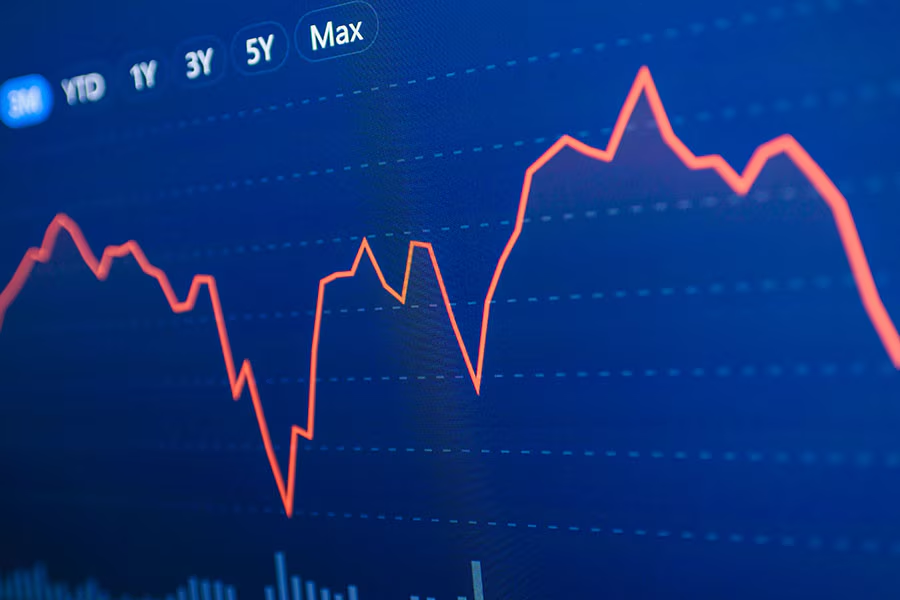
And yet the Stifel team is careful to name the headwinds without softening them. "It's a complicated moment," they write, "with more than a few currents swirling in the biotech sea." The XBI peaked at 169.55 in mid-August, fell below 150 by late September, and sat at 147 as the report was published — seven percent below its summer high, flat across Q3, even as the S&P 500 gained two percent and reached record territory.
The divergence is no accident. Three forces are bearing down on biotech valuations simultaneously: oil-driven inflation, a Fed that has pivoted back to tightening, and growing political risk ahead of the November midterm elections.
The Macro Turn: Oil, Inflation, and a Fed Reversal
The macroeconomic backdrop has shifted meaningfully since the summer. Brent crude hit $113.96 per barrel on September 29, driven by disruptions in the Strait of Hormuz, before easing to approximately $101 by October 6. Headline CPI reached 3.4% in August, well above the Fed's 2% target. The 10-year U.S. Treasury yield closed at 5.27% on October 6 — its highest level since 2007.
On September 16, the Federal Reserve raised its target range by 25 basis points to 3.75–4.00%, its first increase since 2023. The Stifel team summarizes the consequences plainly: "Higher discount rates weigh on pre-revenue valuations. Higher short rates make funding costlier and cash more competitive." The language is blunt because the mechanism is direct. When the risk-free rate is above 5%, early-stage biotech loses one of its most reliable tailwinds.
Fed deputies Philip Jefferson and John Williams have since signalled patience, pushing expectations for the next hike from October to December. Futures markets now price the fed funds rate at approximately 4.1% by January 2027. A slower hiking path would ease pressure on long-term yields — a key variable for biotech valuations — but the direction of travel remains unfavourable in the near term.
The FOMO Trade Unwinds
Much of biotech's 2026 rally was driven by a surge in M&A that created what the Stifel team calls a "generalist fear of missing out." As large-cap pharma companies moved aggressively to restock pipelines — facing a $300 billion patent cliff over five years and internal pipelines that "aren't nearly strong enough to provide the growth drivers pharma needs" — generalist funds piled into biotech seeking exposure to acquisition premiums.
That dynamic has faded. Monthly M&A dollar volumes peaked in April 2026 at nearly $45 billion and fell to under $2 billion in September. "As the year has proceeded, M&A activity has fallen — which in turn has caused this generalist fear of missing out participation to subside." The froth that was visible in August is now gone.
Critically, the Stifel team does not interpret this as structural deterioration. "It's also not a fear-driven market. Investors are still hunting for good deals. They still have high conviction for good stocks and, in many ways, are as rational now as they have ever been." The pause in M&A is attributed to election optics, stretched valuations during the summer froth, and the natural lag between valuation normalization and deal execution — not to any change in the underlying strategic imperative for large pharma to acquire.
Three Reasons the Outlook Remains Positive
Stifel is not turning bearish. The team's thesis rests on three pillars.
First, the macroeconomic environment is expected to improve. Game theory between the U.S. and Iran, the primary driver of both oil prices and inflation, is evolving. The team puts at least 50/50 odds on a resolution to the current stalemate within six months. Should oil prices turn lower, inflation would follow, and the Fed tightening threat would recede.
Second, M&A will come back. "Our industry conversations aren't telling us that M&A might pick up in the coming months. Those conversations tell us that M&A will pick up." The structural case is intact: over a trillion dollars in pharma industry M&A buying power, a massive patent cliff, and internal pipelines that cannot bridge the gap.
Third, artificial intelligence represents a secular demand driver for the pharmaceutical sector that is still in its early innings. "Better AI means better productivity. Better productivity means more wealth. And more wealth means more pharma demand." The team estimates that AI-driven GDP growth could produce a pharma economy 15 to 20 percent larger a decade from now than it would otherwise have been — a structural tailwind that transcends any single rate cycle.
Capital Markets: Volume Strong, Access Selective
Biopharma capital markets have been exceptionally active. Global public issuance reached $80 billion across 974 deals year-to-date, tracking toward the second strongest financing year in sector history. The IPO market is on pace for its third strongest year on record, with 23 biotechs completing initial public offerings in the first three quarters — nearly three times the full-year 2025 total of eight. Sixteen of those 23 now trade above their offer price, with a median return of 12%. The venture market is tracking to $50 billion in equity investment for the year, 45% above 2025's weekly pace.
The Stifel team is careful to distinguish volume from access. "Aggregate issuance is an incomplete measure of capital access across the ecosystem." The IPO window favours companies with validated clinical programs and credible management. Reverse mergers have surged — 23 completed year-to-date versus four in all of 2025 — serving earlier-stage companies that cannot yet command IPO valuations. The median PIPE proceeds in reverse mergers this year stand at $165 million, versus a post-money equity value for traditional IPOs of $860 million, illustrating the persistent bifurcation between institutional-grade capital and the broader market.
Pharma, Politics, and the Pricing Risk Overhang
The political environment adds a layer of risk that the Stifel team addresses directly. President Trump's net approval rating stands at negative 26, with approval on the economy at negative 33 and on inflation at negative 49 — both at all-time lows. "A president with low approval ratings and a hostile electorate has historically reached for pharma as a punching bag." The Nixon, Clinton, and Obama administrations all did versions of this.
The pharma industry has played effective political defense in the first half of the Trump administration, negotiating MFN agreements, domestic manufacturing commitments, and TrumpRx discount programs that have materially reduced the projected impact of Medicare drug pricing reforms — projected seven-year savings were gutted from $11.9 billion to $440 million. But these defences are not permanent. A Democratic sweep in November would increase pressure on pricing from the legislative side, and drug pricing remains one of the few areas where both parties have historically found common ground.
Five Key Takeaways for Advisors and Investors
- The macro headwind is real but potentially temporary. Rising rates and oil-driven inflation are genuine headwinds for biotech valuations in the near term. The resolution of the U.S.-Iran stalemate remains the single most important variable to watch.
- The M&A pause is structural, not permanent. The patent cliff, weak internal pipelines, and over $1 trillion in pharma dry powder create a durable case for deal flow resumption. Expect activity to accelerate after the November election.
- Quality bifurcation is widening. The ratio of average enterprise value between companies with "very good" clinical data versus "medium" data now stands at 29-to-1. Companies without validated clinical programs face a structurally more difficult financing environment.
- AI is a long-cycle demand driver, not a near-term catalyst. The sector's long-term case is strengthened by AI-driven productivity and wealth creation, but advisors should hold this as a structural view, not a trading signal.
- Political risk is rising into year-end. Post-midterm dynamics — regardless of outcome — are likely to bring renewed scrutiny of drug pricing. The pharma industry's legislative defences may weaken precisely when M&A and capital markets activity are expected to re-accelerate.
Footnote:
1 Stifel Healthcare Investment Banking. "Q3 2026 Biopharma Market Update." Stifel, Nicolaus & Company, Incorporated, 9 Oct. 2026, https://www.stifel.com/newsletters/investmentbanking/bal/marketing/healthcare/biopharma_timopler/2026/BiopharmaMarketUpdate_100926.pdf. Accessed 16 Oct. 2026.