

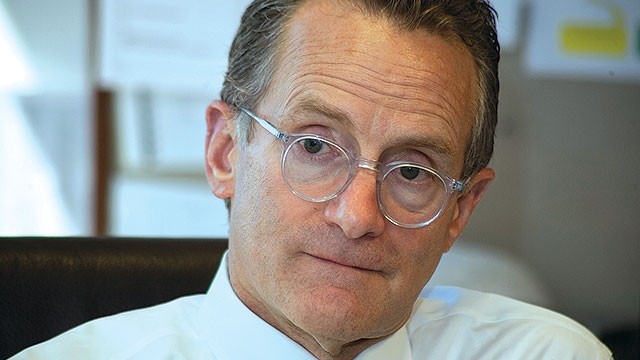

At the Qatar Economic Forum, Howard Marks1, co-chair of Oaktree Capital Management, sat down with Bloomberg for a wide-ranging conversation that moved from Fed communication philosophy to the existential mathematics of artificial intelligence. What emerged was a portrait of one of the most respected value investors alive grappling, openly and honestly, with an era that may resist valuation entirely.
Less Signal, More Resilience
The conversation opened with a question most market participants would not think to ask: is the Fed communicating too much? Marks thinks so. "If to the extent that the central banker tells people less about what he's going to do," he says, "they have to make their portfolios and their businesses antifragile, which is better for society." The logic is pointed. When everyone positions for a known outcome, the system grows dependent on that outcome. Surprise breaks it. Silence, paradoxically, builds strength. Marks' preference is for a central bank that intervenes only when the economy risks going off the rails. "If it's not too hot or too cold, leave it alone." It is a Goldilocks argument in reverse: the porridge is fine, put down the spoon.
The Optimist in Charge
Since October 2022, Marks observes, markets have been "generally ruled by optimists." The S&P 500 has more than doubled in that period. Equity prices, by his read, have drifted above intrinsic value, warranting caution. Yet he is careful not to overstate the case. The optimism is not without foundation. The U.S. remains, in his view, the best-performing developed-world economy. The old TINA dynamic, there is no alternative, persists in modified form. And then there is AI. "When the optimists are in charge, they kinda slough off the bad news," he notes, and get "excited when there's word of a settlement." They do not get depressed when it falls through. The asymmetry is real. The prescription is practical: "Maybe you build in a little defense, or you take care in what you do."
The Societal Ledger
Marks has written extensively about AI's societal consequences, and the Bloomberg anchor pressed him on whether those fears have compounded. His answer was disciplined. A sentient human being, he says, has to think about these things, "has to acknowledge there's nothing we can do about it." His wife's definition of worrying, which he cites directly, is "bleeding before you're shot." Where there is no lever to pull, preoccupation is waste. That said, he is not satisfied with government's response. "I think there should be a task force on the effect of, the coming effect of AI, and there isn't." The specific problem he flags is fiscal, not technological: if AI displaces workers, those workers stop paying taxes. "Will it take their place as taxpayers and how? So what will happen to government revenues when and if people lose their jobs?" It is a question no one in power is yet seriously asking.
AI as Investment Problem
When the conversation turned to markets, Marks drew on Alan Greenspan's 1997 phrase: "irrational exuberance." We have the exuberance, he says. The question is whether it's irrational. And here is where he offers his most precise insight: "Since nobody, in my opinion, can spec out exactly what it is that AI has been gonna be doing and with what effect and with what profitability, I don't think anybody can say that it's irrational, but you have to consider the possibility." The uncertainty itself does not make the enthusiasm irrational. The outcome could yet justify every multiple. It could also fail to. That ambiguity is the investment problem.
For value investors, the difficulty is structural. Hyperscalers like Microsoft and Amazon have diversified earnings streams that can anchor a valuation. But for pure-play AI companies with no earnings history, "there's an unusual degree of uncertainty in coming up with any quantification of earnings potential and thus of what we call intrinsic value." Warren Buffett, Marks reminds the anchor, called things like this the "too hard pile." It may be too hard for the value investor with the capital V. "And it's challenging for the one with the small v."
Five Key Takeaways for Advisors and Investors
- Antifragility over anticipation. Building portfolios that depend on a known Fed path is a structural vulnerability. Design for resilience, not prediction.
- Optimist-dominated markets call for quiet defense. When prices exceed intrinsic value and sentiment is asymmetrically positive, the right move is not to exit but to build in margin.
- AI uncertainty cuts both ways. The exuberance around AI cannot be called irrational because the upside scenario remains genuinely possible. That same logic means investors must hold the uncertainty, not dismiss it.
- Pure-play AI is on the too-hard pile. Without a path to quantifiable earnings, intrinsic value is almost unknowable. Hyperscalers with diversified revenue streams present a more tractable valuation problem.
- Government has not caught up. The fiscal consequences of AI-driven job displacement, specifically what happens to tax revenues, represent a policy gap that advisors should be watching as a macro risk.
Footnote: Marks, Howard. "Howard Marks Flags the Uncertainty in AI Investing." Bloomberg at the Qatar Economic Forum, 24 Sept. 2026, https://www.youtube.com/watch?v=-ZdgxiRWuS0.