





by Carl Tannenbaum, Ryan Boyle & Vaibhav Tandon, Northern Trust
In choppy waters, many novice ship passengers will experience sea sickness. The only sure remedy is to wait it out. Symptoms will pass, as will the rough waters.
When a driver sees an unfamiliar light on the dashboard, the hope is that it’s a false positive that will go away on its own. But a persistent warning must be addressed before it becomes a bigger problem. The global economy is moving forward with several warning lights flashing, and those signals are becoming harder to ignore.
Conflicts in the Middle East and Ukraine, along with renewed trade tensions, are caution signals. Yet despite the risks, growth continues to move forward, albeit at a measured pace. Our baseline assumes that these challenges will flash for an extended period but not turn red.
Inflation should remain high enough to keep policymakers cautious, but not so high as to trigger a prolonged tightening cycle. Fiscal support is expected to keep a floor under economic activity but also raise danger signals about the state of public finances. Overall, that combination should keep growth positive across most economies, even if the pace remains modest.
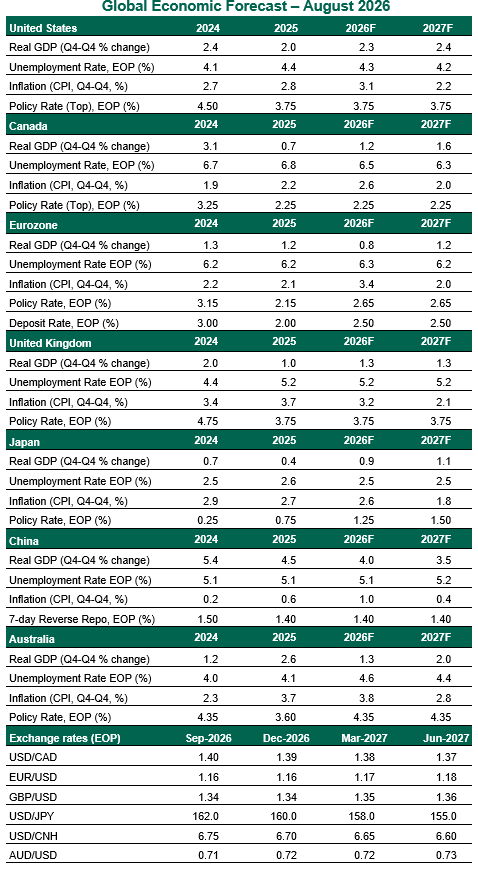
Following are our outlooks for the world’s major markets.
United States
- The U.S. economy continues to motor along. Growth moderated to a 1.5% annualized pace in the second quarter, led by inventory drawdowns, a wider trade deficit, and slower government outlays. But consumer spending and business investment both rebounded, highlighting the economy's underlying resilience and ongoing technology-related investment. Inflation remains above the Federal Reserve's target. Recent labor market data is mixed, but not yet a reason for concern.
- Uncertainty surrounding the Federal Reserve remains elevated. Chair Warsh has attracted criticism for offering limited commentary on the economic outlook during public appearances, though he has consistently reaffirmed the Fed's commitment to its 2% inflation objective. Divisions are becoming apparent within the Federal Open Market Committee, with three voting members dissenting in favor of a rate increase at the last meeting. Should inflation reaccelerate, that view could gain broader support within the Committee. Our baseline expectation remains that inflation will moderate gradually, allowing the Fed to leave policy rates unchanged for an extended period.
Canada
- After two consecutive quarters of modest contraction, Canada's economy showed broad-based expansion in the second quarter across exports, consumer spending, and business and residential investment. However, the pace of growth is unlikely to be sustained. Caught between resilience at home and uncertainty abroad, Canada faces a challenging path forward.
Uncertainty over the future trading relationship with the United States is likely to restrain private investment. The recent collapse of negotiations and new tariff threats present a downside risk, though not enough to push the economy into recession. U.S.-Canada trade ties appear to be entering a period of gradual but persistent deterioration, with economic integration becoming less of a certainty than it once was. - Underlying price pressures in Canada remain contained despite recent increases in energy costs. Headline inflation rose two-tenths to 3.0% year over year in July, reaching the top of the Bank of Canada’s (BoC) 1%-3% band. Core readings, including the central bank’s preferred measures, also edged up but remain contained around the 2% mark. With economic slack still evident, the BoC is likely to maintain a cautious stance and keep rates unchanged over our forecast horizon.
Eurozone
- The eurozone is exhibiting a surprising degree of resilience, with real gross domestic product (GDP) clocking a solid 0.4% quarter over quarter gain in the second quarter. Growth has held up better than expected despite a renewed rise in energy costs, echoing the region's ability to absorb the 2022-23 energy shock without falling into a deep contraction. Supportive fiscal policy, solid household balance sheets, and generally easier financial conditions have all helped cushion the impact of geopolitical disruptions.
- That resilience will be tested in the months ahead. Energy markets are tightening as countries replenish storage for winter amid growing competition for liquefied natural gas supplies. At the same time, heatwaves, transportation bottlenecks, and prospects for higher global food prices threaten to add to inflationary pressures. In light of this, we expect the European Central Bank to deliver one final rate hike before returning to the sidelines.
United Kingdom
- The U.K.'s strong start to the year is beginning to fade. Real GDP growth slowed to a rate of 0.4% in the second quarter as some of the temporary support from inventory accumulation and preemptive spending ahead of expected Middle East-related price increases are beginning to unwind. Consumer spending moderated after a robust first quarter, though business investment remains a bright spot. Economic activity is likely to cool further in the second half of the year as the effects of higher energy costs and broader geopolitical uncertainty work their way through the economy.
- Inflation pressures are once again moving in the wrong direction and will continue to do so in the near-term, largely driven by rising utility bills as price caps are stepped up. Softening labor market conditions and a continued deceleration in wage growth suggest that domestic inflation pressures remain contained, with no signs of second-order effects from the Middle East war so far. The Bank of England, therefore, has scope to remain patient. Fiscal policy may become a greater source of concern. Markets will scrutinize the government's first budget closely for signs of a softer commitment to fiscal discipline, particularly if investment spending is increased without a corresponding improvement in public finances.
Japan
- A sustained recovery in Japanese domestic demand remains elusive. Exports continued to provide support in the second quarter, but consumption stagnated and business investment shrank for the second consecutive quarter. Real incomes are beginning to benefit from stronger wage gains and are expected to provide a welcome tailwind to consumption. At the same time, the government's ambitious growth strategy aims to mobilize substantial public and private investment across several strategic industries, reflecting a renewed focus on boosting the economy's long-term potential. Though beneficial over the long term, the plan is adding to market unease. The administration’s initiatives are expected to cost $2.3 trillion over the next 14 years. Coupled with a temporary reduction in the consumption tax on food from 8% to 1%, these measures have renewed concerns about the government's commitment to fiscal discipline.
- The yen remains under pressure despite the recent joint intervention by Japanese and U.S. authorities. Persistent yen weakness, higher energy costs, and growing fiscal concerns are all adding to inflation risks. Against this backdrop, the Bank of Japan is likely to take a more proactive approach, delivering one rate hike before year-end and another early in 2027 to avoid perceptions that it is falling behind the curve.
China
- China's challenges are increasingly homegrown rather than imported. Economic growth slowed in the second quarter, led by a sharp fall in investment and sluggish consumption. Retail sales remain lackluster, infrastructure investment has failed to gain traction, and the property sector continues to face stress. Incoming data suggests a further loss of momentum. Exports continue to carry a disproportionate share of the growth burden, but even that pillar faces a more challenging environment as Western economies become increasingly wary of China's trade practices. Deflationary concerns continue to linger, with consumer price inflation decelerating for three months in a row, falling below a 1% annual rate in July.
- While softer growth increases pressure for additional stimulus, Chinese authorities continue to prioritize restraint over aggressive intervention. As a result, policy support is likely to remain targeted and selective rather than broad-based.
Australia
- Two-speed growth remains the defining feature of Australia's economy. Consumer spending remains the principal soft spot. Falling house prices and the lingering effects of restrictive monetary policy have weighed on household wealth and spending decisions. Investment related to data centers and AI infrastructure represents a growing source of support, reflecting Australia's role in the global technology picture. These positive developments should help offset weaknesses elsewhere in the economy.
- Inflation has moderated somewhat, but remains above the central bank’s target range. Labor market conditions are also relatively healthy. Demand has softened, but not enough to provide the Reserve Bank of Australia (RBA) with confidence that inflation will return sustainably to target. The RBA is therefore likely to remain on hold, retaining a tightening bias.
Copyright © Northern Trust