



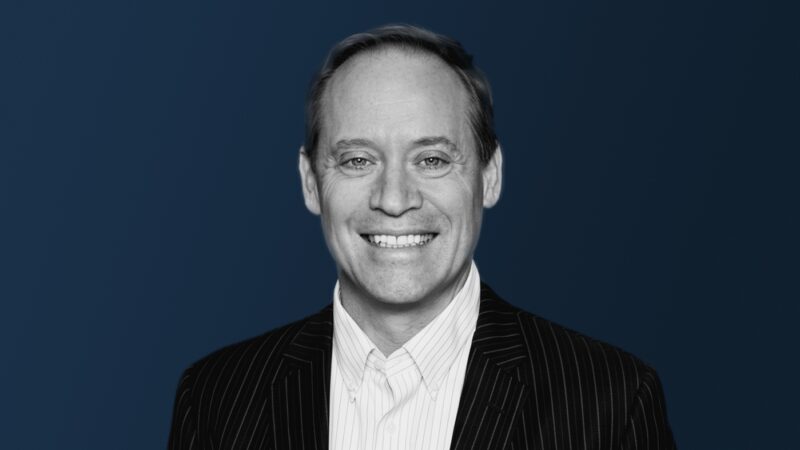

Michael Green Tells Pierre Daillie and Adam Butler the Passive Bid Is No Longer a Background Feature. It Is the Market.
The stock market, as most practitioners were trained to understand it, no longer exists. That is not a rhetorical provocation. It is Michael Green's considered conclusion after more than a decade of research1, field testing, academic cross-examination, and what he describes as a great many blows taken along the way. Green, Chief Investment Strategist at Simplify Asset Management, joined AdvisorAnalyst's Pierre Daillie and Adam Butler, CIO, ReSolve Asset Management on Raise Your Average in July 2026 to work through the state of a market that has absorbed oil shocks, geopolitical convulsions, and softening fundamentals, and responded by making new all-time highs.
"We can't really just look at it as 2026," Green says. "We have to think about this in the context of a much broader theme that has been in place, I would argue, for going on almost fifty years."
That theme is the structural transfer of retirement savings from defined benefit pensions into defined contribution plans, tracing its origins to the ERISA-enabled creation of the 401(k) in 1978. What sounds like administrative history has, in Green's framework, produced a permanently elevated and mechanically insensitive flow of capital into US equity markets. Every paycheck, every contribution cycle, sends money into the biggest stocks, which become bigger, which attracts more money, which has no opinion whatsoever about whether the price is right.
The Price Has Left the Building
The efficiency hypothesis, upon which modern portfolio theory rests, depends on active participants who care about valuation. As those participants have been redeemed, defunded, and structurally disadvantaged, the corrective mechanism has been quietly dismantled.
Green is precise about what this means mathematically. The 2021 Gabaix and Koijen paper on the Inelastic Market Hypothesis found that the flow multiplier, the amount by which a dollar entering the market lifts market capitalization, averaged five dollars between 1992 and 2019. Not the one penny assumed by the efficient market literature. Green's current estimate places that multiplier at twenty-two for the broad market. "For the largest stocks," he says, "it's approaching a hundred." A relatively small influx of capital, in other words, can generate market cap gains of an order that has nothing to do with what the underlying businesses are producing.
The Grossman-Stiglitz framework, the intellectual foundation for why markets should remain efficient even as some participants go passive, fails on three counts in Green's analysis. First, it assumes that departing active managers are replaced one-for-one by other active managers. Valentin Haddad's research shows the competitive response is partial, not complete. Second, it assumes equal endowment among participants, a condition that ceased to describe reality long ago. Third, and most consequentially, it assumes that markets are highly elastic. They are not. "You do not get into airplanes that are being flown with five hundred to one misspecifications," Green says. "This is just life advice."
The Alpha Problem Is Structural, Not a Skill Problem
For advisors who have watched active managers fail to beat passive benchmarks year after year and concluded that managers simply lack skill, Green has an uncomfortable alternative explanation. The negative alpha observed is not the result of more skilled players competing more efficiently. It is the mechanical consequence of a market that has become mean expansionary rather than mean reverting.
In a market driven by discounting, asset prices tend to revert toward fair value over time, and active managers who sell expensive securities and buy cheap ones generate alpha. In a market driven by passive flows, the market cap momentum is structurally overwhelming. "The only way to beat the market right now," Green states, "is to effectively be more aggressively exposed to the quote unquote passive factor."
He makes this point without any defensiveness about conflict of interest. When Butler raises it directly, Green's response is blunt: "The other side's right. It is just sour grapes." Then he explains why the ad hominem framing does not settle the empirical question.
The paper that won the Two Sigma Award in June 2026 demonstrates precisely what Green has argued for a decade: the growth of passive share is the causative variable driving active underperformance, and the excess return available from active decision-making has turned negative. "There is no capacity for that in the skill explanation," he says. "And so it has failed, and yet its adherents still say, 'Well, that just makes more sense.'"
The Real Economy Behind the All-Time Highs
Green's skepticism extends to the headline numbers that justify elevated valuations. GDP growth in the United States is increasingly inflated by investment in intellectual property, a category that assumes any margin expansion above historical norms must reflect dark-matter-like innovation rather than market power. Corporate earnings in the AI complex are being circularly funded through vendor financing arrangements that belong on balance sheets but are not reported there. Credit card spending is being cited as evidence of consumer health while households put gasoline on revolving credit at double-digit rates.
"More and more Americans and Canadians feel that they are on the gaslit side of the equation," he says, "where they're being told everything's great, and they're watching the stock market go up, and they're looking at their own balance sheet and saying, 'Wait, my money is not compounding.'"
The AI capital expenditure cycle draws his most pointed analogy. Cisco's vendor financing in the late 1990s created the appearance of sustainable earnings growth through circular activity. Today's Mag Seven are financing customers to buy compute, then booking the appreciation of their equity stakes in those same customers as earnings. "Once you buy an overpriced GPU and contract to build an overpriced data center, you might as well buy the overpriced memory to go along with it," he says. "It's a little bit like a pocket square in a finely designed suit."
The Terminus and What Comes After
Green does not resist the logic of Stein's Law. What cannot go on forever will stop. His read of where the system currently sits, with levered sector ETFs creating procyclical feedback loops, SpaceX-style IPOs liberating insider capital at inflated valuations, and the academic literature finally catching up to where his research was a decade ago, is that the end stages of the passive phenomenon are visible. "We are standing at the back of the line and we're saying, 'Hey, guys, we just looked at the map and we're about to go off a cliff,'" he says.
For advisors and portfolio managers trying to navigate the remaining duration of the trend and position for what follows, Green and Butler converge on managed futures trend following as genuinely convex exposure. Green frames its logic as liquidity provision rather than trend speculation. "The idea behind a market maker is that when there's nobody else on the other side of the trade, they will step in and provide the capital for that. That is effectively what you are doing with managed futures."
He is candid, however, about the limitations. Managed futures is capacity constrained. It is arrayed against an equity behemoth that the consensus treats as unconstrained. And the decade of low rates that compressed carry returns did real damage to the asset class's diversification properties. The risks of crowding into replication strategies are real.
The most honest framing Green offers is this: "The only way to beat the market right now is to effectively be more aggressively exposed to the passive factor," and the tools being built to navigate the aftermath are newer and less tested than the passive machine they are designed to survive.
The research has held every test thrown at it. The academics are arriving. The multiplier is rising. For those who want to know what the map says, Green has been reading it for ten years.
5 Key Takeaways for Advisors and Investors
1. Passive flows are the dominant market pricing mechanism. The inelastic market multiplier has risen to an estimated 22 for the broad market and approaches 100 for the largest stocks, meaning capital flows, not fundamentals, are setting prices. Valuation as a near-term timing signal has ceased to function.
2. Active underperformance is structural, not a skill deficit. The Two Sigma Award-winning research published in 2026 confirms that passive market share growth, not the paradox of skill, explains negative active alpha. Fighting this with traditional stock picking in large-cap equities is a compounding losing bet that worsens as passive share grows.
3. The headline economy and the real economy are diverging sharply. GDP growth inflated by intellectual property accounting, circular AI earnings, and credit-funded consumer spending are all masking deterioration in household balance sheets. Macro fundamentals no longer anchor equity prices, but they will eventually matter.
4. Levered ETFs are accelerating the endgame. Instruments like 3X sector ETFs create procyclical rebalancing flows independent of investor decisions, amplify inelasticity in the largest stocks, and suppress index-level volatility while concentrating systemic risk. This looks like the late-stage pattern that preceded previous market dislocations.
5. Genuine alternatives, not active stock picking, are the structural hedge. Managed futures trend following functions as liquidity provision and offers convex diversification. Its attractiveness as a terminal hedge grows as the passive phenomenon approaches its limits. Capacity constraints are real but remain well below binding levels for most allocators.
Footnote:
1 Daillie, Pierre, Adam Butler, and Michael Green. "When the Machine Replaces the Market." Raise Your Average, July 2026, www.youtube.com/watch?v=VU2_zVuUeRk. July 31, 2026.