





Canada's economy delivered a stronger-than-expected performance in May, adding fresh evidence that growth rebounded solidly in the second quarter following a stall over the winter months. Statistics Canada reported GDP rose 0.3% in May, with an early estimate pointing to a further 0.2% increase in June — figures that RBC economists Abbey Xu and Nathan Janzen say confirm a broader pattern of recovery despite an increasingly uncertain trade backdrop.
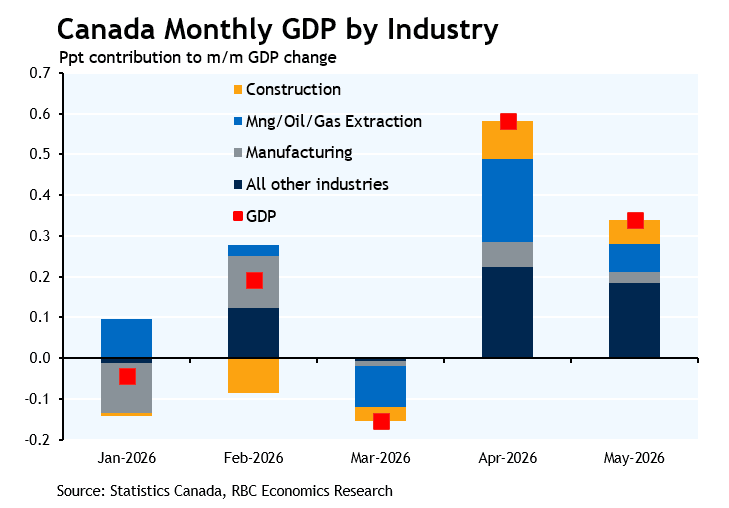
"The stronger-than-expected 0.3% increase in Canadian GDP in May (and early estimate of another 0.2% increase in June) added to evidence that the economy bounced back at a solid pace in the second quarter after growth stalled over the winter," Xu and Janzen write. Crucially, the expansion was not confined to a single sector. "Growth was broad-based across both goods-producing and services-providing industries, with gains in mining, quarrying and oil and gas extractions, construction, manufacturing, real estate and rental and leasing, and public administration."
The May data build on an already-solid start to the quarter. Yet the recovery is uneven beneath the surface. Xu and Janzen note that "while some trade-sensitive industries continued to face headwinds, including a decline in wholesale trade activity, growth elsewhere remained relatively resilient, supported by a second consecutive increase in manufacturing output, continued gains in the resource sector, and emerging green shoots in housing market activity." That phrase — green shoots — signals a tentative but real turn in a housing market that has weighed on growth for some time.
The headline number for the quarter is striking. Taken together with the June advance estimate, the report "points to annualized quarter-over-quarter growth of 3.4% in Q2, more than a percentage point above our 2.2% forecast." That is a meaningful upside surprise, though the economists are careful to flag the caveat that matters most: "Monthly GDP readings and advance estimates are notoriously revision-prone."
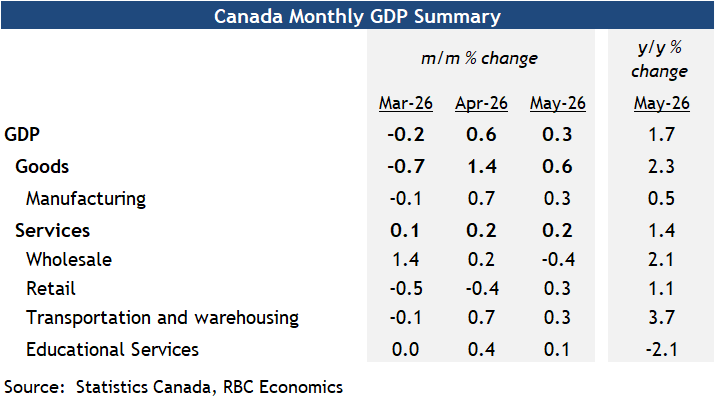
On the sectoral details, goods-producing industries expanded 0.6% in May, following "a robust 1.4% advance the prior month," led by mining, quarrying and oil and gas extraction, construction, and manufacturing. Manufacturing itself rose 0.3%, building on April's 0.7% gain, with strength described as "broad-based... across 10 of 18 subsectors." Construction continued its run as well, climbing another 0.8% after April's 1.3% growth, "driven primarily by engineering and other construction alongside residential building."
Services told a more muted story. Services-producing industries rose 0.2%, matching April's pace, with real estate and rental and leasing, along with the public sector, leading the gains, while wholesale trade posted declines. Real estate specifically rose 0.4% in May — "marking a fourth consecutive monthly gain and aligning with strong home resale volumes during the period," a signal that housing demand is translating into measurable output gains rather than just anecdotal chatter.
The June advance estimate, while preliminary, reinforces the mixed-but-positive picture: "Gains in wholesale, finance and insurance, and retail trade were partially offset by losses in utilities and agriculture, forestry, fishing and hunting."
Where does this leave the outlook? Xu and Janzen strike a balanced tone, acknowledging real risk without abandoning optimism. "Looking ahead, escalating trade tensions and the latest U.S. tariff announcements pose downside risks to the outlook, particularly for targeted industries." But they temper that risk with encouraging underlying signals: "Still, signs of a bounce-back in Q2 growth and stabilization in labour markets are encouraging. We continue to expect the economy to gradually improve on a per-person and per-worker basis this year."
Their closing synthesis captures the tension running through the whole report: "Taken together, available data suggest economic momentum remained broadly positive through the second quarter, although uncertainty surrounding global trade policy continues to weigh on the outlook for the second half of the year." Growth is real, broad-based, and beating forecasts — but it is running against a headwind that hasn't gone away.
Five Key Takeaways for Advisors and Investors
- The Q2 growth surprise (3.4% annualized versus a 2.2% forecast) suggests the economy has more underlying momentum than consensus expected, which could shift near-term rate and currency expectations.
- Manufacturing's second consecutive monthly gain points to a sector finding footing despite tariff pressure, worth watching for continuation.
- Housing-linked real estate gains, now four months running, indicate the sector is turning from stabilization to modest growth, relevant for rate-sensitive portfolios.
- Wholesale trade's persistent weakness is a visible marker of where U.S. tariff exposure is already biting, useful for sector-level positioning.
- The revision-prone nature of monthly and advance GDP estimates means this strength, while encouraging, should be treated as provisional until confirmed by subsequent data.
Footnote:
1 Xu, Abbey, and Nathan Janzen. "Canadian Economy Continued to Expand in May Despite Mounting Trade Uncertainty." RBC Economics, Royal Bank of Canada, 2026.