


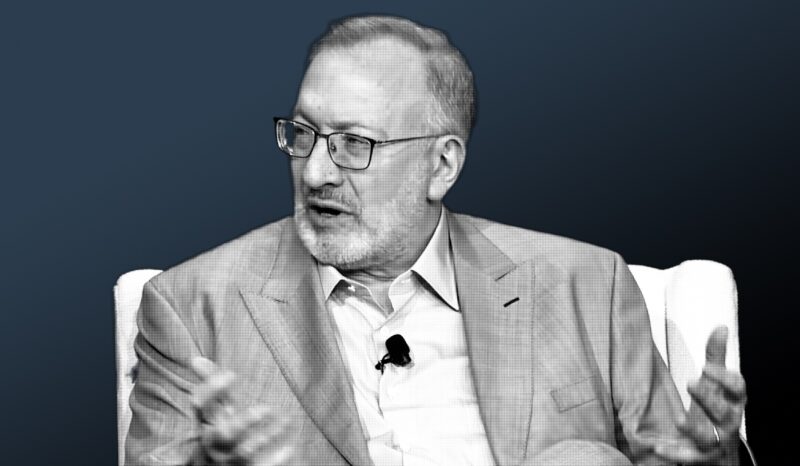

Seth Klarman does not need the legendary label CNBC's Sara Eisen attaches to him before their conversation even begins1. Forty-four years running Baupost Group, only five down years, a worst drawdown of roughly 10 percent — the track record speaks before he does. But what makes this exchange notable is not the résumé. It is the bluntness with which one of the industry's most disciplined value investors looks directly at the defining theme of this market cycle and declines to look away from its risks.
Asked point blank whether today's environment is a bubble, Klarman does not hedge into vagueness. "I think it has characteristics of a bubble," he says, describing "an optimistic tone around the technology, around a new era, this kind of new era thinking." He points to a tell that should make any advisor pause: "you certainly see it in places like when Allbirds, the shoe company added AI to their name. The stock did well and that's crazy. That's reminiscent of the dot com era." Yet Klarman refuses the easy dismissal that bubble-callers often reach for. AI, he says, "seems like a technology that could be so game changing that it would be hard to dismiss it or call anything in particular around in a bubble." The discomfort he describes is not skepticism about the technology — it is uncertainty about pricing it. "None of us can know with any confidence how's it all going to pan out," he says, listing the open questions plainly: “Are the winners today going to still be the winners? Will it be a winner-take-all technology or will there be room for a lot of different winners?"
This is where Klarman's value framework reasserts itself against decades of academic shorthand. "There's a temptation by a lot of people and especially by academics to think of value as cheap paint by numbers," he says — the lowest-multiple stocks, mechanically screened. Baupost rejected that definition at its founding. "The right definition is to think about what's a business worth," he explains, warning that "the melting ice cubes of today's businesses are melting faster than ever." His real objection to current AI valuations is epistemological, not moral: "When you're paying 40 times multiples or in some case infinite multiples, you've got to have some degree of conviction about a very distant future. And I just don't see how we can do that. We don't know if AI is going to turn into AGI." His conclusion is the article's load-bearing line: “If you threw this much uncertainty into a market, I think you'd say maybe the market should be actually at a lower multiple to accommodate all this uncertainty. And instead the multiple keeps going up."
That does not make Klarman a refusenik on AI exposure. Roughly 10 percent of Baupost's book "is probably going to benefit from the immediate rollout of AI," concentrated in companies he calls "enormous cash flow machines" — Amazon and Google among them — bought, characteristically, on "blips" rather than momentum. He is openly skeptical of the trillion-dollar model layer, asking the question he says every investor should ask: "is it winner take all? Are you sure that those are the two companies?" The model companies, he notes, "seem to eat a lot of cash to keep the models trained, keep the models updated," which is "not Warren Buffett's definition of a great business." Still, he tempers his own skepticism with humility borrowed from Eric Schmidt: "don't make the mistake of underestimating AI, that it could be a bigger winner than anybody's discounting."
The more distinctive idea in the conversation is Baupost's hunt for "AI agnostic" companies and "perceived AI losers that we're not sure really will be losers" — including software credits "getting pretty clobbered" and trading, in his words, "at very, very low multiples, cash flow, and through the debt layer, even lower multiples." It is unglamorous territory by design: "the returns are not as exciting as AI winners," which is precisely why Baupost is there.
Klarman's largest current conviction sits outside technology entirely. Commercial real estate — "as big a market as equities," he reminds Eisen — is where he sees "fundamentals... starting to improve," with capital deployable "at significant discounts to replacement cost at very attractive returns without heroic assumptions." His single favorite idea: assisted living, "which has gone through a horrible time since COVID," now "starting to turn" though "still in the early stages." Distressed credit is reawakening too, idiosyncratically — a Brazilian restructuring, a private equity exchange offer — with Klarman noting plainly, "I think we are due for a credit cycle."
The conversation widens into macro terrain Klarman treats with unusual candor for a CNBC segment. On U.S. debt: "debt just hit 100% debt to GDP and that's an alarming number." On Treasuries as a haven: "the risk free asset is riskier every day." On the DOGE spending-cut effort: "we can see that all that was a show," concluding foreign creditors now know "we can't really rein in our debt." On the Strait of Hormuz and oil: "why can't it go to 150 or higher," warning that sustained disruption "could really get uncomfortable." On the Fed under Kevin Warsh, whom he calls "a deeply thoughtful guy," he expects patience: "maybe they have one increase or two increases," with room to cut later if AI proves disinflationary.
Asked for his biggest miss, Klarman recounts passing on an early Palantir stake: "I think we would have made billions if not tens of billions of dollars on that stake." On succession, at "still my 60s," he is candid about timing his own exit: "the moment I think I'm not the best person at the firm to lead the firm, I'll get out of the way."
Five Key Takeaways for Advisors and Investors
- Treat valuation discipline as a question, not a verdict. Klarman's bubble call rests on uncertainty about multiples relative to unknowable futures — advisors should stress-test AI-heavy client portfolios against the question "what do we know for sure?" rather than against momentum.
- AI-agnostic and "perceived loser" exposure is an underused diversifier. Capital is crowding into AI winners while overlooked sectors and distressed software credit drift to attractive entry points — a useful screen for clients seeking ballast without abandoning growth exposure.
- Commercial real estate, particularly assisted living, is in early-stage recovery. Klarman's top idea reflects post-COVID distress clearing the system — a theme advisors should track for clients with real estate or alternatives allocations.
- Rising debt-to-GDP and Treasury risk deserve renewed client conversations. A 100% debt-to-GDP ratio and structurally widening deficits challenge the "risk-free asset" assumption embedded in many fixed income allocations.
- A credit cycle may be overdue. Years without significant corporate bankruptcies, paired with rising private credit stress, suggest advisors should revisit clients' credit quality assumptions and liquidity terms before dislocation arrives.
Footnote:
1 iConnections. "Seth Klarman: "This Is a Bubble" | The Legendary Investor's Brutal AI Warning." YouTube, 12 June 2026.